

Published: · 6 min read
The 13 IDEA disability categories answer one question — is this student eligible — and none of the questions that follow it. Services come from needs, not from labels. But eligibility is where every IEP starts, and teams that are vague about the definitions end up arguing about the wrong thing in the meeting.
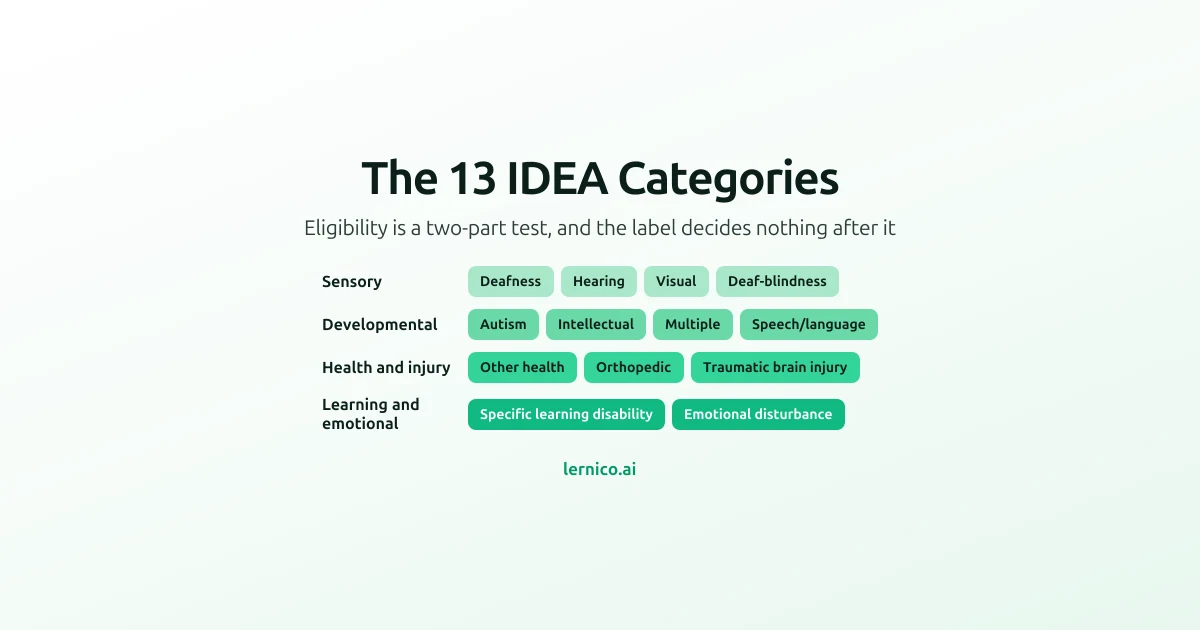
This page sets out the 13 categories at 34 CFR §300.8(c), what each definition actually requires, and the goal areas that typically follow.
Eligibility is a two-part test
Both halves have to be met, and the second is where most disputes live.
Part one. The student has a disability meeting the definition of one of the thirteen categories.
Part two. By reason of that disability, the student needs special education and related services.
A diagnosis alone does not qualify anyone. A student can have documented ADHD, a clinical report, genuine difficulty, and still not be IDEA-eligible — because they do not need specially designed instruction to access the curriculum. That student is typically served under a 504 plan instead.
Note also the phrase that recurs in almost every definition below: "adversely affects a child's educational performance." It is doing work. A condition that meets the clinical description but does not affect educational performance does not establish eligibility on its own.
The 13 categories
1. Autism
A developmental disability significantly affecting verbal and nonverbal communication and social interaction, generally evident before age three, that adversely affects educational performance. The regulation notes it does not apply where the primary reason for the adverse effect is emotional disturbance.
Typical goal areas: autism goals, speech and language, social-emotional.
2. Deaf-blindness
Concomitant hearing and visual impairments, the combination of which causes such severe communication and other developmental and educational needs that they cannot be accommodated in special education programs solely for children with deafness or blindness.
Typical goal areas: communication and AAC, life skills, orientation and mobility.
3. Deafness
A hearing impairment so severe that the child is impaired in processing linguistic information through hearing, with or without amplification, that adversely affects educational performance.
Typical goal areas: language and communication, literacy, self-advocacy.
4. Emotional disturbance
A condition exhibiting one or more listed characteristics over a long period of time and to a marked degree that adversely affects educational performance — including an inability to learn not explained by intellectual, sensory or health factors, an inability to build or maintain satisfactory relationships, inappropriate behavior or feelings under normal circumstances, a general pervasive mood of unhappiness or depression, and a tendency to develop physical symptoms or fears associated with personal or school problems.
Two qualifiers do most of the work here: long period of time and marked degree. A difficult term is not this category.
Typical goal areas: behavior, anxiety, social-emotional. Usually paired with a functional behavior assessment.
5. Hearing impairment
An impairment in hearing, whether permanent or fluctuating, that adversely affects educational performance but is not included under the definition of deafness. The two are separate categories on purpose.
Typical goal areas: language, access and assistive technology, self-advocacy.
6. Intellectual disability
Significantly subaverage general intellectual functioning, existing concurrently with deficits in adaptive behavior, manifested during the developmental period, that adversely affects educational performance. Both halves are required — a score alone does not establish it.
Typical goal areas: life skills, communication, functional academics, transition.
7. Multiple disabilities
Concomitant impairments — the regulation gives intellectual disability with blindness, or with orthopedic impairment, as examples — the combination of which causes such severe educational needs that they cannot be accommodated in a program for one of the impairments alone. Deaf-blindness is excluded, having its own category.
Typical goal areas: life skills, communication, motor.
8. Orthopedic impairment
A severe orthopedic impairment that adversely affects educational performance, including impairments from a congenital anomaly, from disease, and from other causes such as cerebral palsy, amputations and fractures or burns causing contractures.
Typical goal areas: fine and gross motor, access and assistive technology, independence.
9. Other health impairment
Having limited strength, vitality or alertness — including a heightened alertness to environmental stimuli that results in limited alertness with respect to the educational environment — due to a chronic or acute health problem, that adversely affects educational performance. The regulation's examples include asthma, ADHD, diabetes, epilepsy, a heart condition, leukemia and Tourette syndrome.
That heightened-alertness clause is the route by which ADHD is served here.
Typical goal areas: ADHD goals, executive functioning, attendance and stamina.
10. Specific learning disability
A disorder in one or more of the basic psychological processes involved in understanding or using language, spoken or written, which may manifest in an imperfect ability to listen, think, speak, read, write, spell or do mathematical calculations. The term includes perceptual disabilities, brain injury, minimal brain dysfunction, dyslexia and developmental aphasia. It excludes learning problems primarily the result of visual, hearing or motor disabilities, intellectual disability, emotional disturbance, or environmental, cultural or economic disadvantage.
This is the largest category in most districts. Note that dyslexia is named in the regulation itself.
Typical goal areas: reading, writing, math.
11. Speech or language impairment
A communication disorder — the regulation names stuttering, impaired articulation, a language impairment and a voice impairment — that adversely affects educational performance.
Typical goal areas: speech and language.
12. Traumatic brain injury
An acquired injury to the brain caused by an external physical force, resulting in total or partial functional disability or psychosocial impairment, that adversely affects educational performance. The regulation excludes congenital or degenerative brain injuries and those induced by birth trauma.
Typical goal areas: executive functioning, memory and attention, behavior, motor.
13. Visual impairment including blindness
An impairment in vision that, even with correction, adversely affects educational performance. The term includes both partial sight and blindness.
Typical goal areas: braille and access, orientation and mobility, assistive technology, self-advocacy.
The fourteenth category, at state discretion
Developmental delay may be used for children aged three through nine, or a subset of that range, at each state's discretion — and a district may not use it unless the state has adopted it. It exists so a young child with clear need does not have to be forced into a specific category before the picture is clear.
Students identified this way usually move to a specific category at a reevaluation. Typical goal areas: preschool and kindergarten goals.
What the category does not decide
It does not determine services. Services follow the needs described in the present levels. Two students in the same category can have entirely different IEPs, and any district practice that attaches a standard service package to a label is doing it backwards.
It does not determine placement. Placement is decided from the IEP, under the least restrictive environment requirement, after the goals and services are written.
It does not determine goals. The category suggests where to look. The data decides — see the IEP goal bank for goals across every area.
It is not permanent. Categories change at reevaluation, and a change of category does not by itself change a single service.
Writing the plan the eligibility leads to
Eligibility is the beginning. The work is the present levels, the goals, and the instruction that follows.
Lernico drafts standards-aligned IEP goals from a student's present levels, across all 50 states' standards, and produces the specially designed instruction and accommodations language the general education teacher needs. You stay the author of every word.
Book a 15-minute demo and bring a real student profile.
Frequently asked questions
How many disability categories does IDEA have?
Thirteen, defined at 34 CFR 300.8(c). States may also use a fourteenth, developmental delay, for children aged three through nine, but that one is optional and its age range is set by each state. A district may not use developmental delay unless its state has adopted it.
Does a medical diagnosis qualify a student for an IEP?
No. Eligibility is a two-part test at 34 CFR 300.8(a)(1): the student has a disability in one of the categories, and by reason of that disability needs special education and related services. A student can have a documented diagnosis, real difficulty at school, and still not be IDEA-eligible because they do not need specially designed instruction.
Which category does ADHD fall under?
Usually other health impairment, which names limited alertness with respect to the educational environment. ADHD is not a category by name. Many students with ADHD are served under Section 504 instead, because they need accommodations rather than specially designed instruction.
Does the category determine the services a student gets?
No, and this is worth saying at meetings. Services follow from the student's individual needs as described in the present levels, not from the label. Two students in the same category can have entirely different IEPs, and a category is not a licence to hand out a standard package.
Can a student's category change?
Yes, usually at a reevaluation. A young child identified under developmental delay commonly moves to a specific category as they age out of the state's permitted range. A change of category does not by itself change the services; the IEP still follows the needs.
What is dyslexia classified as under IDEA?
Specific learning disability. The regulation's own definition names dyslexia among the conditions the term includes, alongside perceptual disabilities, brain injury, minimal brain dysfunction and developmental aphasia. Federal guidance has confirmed that nothing prevents a district from using the word dyslexia in the IEP itself.