

Published: · 6 min read
A life skills goal is held to the same standard as a reading goal: a condition, an observable behavior, a criterion and a measurement method. It fails more often than a reading goal because "will make a sandwich" feels self-evidently measurable and is not — two staff will score it differently on the same day.
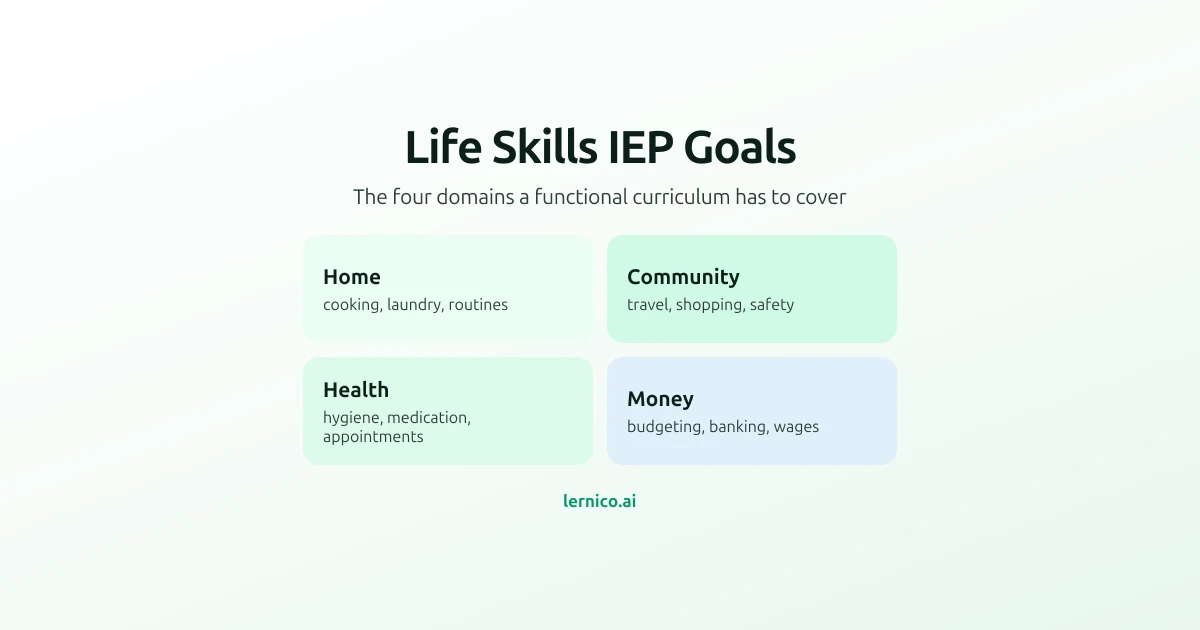
The fix is a task analysis, and every goal below assumes one. These 28 goals cover the four domains a functional curriculum has to reach: home, community, health, and money. For goals outside this area, see the IEP goal bank.
Start with the task analysis, or the goal is unmeasurable
Break the routine into its steps. Record, across at least three trials, which steps the student completes independently, which need a verbal or gestural prompt, and which need hands-on help. That gives you two numbers: steps independent and prompt level.
A life skills goal moves one of those two. It does not move "percentage of the task", because nobody can reconstruct what that meant six months later. Write the number of steps into the goal and the data sheet writes itself.
Home and daily living goals
1. Preparing a no-cook snack. By [date], given a visual recipe, [Student] will prepare a no-cook snack completing [X] of [Y] steps independently in 3 of 4 opportunities, as measured by a task-analysis data sheet.
2. Cooking with a heat source. By [date], given a simple recipe requiring a stove or microwave, [Student] will prepare the item following all safety steps in 3 of 4 opportunities, as measured by a task-analysis data sheet.
3. Planning a meal. By [date], [Student] will plan and prepare a balanced meal for two people, completing all steps in 3 of 4 opportunities, as measured by a task-analysis data sheet.
4. Laundry. By [date], given a laundry task and a checklist, [Student] will complete all steps in 3 of 4 opportunities, as measured by a task-analysis data sheet.
5. Cleaning a room. By [date], [Student] will follow a written multi-step cleaning routine to completion in 4 of 5 opportunities, as measured by a task-analysis data sheet.
6. Managing belongings. By [date], [Student] will independently manage personal belongings at arrival and dismissal in 8 of 10 school days, as measured by a staff-kept checklist.
7. Using a household appliance safely. By [date], given a written procedure, [Student] will operate [named appliance] following every safety step in 4 of 5 opportunities, as measured by a task-analysis data sheet.
Community and safety goals
8. Using public transport. By [date], [Student] will use public transportation to reach a stated destination with fading adult support in 3 of 4 trials, as measured by a community-instruction data sheet.
9. Travelling a fixed route independently. By [date], [Student] will travel a fixed route between home and a work or study site independently for 4 consecutive weeks, as measured by a community-instruction data sheet.
10. Shopping from a list. By [date], [Student] will use a shopping list to locate and collect 5 items in a store with fading adult support in 3 of 4 trips, as measured by a community-instruction data sheet.
11. Reading safety signs. By [date], [Student] will identify 5 common safety signs and state what each requires them to do, with 90% accuracy in 4 of 5 opportunities, as measured by teacher-scored classwork.
12. Responding to an emergency. By [date], [Student] will state what to do in 4 of 5 stated emergency scenarios, including who to call and what to say, as measured by teacher-recorded responses.
13. Personal information. By [date], [Student] will state their full name, address and a caregiver's phone number on request in 4 of 5 opportunities, as measured by teacher-recorded responses.
14. Asking for help in the community. By [date], when lost or unable to complete a step, [Student] will approach a staff member or an identified safe adult and ask for help in 3 of 4 opportunities, as measured by a community-instruction data sheet.
Health and self-care goals
15. Hygiene routine. By [date], [Student] will complete a 4-step hygiene routine with no more than one verbal prompt in 4 of 5 opportunities, as measured by a task-analysis data sheet.
16. Independent grooming. By [date], [Student] will complete a personal-grooming routine independently in 8 of 10 school days, as measured by a staff-kept checklist.
17. Dressing for the weather. By [date], [Student] will select clothing appropriate to the stated forecast in 4 of 5 opportunities, as measured by teacher-scored classwork.
18. Medication or health routine. By [date], [Student] will complete a scheduled health routine with a visual prompt only, in 8 of 10 opportunities, as measured by nursing records.
19. Reporting symptoms. By [date], when unwell or in pain, [Student] will tell a staff member what is wrong and where, in 4 of 5 observed opportunities, as measured by nursing and staff records.
20. Making an appointment. By [date], [Student] will schedule and attend a personal appointment with fading adult support in 3 of 4 opportunities, as measured by case-manager records.
21. Choosing a balanced meal. By [date], given a menu, [Student] will select a meal meeting stated nutritional criteria in 4 of 5 opportunities, as measured by teacher-scored classwork.
Money and employment readiness goals
22. Coin and bill value. By [date], given a mixed set of coins and bills, [Student] will state the total value with 80% accuracy in 4 of 5 opportunities, as measured by teacher-scored classwork.
23. Making a purchase. By [date], given a purchase price under $20 and a $20 bill, [Student] will pay and verify the change in 4 of 5 opportunities, as measured by a community-instruction data sheet.
24. Weekly budget. By [date], [Student] will manage a personal budget of a stated weekly amount across 4 consecutive weeks without overspending, as measured by a student-kept ledger.
25. Tracking an account. By [date], [Student] will use a banking app or a written register to record deposits and withdrawals for 4 consecutive weeks, as measured by a student-kept ledger.
26. Reading a pay stub. By [date], given a pay stub, [Student] will identify gross pay, deductions and net pay with 90% accuracy in 4 of 5 opportunities, as measured by teacher-scored classwork.
27. Completing an application. By [date], [Student] will complete a job or housing application accurately with no more than 2 errors in 3 of 4 opportunities, as measured by work samples.
28. Meeting workplace expectations. By [date], [Student] will arrive on time, in the required dress, and follow site expectations with no more than one reminder per shift, in 8 of 10 shifts, as measured by a supervisor-scored checklist.
How to customize these goals
Teach where the skill will be used. A kitchen skill taught only in a school kitchen often does not transfer to a home one, and a travel skill rehearsed only on a map does not survive a bus that is running late. Where the goal names a community setting, the data sheet has to come from that setting.
Fade the prompt on a schedule. Write the hierarchy into the goal — full physical, partial physical, gestural, verbal, independent — so a quarter's data shows movement even when the step count has not changed yet.
Set the criterion from the task analysis, not from a percentage. "80% of steps" on a 5-step task means four steps; on a 22-step task it means eighteen, and those are wildly different asks. Write the step count.
Do not let a functional goal replace an academic one. IDEA requires the IEP to address academic and functional needs both. A student working on money skills may also need the reading and maths goals that make those skills usable.
Involve the family in the target, not just the report. These are the goals most likely to be practised at home and most likely to be measured differently there. Agree what counts as independent before the meeting ends.
Writing functional goals from present levels
Turning a task analysis, an observation log and a family's priorities into a goal that is measurable and defensible a year from now is the slow part of this work.
Lernico generates standards-aligned IEP goals from a student's present levels, and produces the specially designed instruction and accommodations language the general education teacher needs to deliver them. You stay the author of every goal.
Book a 15-minute demo and bring a real student profile.
Frequently asked questions
What are life skills IEP goals?
Life skills goals, also called functional goals, target the skills a student needs to live and work as independently as possible — cooking, travel, hygiene, money, safety. They belong in the IEP when the disability affects those skills, and they are held to exactly the same measurability standard as an academic goal.
How do you measure a life skills goal?
With a task analysis. Break the routine into its steps, record which steps the student does independently, which need a prompt and which need hands-on help, then write the goal to move steps from prompted to independent. The number that changes is the count of independent steps, not a percentage nobody can reconstruct.
Can a student have life skills goals and academic goals?
Yes, and most do. A functional goal is not a signal that academics have been given up on. IDEA requires the IEP to address academic and functional needs both, and the least restrictive environment requirement applies to life skills instruction as much as to a maths class.
Where should life skills instruction happen?
Wherever the skill will actually be used, as far as that is possible. Skills taught only in a classroom kitchen frequently do not transfer to a real one, which is why community-based instruction data is the standard measure for the travel, shopping and safety goals in this list.
When should life skills goals start?
Self-care and routine goals appear in elementary IEPs. The functional cluster around money, travel and employment usually arrives with transition planning, which IDEA requires by the IEP in effect when the student turns 16 — and many states require it at 14.