

Published: · 7 min read
Most behavior plans that do not work were built on an assumption about why the behavior happens. The assumption is usually reasonable and frequently wrong, and everything downstream inherits the error — the wrong replacement skill, the wrong antecedent changes, and a term of data showing no improvement.
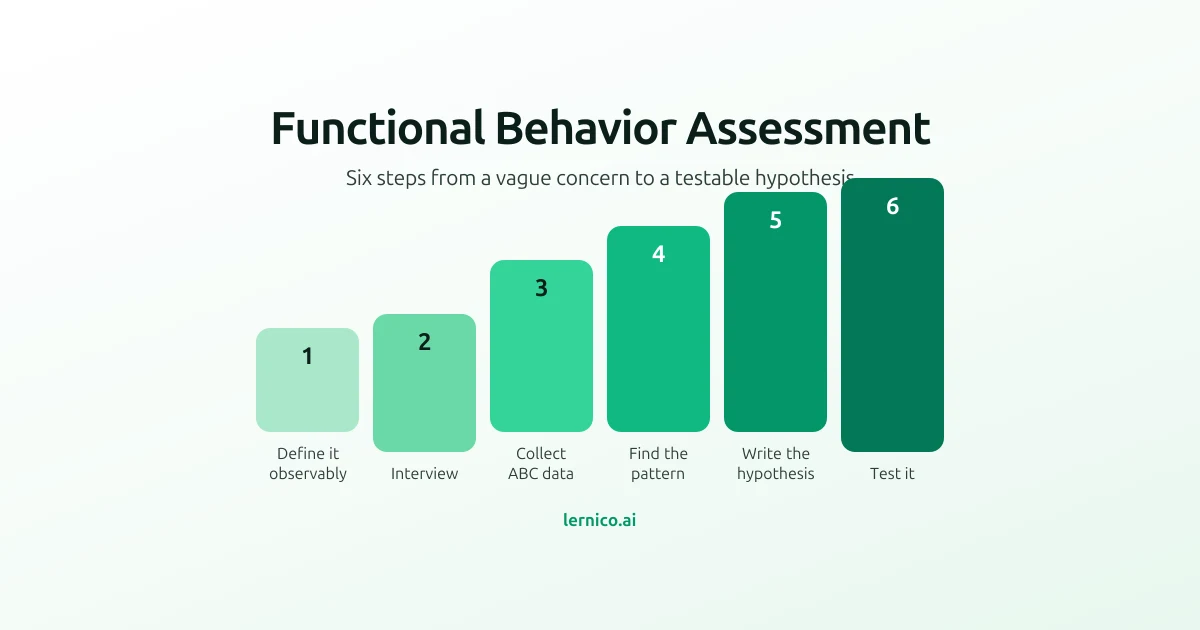
A functional behavior assessment is the process that replaces the assumption with evidence. This page covers the six steps, an ABC recording sheet you can copy, and how to turn a stack of entries into a hypothesis a plan can be built on.
When an FBA is required
IDEA names the FBA explicitly in one place. At 34 CFR §300.530(f), where the team determines that conduct subject to a disciplinary change of placement was a manifestation of the child's disability, it must conduct a functional behavioral assessment — unless one had already been conducted before the behavior occurred — and implement a behavior intervention plan.
Outside discipline, the driver is §300.324(a)(2)(i): where behavior impedes the child's learning or that of others, the team must consider positive behavioral interventions and supports. An FBA is how a team knows which supports, so in practice it precedes any serious plan. Several states impose their own requirements beyond the federal floor.
The four functions
Every FBA is looking for one of four answers. The behavior gets the student:
- Escape or avoidance — out of a task, a setting, a demand, or an interaction.
- Attention — from an adult or from peers, and negative attention counts.
- Access to a tangible — an item or a preferred activity.
- Automatic or sensory reinforcement — the behavior is its own reward, and no one else needs to be involved.
The same topography can serve different functions in different students, and in the same student in different settings. That is the whole reason the assessment exists.
The six steps
1. Define the behavior operationally
Write it so two adults counting independently would produce the same number. The test is whether a substitute could use it on their first day.
- Not "disruptive" — "makes a sound audible from the far side of the room during whole-group instruction".
- Not "aggressive" — "hits, kicks, pushes or bites another person".
- Not "off task" — "eyes away from the assigned materials for more than 10 consecutive seconds".
Pick one behavior, or at most two. An FBA covering "everything difficult" produces data nobody can interpret.
2. Gather indirect information
Interview the people who see it: the classroom teacher, specialists, the paraprofessional, the family, and where appropriate the student. Ask what makes it more likely and less likely, what has already been tried, and what happens immediately afterwards.
Parents supply the setting events nobody at school can observe — sleep, illness, medication changes, what happened before the bus. These are frequently the variable that explains why the same trigger produces the behavior on Tuesday and not on Thursday.
3. Collect direct ABC data
This is the part that cannot be skipped. Record, at the time, what happened immediately before, the behavior itself, and what happened immediately after.
| Date / time | Setting and activity | Antecedent | Behavior | Consequence | Duration | Recorder |
|---|---|---|---|---|---|---|
| What happened immediately before | Observable terms only | What happened immediately after |
Four rules that decide whether the sheet is usable.
Record at the time, not at the end of the day. Reconstructed antecedents are reconstructed to fit the recorder's existing theory.
Write what the adult did in the consequence column, honestly. "Redirected to the task" and "sent to the office" are different consequences, and the second one is escape.
Sample across settings and times. A behavior recorded only in third period supports a hypothesis only about third period.
Aim for ten to fifteen instances across at least five days. Fewer than that and you are describing a week rather than a pattern.
4. Look for the pattern
Sort the entries by antecedent, then by consequence, and count. You are looking for a column that repeats.
- Antecedents clustering on task demands, with consequences that removed the demand → escape.
- Antecedents clustering on adult attention going elsewhere, with consequences that brought it back → attention.
- Antecedents clustering on a denied or ended activity → tangible.
- No clear social antecedent or consequence, and the behavior continues when alone → automatic.
A useful cross-check: ask what the student gains in the thirty seconds after the behavior. If the answer is consistent across entries, that is the function.
5. Write the hypothesis
One sentence, in a fixed format, so the plan has something to attach to.
When [antecedent], [Student] will [behavior], in order to [function]. This is more likely when [setting event].
Worked examples:
- When given an independent writing task of more than two sentences, [Student] puts their head down and stops working, in order to escape a task where output is effortful. This is more likely on days following a late night.
- When adult attention is directed to another student during small-group work, [Student] calls out off-topic comments, in order to obtain adult attention. This is more likely in the last period of the day.
- When a preferred activity is ended, [Student] protests and refuses to transition, in order to maintain access to the activity. This is more likely when the ending was not previewed.
If you cannot complete the sentence from the data, the assessment is not finished. Guessing at this step is exactly the failure the FBA exists to prevent.
6. Test it, then build the plan
The hypothesis is a prediction, so check it before committing. Change one antecedent for a week and watch the same measure. If the behavior drops when the demand is pre-taught, the escape hypothesis is holding; if it does not move at all, revisit step 4 rather than the plan.
Then write the plan. Every element of a behavior intervention plan — the antecedent strategies, the replacement behavior, the consequence strategies — follows from the function this hypothesis names.
The ABC sheet, and lighter alternatives
Full ABC recording is the richest data and the heaviest to collect. A teacher with 28 students will not sustain it for a month. Match the method to the question.
| Method | Records | Use it when | Cost |
|---|---|---|---|
| ABC narrative | Antecedent, behavior, consequence per instance | You do not yet know the function | High |
| Frequency count | Tally per period | The behavior is discrete and countable | Low |
| Duration | Minutes per occurrence | Length is the problem, not the count | Medium |
| Latency | Seconds from direction to start | The problem is not starting | Low |
| Scatterplot | A grid of time slots marked when it occurs | You suspect a time or setting pattern | Low |
A scatterplot is the underused one. Two weeks of ticks in a grid of periods will often localise the behavior to one subject or one transition before anyone writes a narrative entry, which then tells you where to point the ABC sheet.
What to avoid
Defining the behavior by its assumed cause. "Attention-seeking calling out" has answered the question in the definition, and every subsequent entry will confirm it.
Recording only the instances that were serious. Selecting on severity biases the antecedents toward crisis conditions and hides the ordinary pattern.
Treating the consequence column as a judgement of the adult. It is not. "Sent to the office" is data, and a plan cannot be built without it being recorded accurately.
Skipping to the plan because the behavior is urgent. Urgency is the argument for interim safety measures, not for a plan built on a guess. Put the safety response in place, and run the assessment underneath it.
Assuming one function for a behavior that occurs everywhere. Two settings, two hypotheses. Averaging them produces a plan that fits neither.
From assessment to goals
The hypothesis belongs in the present levels, where it explains the need the goal will address, and the replacement behavior becomes the goal itself — see behavior IEP goals for measurable examples.
Lernico drafts standards-aligned IEP goals from a student's present levels and produces the specially designed instruction that goes with them, which for a behavior goal is how the replacement skill actually gets taught. You stay the author of every word.
Book a 15-minute demo and bring a real student profile.
Frequently asked questions
What is a functional behavior assessment?
An FBA is a structured process for working out why a behavior happens. It defines the behavior observably, collects data on what precedes and follows it, and produces a hypothesis about the function that behavior serves. That hypothesis is what a behavior intervention plan is built on.
When is an FBA legally required?
IDEA names it directly in one place: at 34 CFR 300.530(f), after a manifestation determination finds the conduct was a manifestation of the disability, the team must conduct an FBA unless one was already done. It is also standard practice whenever behavior impedes learning, because 300.324(a)(2)(i) requires the team to consider positive behavioral interventions and an FBA is how you know which ones.
What does ABC stand for in behavior data?
Antecedent, Behavior, Consequence. You record what happened immediately before the behavior, the behavior itself in observable terms, and what happened immediately after. Patterns across enough entries point at the function — which is why the consequence column matters even when the adult response felt neutral at the time.
How many days of data does an FBA need?
Enough that a pattern is visible rather than a bad week. Ten to fifteen recorded instances across at least five days, covering the different settings and times of day where the behavior occurs, is a common working minimum. Data from one classroom cannot support a hypothesis about a behavior that also happens at lunch.
Who conducts the FBA?
Usually a school psychologist or behavior specialist, with classroom staff collecting the direct observation data. Parents contribute the setting events nobody at school can see — sleep, medication changes, what happened before the bus — which are frequently the missing variable.
What if the data shows more than one function?
That is common and it is not a failure of the assessment. A behavior can be maintained by escape in maths and attention at lunch. Write it as two hypotheses tied to their settings, and let the plan carry two sets of strategies rather than averaging them into one that fits neither.