

Published: · 7 min read
Self-advocacy is the only IEP goal area where success means the student needs you less. It is also the one most often written unmeasurably — "[Student] will advocate for themselves" gives a case manager nothing to record in January.
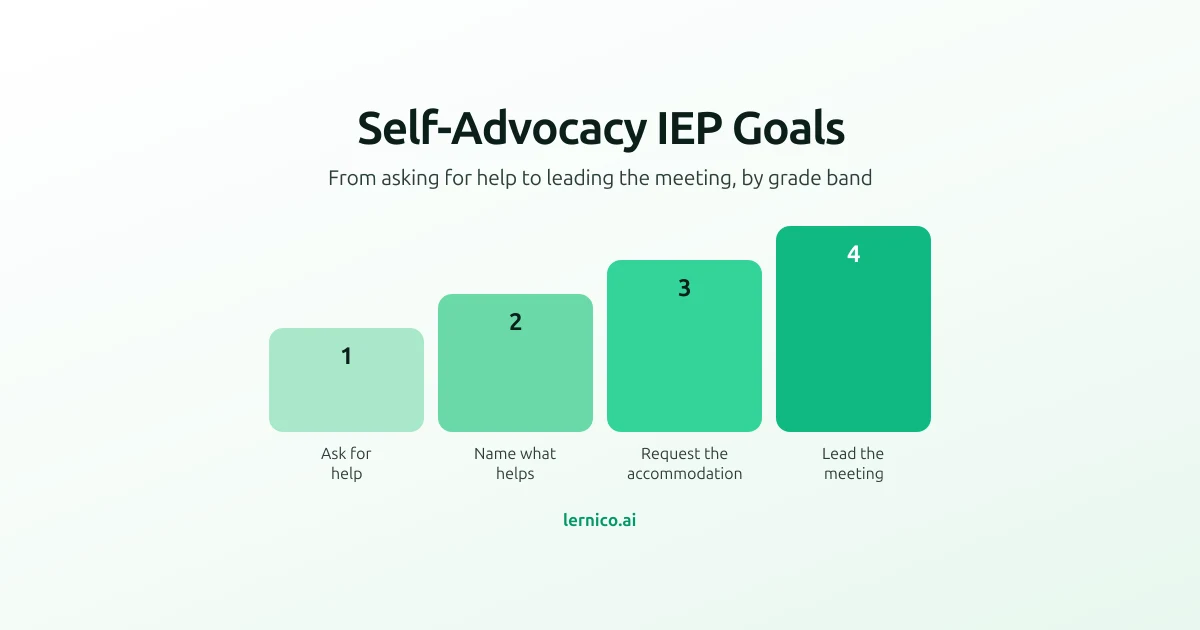
These 24 goals are ordered the way the skill actually develops: asking for help, then naming what helps, then requesting it from someone who does not already know, then running the meeting. Each is written with a condition, a criterion and a measurement method. For goals outside this area, see the IEP goal bank.
Why this belongs in the IEP, not in advice
Two things make self-advocacy a goal rather than a hope.
IDEA requires it by 16, and assumes it earlier. Transition services must be based on the student's own preferences and interests, which means somebody has to have asked, and the student has to have an answer. A transition plan written from a file rather than from the student is the finding a state monitor looks for. The transition goals that follow depend on this skill being in place first.
The legal ground shifts at graduation. Under IDEA the district must identify the student, evaluate them and write a plan. Under Section 504 and the ADA — which is what a college or an employer works from — nothing happens until the person asks and produces documentation. A student who has never asked for an accommodation in a school where everyone already knew them is being sent somewhere nobody does.
Self-advocacy goals for kindergarten to grade 2
At this age the target is a signal, not a speech. Keep the response the student has to produce very short, and teach the adult to wait rather than pre-empt.
1. Asking for help. By [date], when [Student] cannot complete a task, they will raise a hand or use the agreed signal rather than waiting silently or leaving the task, in 4 of 5 observed opportunities across 3 consecutive weeks, as measured by a teacher-kept tally.
2. Requesting a break. By [date], when [Student] needs a break, they will use the taught break signal before escalating, in 4 of 5 observed opportunities, as measured by a teacher-kept tally.
3. Reporting difficulty. By [date], when asked, [Student] will state whether a task is too hard, too easy or just right in 8 of 10 opportunities, as measured by teacher-recorded responses.
4. Naming a tool that helps. By [date], [Student] will name one tool that helps them work — headphones, a pencil grip, a slant board — and request it in 3 of 4 opportunities, as measured by teacher observation data.
5. Reporting a physical need. By [date], [Student] will tell an adult when they are hurt, unwell or unable to see or hear the lesson, in 4 of 5 observed opportunities, as measured by a teacher-kept tally.
6. Declining help politely. By [date], when offered help they do not need, [Student] will say so using a taught phrase rather than accepting it silently, in 3 of 4 opportunities, as measured by teacher observation data.
Self-advocacy goals for grades 3 to 5
The shift here is from signalling to explaining. A student who can name two things that help them has the raw material for every later goal in this list.
7. Asking a clarifying question. By [date], when [Student] does not understand a direction, they will ask a specific clarifying question rather than starting incorrectly or not starting, in 4 of 5 observed opportunities across 3 consecutive weeks, as measured by a teacher-kept tally.
8. Naming strengths and supports. By [date], [Student] will name 3 of their own learning strengths and 2 supports that help them, as measured by a structured interview scored against a checklist.
9. Requesting an accommodation. By [date], [Student] will request a stated accommodation from a general education teacher without a prompt from the case manager, in 3 of 4 opportunities, as measured by teacher observation data.
10. Using the break system. By [date], when needing a break, [Student] will use the agreed request rather than leaving the room, in 4 of 5 opportunities across 3 consecutive weeks, as measured by a teacher-kept tally.
11. Attending the IEP meeting. By [date], [Student] will attend part of their own IEP meeting and state one thing that helps them learn, as measured by meeting notes.
12. Self-checking against a rubric. By [date], given the rubric before submitting, [Student] will identify one part of their work that does not yet meet it and say what help they need, in 4 of 5 opportunities, as measured by work samples.
Self-advocacy goals for grades 6 to 8
Middle school is where the skill has to survive contact with six teachers who each see the student for fifty minutes. Goals at this band should require the student to initiate with someone who does not already know their plan.
13. Speaking to their own goal. By [date], [Student] will state one goal from their IEP in their own words during the annual meeting, as measured by meeting notes.
14. Requesting in writing. By [date], [Student] will email a teacher to request a stated accommodation, in 3 of 4 opportunities, as measured by sent-message records reviewed with the case manager.
15. Naming the plan. By [date], [Student] will name their disability category and 3 accommodations they receive, as measured by a structured interview.
16. Reporting a missing accommodation. By [date], when an accommodation listed in the IEP is not provided, [Student] will report it to their case manager within one school day, in 3 of 4 opportunities, as measured by case-manager records.
17. Refusing unnecessary help. By [date], [Student] will decline an offer of help they do not need using a polite refusal, in 4 of 5 role-play opportunities, as measured by counselor session data.
18. Asking for a re-teach. By [date], after a returned assessment, [Student] will identify a topic they did not understand and ask the teacher for another explanation, in 3 of 4 opportunities, as measured by a student-kept log reviewed weekly.
Self-advocacy goals for grades 9 to 12
These goals are written for the world after the IEP. The measurement moves toward unfamiliar adults and real settings on purpose — a student who can only advocate to their case manager has not yet learned the skill.
19. Leading part of the meeting. By [date], [Student] will lead a section of their own IEP meeting using a prepared outline, as measured by meeting notes.
20. Explaining the disability to a new teacher. By [date], [Student] will explain how their disability affects their learning and what supports address it, in language a teacher who has never met them could act on, as measured by a structured interview.
21. Mapping postsecondary supports. By [date], [Student] will identify the accommodations they will request in a postsecondary setting and the office that provides them, as measured by counselor records.
22. Knowing what documentation is required. By [date], [Student] will describe the documentation a college or an employer requires before granting an accommodation, and where their own copy is kept, as measured by a structured interview.
23. Requesting from an unfamiliar adult. By [date], [Student] will request an accommodation from an unfamiliar adult in a community or work setting, in 3 of 4 opportunities, as measured by a supervisor-scored checklist.
24. Knowing which law applies. By [date], [Student] will state the difference between the rights they hold under IDEA and those they will hold under Section 504 and the ADA after graduation, as measured by a structured interview.
How to make these goals measurable in practice
Count unprompted requests only. The most common failure is a data sheet that records "[Student] requested a break" after an adult asked whether they needed one. That is a prompted response, and it measures the adult. Decide before the goal is written what counts as an opportunity and what counts as a prompt, and write both into the condition.
Name who observes, and where. Self-advocacy happens in six classrooms, not in the resource room. A goal collected only by the case manager measures the one setting where the student least needs the skill. Name the general education setting in the condition if that is where the goal matters.
Give the student the words first. A goal that asks a student to request an accommodation before anyone has taught them a sentence to say is measuring instruction that has not happened. The specially designed instruction that accompanies these goals is usually explicit teaching of a phrase, then rehearsal, then a fading prompt.
Fade the prompt on a schedule, not by feel. Write the fading into the goal — full verbal model, then a gesture, then a visual cue, then nothing — so the data shows the level, not just the count.
Let the student see their own data. Of every goal area in an IEP, this is the one where showing the student the graph is itself the intervention.
Writing self-advocacy goals from present levels
The hard part is not the wording. It is turning "will not ask for help" into a present level with a number in it, then setting a target that is a year's growth from that number rather than a round figure.
Lernico generates standards-aligned IEP goals from a student's present levels, and produces the specially designed instruction and accommodations language the general education teacher needs to deliver them. You stay the author of every goal.
Book a 15-minute demo and bring a real student profile.
Frequently asked questions
What is a self-advocacy IEP goal?
A self-advocacy goal targets the student's own ability to say what they need and ask for it. It sits in the IEP because the skill is a need arising from the disability, not a soft extra. The commonest forms are asking a clarifying question, requesting a listed accommodation, and taking a stated role in the IEP meeting.
At what age should self-advocacy goals start?
As early as kindergarten, in the form of asking for help and using a break signal. IDEA forces the issue by no later than the IEP in effect when the student turns 16, because transition planning must be based on the student's own stated preferences and interests, and a student who has never been asked cannot state them.
How do you measure a self-advocacy goal?
Count unprompted requests, not prompted ones. If an adult has to say "do you need something?" first, the data describes the adult. The usual sources are a tally kept by the case manager, a structured interview scored against a checklist, and meeting notes for the goals about the IEP meeting itself.
Should the student attend their own IEP meeting?
IDEA requires the student to be invited whenever transition services are being discussed, and nothing stops a team inviting a younger student for part of it. Attendance is the cheapest self-advocacy intervention available: a student who has heard their own goals read aloud can talk about them, and one who has not, cannot.
What changes about self-advocacy after high school?
The obligation moves to the student. IDEA ends at graduation or the state exit age, and postsecondary accommodations come instead through Section 504 and the ADA, which are request-driven — a college does not identify a student or write a plan. Nobody will ask. That is why the last goals in this list are about disclosure and documentation.