

Published: · 8 min read
The present levels statement is the part of the IEP everything else hangs from. A goal is only defensible as a year of growth from a stated baseline. A service is only justified by a named need. Both live here, which is why a weak PLAAFP produces a weak IEP no matter how carefully the rest is written.
It is also the part that takes longest to write and gets copied forward most often. This page covers what the regulation actually requires, the four questions a present level answers, and 15 examples by area you can write from.
What the regulation requires
34 CFR §300.320(a)(1) asks for a statement of the child's present levels of academic achievement and functional performance, including how the child's disability affects the child's involvement and progress in the general education curriculum — or, for preschool children, how it affects participation in appropriate activities.
That is a short requirement with a large implication. The statement is not a description of the student. It is a description of the effect of the disability on access to the curriculum, which is a different thing and a harder one to write.
Academic achievement covers the content areas. Functional performance covers everything else that affects school — behavior, communication, social skills, motor, self-care, organisation. Both are named in the statute, and IEPs that address only the first are a recurring finding.
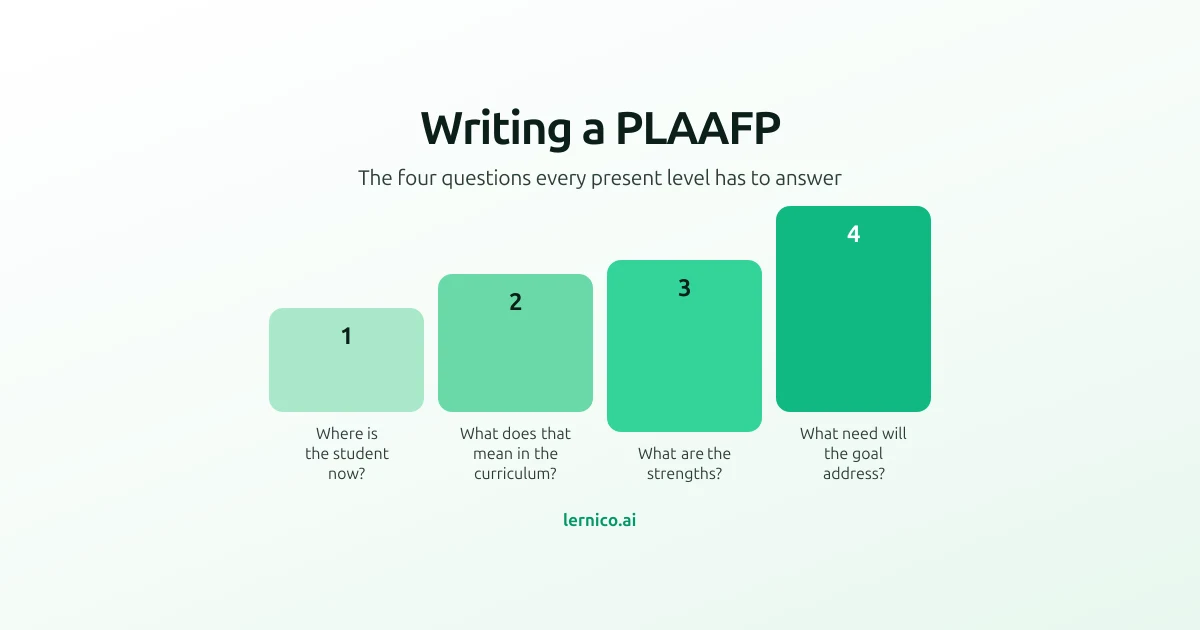
The four questions every present level answers
Write a paragraph per area of need, and make each one answer these in order.
- Where is the student now? In numbers, from a named source. A rate, an accuracy percentage, a frequency count, a rubric score.
- What does that mean in the general curriculum? The consequence, concretely — what they cannot yet do in the classroom because of it.
- What are the strengths and what works? Not a courtesy. The strengths and the supports that already work are what the specially designed instruction will build on.
- What is the need the goal will address? Named explicitly, so the goal that follows has an obvious parent.
A paragraph that answers all four is roughly four to six sentences. A paragraph that answers none of them can be much longer.
What a weak and a strong present level look like
| Weak | Strong | |
|---|---|---|
| Performance | "Reads below grade level" | "Reads 62 wcpm on grade-level passages; class median 118" |
| Effect | "Struggles in class" | "Cannot finish an independent reading task in the period, so misses the written response" |
| Strengths | "Is a nice student" | "Comprehends grade-level text read aloud at 80%; decoding is the barrier, not understanding" |
| Need | "Needs reading support" | "Needs explicit instruction in multisyllabic decoding to build rate" |
The left-hand column is not invented. It is what a present level looks like when it is written from memory the night before the meeting.
15 present levels examples
Each of these is one area's paragraph. Names and numbers are placeholders — the structure is the point.
Reading
1. Decoding and fluency. On three grade-level passages in September, [Student] read a median of 62 words correct per minute with 91% accuracy; the class median is 118 wcpm. Errors are concentrated in multisyllabic words, where [Student] attempts the first syllable and guesses from context. Listening comprehension is a relative strength: when the same passages are read aloud, [Student] answers 4 of 5 comprehension questions correctly, indicating the barrier is decoding rather than understanding. [Student] needs explicit instruction in syllable division to build reading rate.
2. Comprehension. [Student] decodes grade-level text accurately at 112 wcpm but answers 2 of 5 literal comprehension questions after reading independently, against 4 of 5 when the text is discussed first. In class this shows up as complete but incorrect work on reading assignments, and as reluctance to start them. [Student] uses a highlighter effectively when prompted. [Student] needs a taught, rehearsed comprehension routine that does not depend on adult prompting.
Writing
3. Written expression. Given a 15-minute prompt, [Student] produces a median of 34 words across three samples, against a class median of 96, and scores 1 of 4 on the district organisation rubric. Sentences are complete and correctly punctuated; the difficulty is generating and ordering content, and [Student] frequently spends the first eight minutes without writing. With a graphic organiser, output rises to 71 words. [Student] needs explicit instruction in a planning strategy and practice using it without a prompt.
4. Mechanics and handwriting. [Student] composes grade-level content orally but produces illegible handwriting: a second reader who did not observe the writing reads 61% of words in a 10-minute sample. [Student] fatigues after roughly six minutes and grip tightens visibly. Typed samples are legible at 100% and score 3 of 4 on content. [Student] needs handwriting instruction for functional writing, and access to a keyboard for extended composition.
Math
5. Computation fluency. On one-minute multiplication probes across facts 0 to 12, [Student] averages 14 digits correct per minute across three probes; the benchmark is 40. Accuracy is high at 94%, so the barrier is retrieval speed rather than understanding. In class this means multi-step problems are abandoned partway, because the fact retrieval consumes the period. [Student] needs daily timed fluency practice with a set error-correction routine.
6. Problem solving. [Student] computes accurately with two-digit operations at 88% but solves 3 of 10 two-step word problems correctly, most often by performing one of the two operations and stopping. [Student] can restate the problem accurately when asked, so the difficulty is planning the solution rather than reading it. [Student] needs explicit instruction in a schema-based approach organised by problem type.
Communication
7. Articulation. In a 5-minute conversation sample, [Student] produces /r/ accurately in 32% of opportunities in the initial position and 11% at the phrase level. An unfamiliar listener understood 74% of utterances. [Student] self-corrects when the error is modelled, indicating awareness. [Student] needs articulation instruction at the word level with a criterion for moving to phrases.
8. Expressive language. Across three language samples, [Student] uses a mean length of utterance of 4.1 morphemes against an expectation of 6.8 for age, and produces compound sentences in 2 of 20 obligatory contexts. In class this appears as one-word answers and as difficulty explaining a process. [Student] answers questions accurately when given a sentence frame. [Student] needs direct instruction in producing complex sentences using taught conjunctions.
9. Augmentative communication. [Student] uses a speech-generating device and made a median of 9 independent, unprompted communicative acts per 30-minute session across three sessions, 8 of which were requests. Comments, protests and questions were not observed independently. [Student] navigates to a target page accurately in 4 of 5 trials. [Student] needs instruction in using the device for functions other than requesting.
Behavior and social-emotional
10. Task initiation. Across ten observed work periods, [Student] began an assigned task within three minutes on 3 occasions; median latency was 11 minutes. Once started, work completion is 84%, so the difficulty is starting rather than sustaining. A functional behavior assessment completed in August indicates the behavior is maintained by escape from tasks perceived as difficult. [Student] needs a taught initiation routine and a break-request alternative to escape.
11. Self-regulation. [Student] left the classroom without permission a mean of 4.2 times per week across five weeks, most often within ten minutes of an unannounced schedule change. [Student] uses a taught breathing strategy successfully when prompted by an adult, in 4 of 5 opportunities, but has not been observed using it independently. [Student] needs instruction in recognising their own early signs and using the strategy without a prompt.
12. Peer interaction. During unstructured time across ten observations, [Student] initiated an interaction with a peer twice and responded to peer initiations in 6 of 9 opportunities. [Student] participates readily in structured, adult-led group activities. In the cafeteria [Student] sits alone and declines invitations. [Student] needs a taught, rehearsed entry strategy and practice using it in the setting.
Motor and functional
13. Fine motor. [Student] uses a fisted grasp and completes a 10-minute writing task with 3 rest breaks, producing letters that a second reader identified at 58%. Scissors use is within a quarter inch on straight lines but not on curves. [Student] fastens buttons independently and manages a zipper with one verbal prompt. [Student] needs instruction in a functional grasp and in letter formation with immediate feedback.
14. Daily living. On a 22-step morning routine task analysis, [Student] completed 12 steps independently, 7 with a gestural prompt and 3 with hand-over-hand support, across three trials. [Student] follows a picture schedule accurately and initiates the first step without prompting. [Student] needs instruction that fades gestural prompts on the seven steps currently requiring them.
Transition
15. Postsecondary preparation. On an interest inventory completed in September, [Student] identified three careers in skilled trades and named the training required for one of them. In a mock interview [Student] demonstrated 2 of 5 taught interview behaviors. [Student] completed 14 hours of a school-based work experience with satisfactory supervisor ratings on punctuality and 2 of 4 on task independence. [Student] needs instruction in interview behaviors and in requesting accommodations from an employer.
Six ways a PLAAFP goes wrong
It describes the diagnosis. "Has autism" and "has a specific learning disability" are eligibility categories. They belong in the evaluation, not in a statement about performance.
It has no numbers. "Below grade level", "makes progress slowly", "struggles with" — none of these can produce a goal, because none of them says where the student is starting from.
It is copied forward. The clearest tell is a number identical to last year's, or a grade level in the prose that has not moved. It also makes every goal indefensible: a year of growth measured from a two-year-old baseline is not measurable at all.
It omits functional performance. The statute names academic achievement and functional performance. An IEP with three academic paragraphs and nothing on behavior, communication or independence has answered half the requirement.
It omits strengths. Not a formality. Strengths and the supports that already work are what the specially designed instruction builds on, and a PLAAFP without them gives the incoming teacher no starting point.
It names no need. If a reader cannot point at the sentence each goal came from, the goals will be argued about at the meeting and rewritten afterwards.
From present levels to goals
Once the PLAAFP is right, the goal is largely determined: the baseline sets the starting number, the need sets the skill, and a year of ambitious growth sets the target. That last step is the one worth spending time on, and it is the one the IEP goal bank can only structure, not decide.
Lernico drafts standards-aligned goals directly from a student's present levels, across all 50 states' standards, and produces the specially designed instruction and accommodations language that goes with them. You stay the author of every word.
Book a 15-minute demo and bring a real student profile.
Frequently asked questions
What does PLAAFP stand for?
Present Levels of Academic Achievement and Functional Performance. Some states shorten it to PLOP, present levels of performance, or just "present levels". The federal requirement is at 34 CFR 300.320(a)(1) and the wording of the acronym does not change what it has to contain.
What must a PLAAFP include?
How the disability affects the student's involvement and progress in the general education curriculum — or, for preschool children, participation in appropriate activities. In practice that means current performance stated in data, the effect of the disability on accessing the curriculum, the student's strengths, and the needs that the goals will address.
How long should a PLAAFP be?
Long enough that a teacher who has never met the student could describe what they can and cannot do. That is usually a paragraph per area of need, not a page per area. Length is not the standard; a reader who finishes it still not knowing the student's reading rate has read a PLAAFP that failed regardless of length.
Can I copy the PLAAFP from last year's IEP?
Updating a prior statement with current data is normal practice. Carrying one forward unchanged is not, and it is visible — the numbers match the previous year exactly, or the grade level in the text is stale. It also breaks the goals, because a goal is only defensible as a year's growth from a current baseline.
Who writes the PLAAFP?
The case manager usually drafts it, but every provider contributes their own area — the speech-language pathologist writes the communication paragraph, the occupational therapist the motor one. The general education teacher contributes what the student does in the general curriculum, which is the part most often missing.
What is the difference between a PLAAFP and an evaluation report?
The evaluation establishes eligibility and describes functioning in depth, on a three-year cycle. The PLAAFP is an annual summary of where the student is now, written for the people who will teach them. It draws on the evaluation but should not reproduce it — a PLAAFP that is mostly pasted test scores has skipped the interpretation the team needed.