

Published: · 5 min read
Autism is not one profile. It is a spectrum that shows up differently in every student. One student may be nonverbal and working on functional communication. Another may be academically advanced but struggling with the unwritten social rules of a middle school cafeteria. IEP goals for autism need to target the specific areas where the disability affects access to education for that individual student, not a generic checklist of "autism goals." These 10 examples cover the areas that appear most often in IEPs for students on the autism spectrum: communication, social reciprocity, flexible thinking, and sensory regulation. For goals outside communication and sensory needs, see IEP goals across every skill area.
Communication IEP Goals for Autism
Where the student's needs sit in the language system rather than in the social use of it, the speech and language goals are organised by the level ladder an SLP actually works from.
1. Functional Communication of Needs By [date], [Student] will independently communicate a want or need (using speech, AAC device, PECS, or sign language) across at least 3 different school settings in 4 out of 5 opportunities, as measured by speech-language pathologist and teacher data collection.
2. Conversational Turn-Taking By the end of the IEP period, during structured social activities, [Student] will maintain a reciprocal conversation with a peer or adult for at least 4 exchanges (initiation-response-response-response) on a shared topic without adult prompting in 3 out of 5 observed opportunities, as measured by SLP observation data.
3. Understanding Nonverbal Communication By [date], when presented with real or video-based social scenarios, [Student] will correctly identify the emotion or intention conveyed by facial expressions, body language, and tone of voice with 75% accuracy in 4 out of 5 trials, as measured by structured social skills assessment.
Social Reciprocity Goals
4. Initiating Social Interaction with Peers By the end of the school year, [Student] will independently initiate a social interaction with a peer (greeting, asking to join play, asking a question about a shared interest) during unstructured times in 3 out of 5 opportunities per day, as measured by teacher and paraprofessional observation logs.
5. Joint Attention During Group Activities By [date], during group instruction or cooperative learning, [Student] will demonstrate joint attention (looking where others are looking, attending to shared materials, responding to bids for attention from peers) for at least 5 minutes without adult redirection in 4 out of 5 observed opportunities, as measured by teacher observation.
6. Perspective-Taking in Social Situations By the end of the IEP period, when presented with social scenarios (real or hypothetical), [Student] will identify how another person might be feeling and suggest an appropriate response with 70% accuracy in 4 out of 5 structured opportunities, as measured by social skills assessment and teacher documentation.
Flexible Thinking Goals
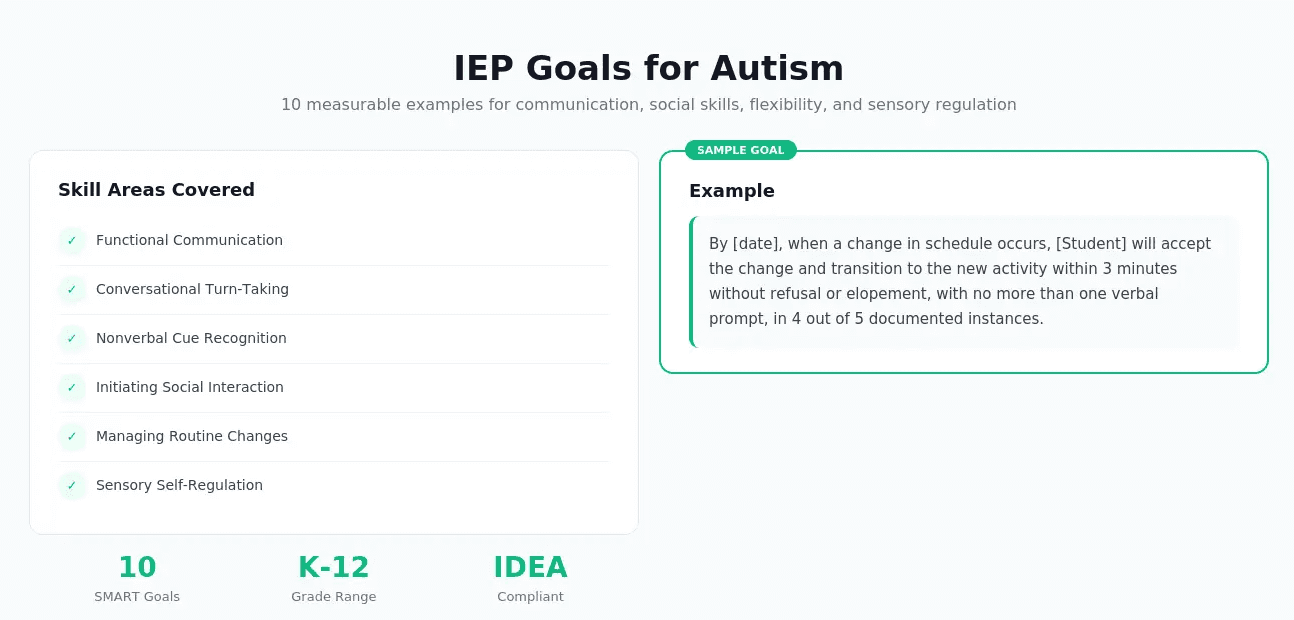
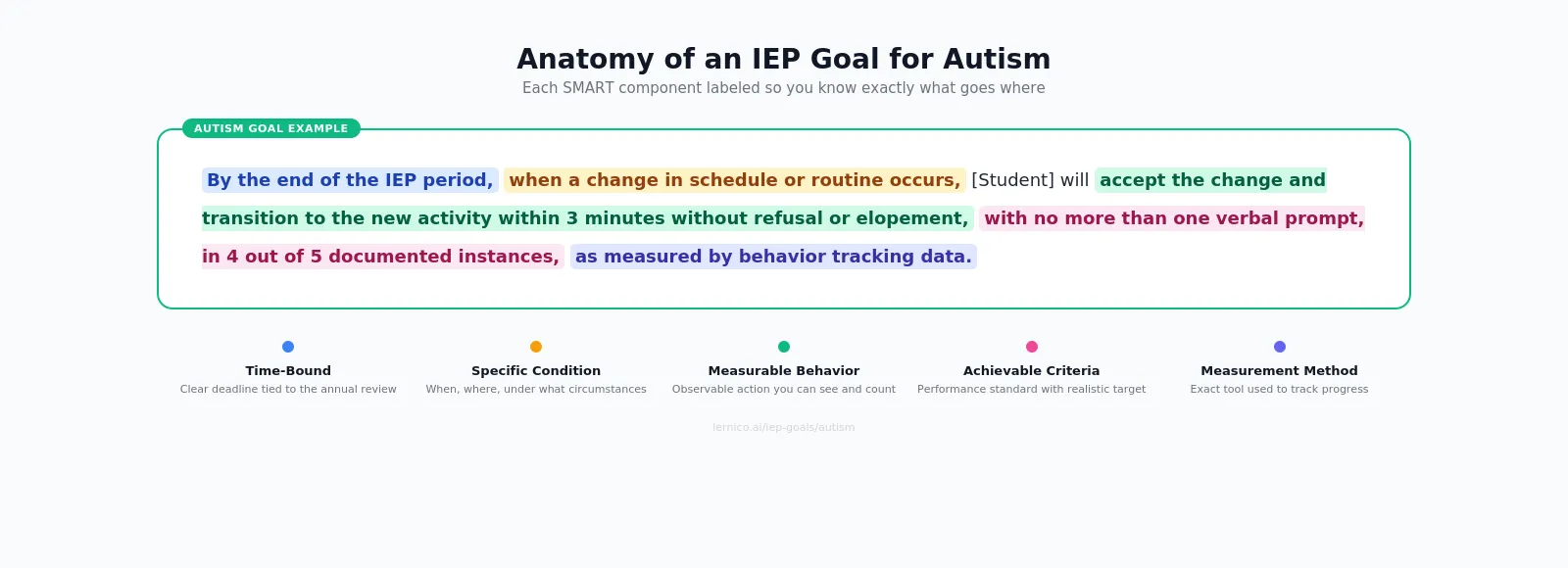
7. Managing Changes in Routine By [date], when a change in schedule or routine occurs, [Student] will accept the change and transition to the new activity within 3 minutes without refusal, meltdown, or elopement, with no more than one verbal prompt, in 4 out of 5 documented instances, as measured by behavior tracking data.
8. Tolerating Non-Preferred Activities By the end of the school year, when asked to participate in a non-preferred but required activity, [Student] will participate for the expected duration (or a reduced duration per accommodation) without disruptive behavior in 4 out of 5 opportunities, as measured by teacher observation and data logs.
Sensory Regulation Goals
9. Using Sensory Strategies Independently By [date], when experiencing sensory overstimulation (identified by student or adult), [Student] will independently use a pre-taught sensory strategy (noise-canceling headphones, fidget tool, sensory break) to regulate and return to the academic task within 5 minutes in 4 out of 5 opportunities, as measured by teacher and OT observation data.
10. Participating in Sensory-Rich Environments By the end of the IEP period, [Student] will participate in whole-school events or assemblies (cafeteria, gymnasium, auditorium) for at least [number] minutes using pre-planned sensory supports, without needing to leave the environment, in 3 out of 5 opportunities, as measured by teacher observation and documentation.
How to Customize These Goals for Students with Autism
Do not write "autism goals." Write goals for the student. Two students with autism may need completely different IEPs. One may need communication goals. Another may need social skills goals but have no communication deficit at all. Let assessment data drive the goals, not the diagnosis.
Specify the communication modality. If the student uses an AAC device, PECS, sign language, or verbal speech, name it in the goal. A goal should not assume verbal communication unless that is the student's primary mode.
Account for generalization. Students with autism often learn a skill in one setting but do not automatically transfer it to another. If generalization is the barrier, write the goal to specify multiple settings (e.g., "across at least 3 school environments").
Include sensory supports in the conditions. If the student uses sensory tools as part of their accommodation plan, name those tools in the goal conditions. The goal measures the behavior, not whether the student can perform without their supports.
Align to grade-level standards where applicable. Academic goals for students with autism follow the same rules as any other IEP: they must be tied to grade-level state standards. Social and behavioral goals align to functional performance standards.
Generate an IEP goal for a student with autism with built-in criteria and measurement plans in under two minutes.
Build IEP Goals for Autism That Fit Your Student
You now have 10 IEP goals for autism covering communication, social reciprocity, flexible thinking, and sensory regulation. Start with the examples above, select the ones that match your student's assessment data, and adjust the baselines and criteria. Or generate a goal in under 2 minutes.
Frequently asked questions
What areas should IEP goals for autism cover?
IEP goals for students with autism most commonly address communication (expressive and receptive), social skills (peer interaction, perspective-taking, joint attention), behavior (flexible thinking, managing transitions, tolerating non-preferred activities), and sensory regulation. The specific goals depend on the individual student's assessment data and present levels.
Are IEP goals for autism different from other IEP goals?
The format is the same: SMART, measurable, tied to grade-level standards under IDEA (for academic goals) or functional performance standards (for behavioral/social goals). The content is different because autism affects communication, social interaction, and behavioral flexibility in ways that other disabilities may not.
How do I write IEP goals for a nonverbal student with autism?
Focus on functional communication using whatever modality works for the student: AAC device, PECS, sign language, gestures. The goal should target the communicative function (requesting, protesting, commenting, greeting) rather than requiring verbal speech. Name the communication modality in the goal conditions.
Should IEP goals for autism address academic skills or social skills?
Both, if both are affected by the disability. Many students with autism need academic goals (reading, writing, math) in addition to social and behavioral goals. The IEP team decides based on assessment data. The National Autism Center's National Standards Project provides evidence ratings for interventions that can inform goal selection. Do not assume that a student with autism only needs social goals.
How often should I monitor progress on autism IEP goals?
At minimum, track data weekly for behavioral and social goals (frequency counts, observation checklists) and biweekly for academic goals (probes, work samples). Social communication goals benefit from video recording periodic samples for more reliable data than live observation alone.