

Published: · 7 min read
Speech and language goals fail in one of two ways. They are written at a level the student has already passed, so the data flatlines at ceiling by November. Or they are written three levels up, so nothing moves and the annual review restates the same goal.
These 30 goals are organised the way the caseload actually is: production first — articulation, fluency, voice — then the language system, then the social rules for using it, then augmentative communication. Each has a condition, a criterion and a measurement method. For goals outside this area, see the IEP goal bank.
The level ladder, which is the whole method
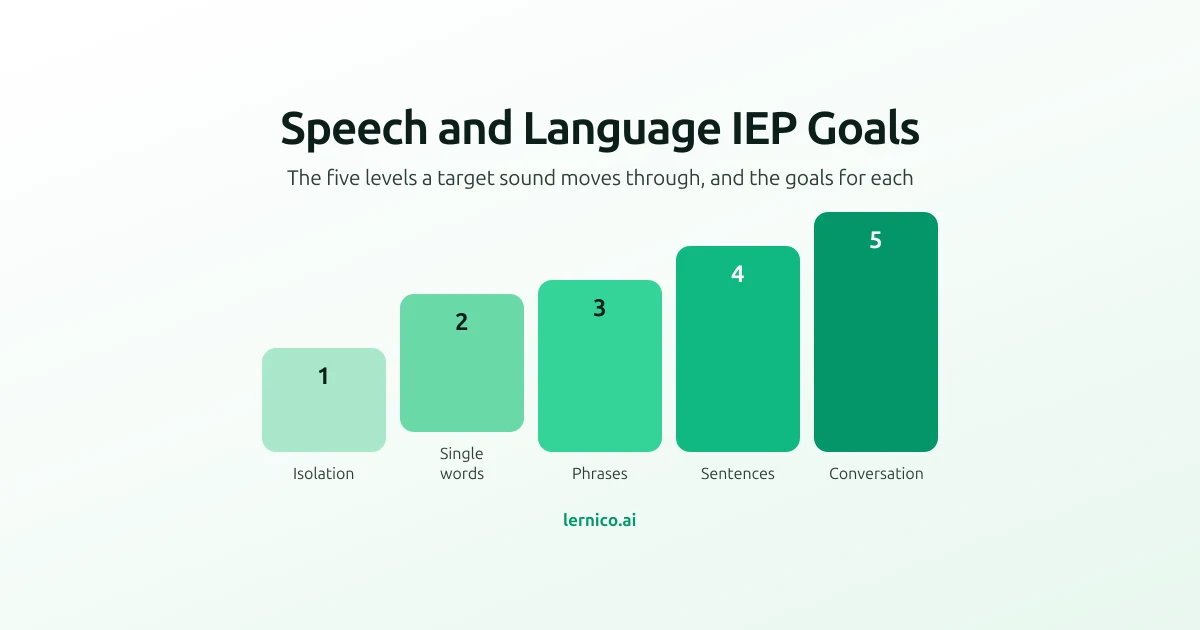
Nearly every articulation goal on a caseload sits somewhere on one ladder: isolation → syllable → single word → phrase → sentence → structured conversation → spontaneous conversation. Baseline is the highest rung the student can sustain at 80% or better. The goal goes on the next rung.
Writing it two rungs up is the single commonest error in this area, and it is invisible in a compliance review because the goal reads fine. It only shows up in the progress data, by which time a quarter is gone.
Articulation and phonology goals
1. Sound in isolation. By [date], given a model, [Student] will produce the target sound in isolation with 90% accuracy across 3 consecutive sessions, as measured by SLP session data.
2. Initial position, single words. By [date], [Student] will produce the target sound in the initial position of single words with 80% accuracy across 3 consecutive sessions, as measured by SLP session data.
3. Medial and final position. By [date], [Student] will produce the target sound in the medial and final positions of single words with 80% accuracy across 3 consecutive sessions, as measured by SLP session data.
4. Phrase level. By [date], [Student] will produce the target sound at the phrase level with 80% accuracy across 3 consecutive sessions, as measured by SLP session data.
5. Structured sentences. By [date], [Student] will produce the target sound in structured sentences with 80% accuracy across 3 consecutive sessions, as measured by SLP session data.
6. Conversation. By [date], during a 5-minute conversation sample, [Student] will produce the target sound with 80% accuracy across 3 consecutive sessions, as measured by SLP session data.
7. Self-monitoring. By [date], given a recording of their own speech, [Student] will identify their own error productions with 80% accuracy across 3 consecutive sessions, as measured by SLP session data.
8. Phonological process. By [date], [Student] will suppress [target process] in single words with 80% accuracy across 3 consecutive sessions, as measured by SLP session data.
9. Intelligibility to an unfamiliar listener. By [date], during a 3-minute conversation, [Student] will be understood by an unfamiliar listener on 80% of utterances across 3 consecutive samples, as measured by SLP-scored recordings.
Fluency goals
10. Using a fluency strategy. By [date], during a 3-minute structured speaking task, [Student] will use a taught fluency-shaping strategy in 8 of 10 opportunities across 3 consecutive sessions, as measured by SLP session data.
11. Identifying disfluency. By [date], [Student] will identify moments of disfluency in a recorded sample with 80% accuracy across 3 consecutive sessions, as measured by SLP session data.
12. Fluency in a real setting. By [date], during a classroom presentation, [Student] will speak with disfluencies on no more than [X] percent of syllables, as measured by SLP-scored recordings across 3 consecutive presentations.
13. Continuing through a block. By [date], during conversation with an unfamiliar adult, [Student] will maintain eye contact and continue speaking through a disfluency in 4 of 5 observed opportunities, as measured by SLP session data.
Receptive language goals
14. Following directions. By [date], [Student] will follow a two-step direction containing a preposition without additional prompting in 8 of 10 opportunities, as measured by teacher-recorded probe data.
15. Answering wh- questions. By [date], [Student] will answer "who", "what" and "where" questions about a familiar activity with 80% accuracy across 3 consecutive sessions, as measured by SLP session data.
16. Inferential questions. By [date], [Student] will answer "why" and "how" questions about a read-aloud passage with 80% accuracy across 3 consecutive sessions, as measured by SLP session data.
17. Categories. By [date], given a category, [Student] will name 5 members and state what they have in common in 4 of 5 opportunities, as measured by SLP session data.
18. Restating a direction. By [date], [Student] will restate a multi-step classroom direction in their own words before beginning, in 8 of 10 opportunities, as measured by teacher observation data.
Expressive language goals
19. Requesting with a phrase. By [date], [Student] will use a 3-word phrase to request a preferred item in 8 of 10 opportunities across 3 consecutive sessions, as measured by SLP session data.
20. Naming. By [date], given a picture scene, [Student] will name 8 of 10 pictured items across 3 consecutive sessions, as measured by SLP session data.
21. Grammatical markers. By [date], [Student] will use plurals and regular past-tense verbs correctly in 8 of 10 obligatory contexts across 3 consecutive language samples, as measured by SLP session data.
22. Complex sentences. By [date], [Student] will produce compound and complex sentences using taught conjunctions in 8 of 10 obligatory contexts across 3 consecutive language samples, as measured by SLP session data.
23. Defining a word. By [date], [Student] will define a grade-level vocabulary word by category and two features with 80% accuracy across 3 consecutive sessions, as measured by SLP session data.
24. Narrative retell. By [date], after hearing or reading a story, [Student] will retell it including character, setting, problem and resolution in 4 of 5 opportunities, as measured by an SLP-scored retell rubric.
25. Figurative language. By [date], given a figurative expression in context, [Student] will state its meaning with 80% accuracy across 3 consecutive sessions, as measured by SLP session data.
Pragmatic and social language goals
26. Topic maintenance. By [date], during a structured conversation, [Student] will maintain the topic across 3 conversational turns in 4 of 5 opportunities, as measured by SLP session data.
27. Entering a conversation. By [date], [Student] will enter an ongoing peer conversation using a taught entry strategy in 3 of 5 observed opportunities, as measured by teacher observation data.
28. Repairing a breakdown. By [date], given a communication breakdown, [Student] will repair it by rephrasing or asking a clarifying question in 4 of 5 opportunities, as measured by SLP session data.
29. Adjusting to the listener. By [date], [Student] will adjust volume, vocabulary and formality to the listener in 4 of 5 observed opportunities across 2 settings, as measured by teacher observation data.
Augmentative and alternative communication goals
30. Independent, unprompted use. By [date], [Student] will use their communication device to make an independent, unprompted communicative act — request, comment, protest or question — [X] times per 30-minute session across 3 consecutive sessions, as measured by SLP session data with the function of each act recorded.
How to customize these goals
Set the level from a baseline, not from the referral. The evaluation report tells you the diagnosis. Three sessions of probe data tell you the rung. Only the second one sets a goal.
Name the modality. If the student communicates through a device, sign, or a picture system, say so in the condition. A goal that quietly assumes speech is a goal the student cannot meet and nobody wrote down why.
Write carryover into the goal, not into a note. Two sessions a week cannot move a sound to conversation level on their own. If the goal is about generalisation, name the setting and the person collecting the data there — the classroom teacher, the parent, the lunch aide — or the goal will be measured in the only room where it was already met.
Count communicative functions separately for AAC. A device used forty times a session entirely to request preferred items looks like strong data and is a narrow communicator. Split the tally by function and the goal will target the gap.
Say what a prompt is. Modelled, cued and independent are three different data points. A goal that does not define them will be scored differently by every adult who collects it.
Writing speech and language goals from present levels
Turning a language sample, an articulation inventory and a set of classroom observations into a goal at the right rung — aligned to your state's standards and defensible a year from now — is the slow part.
Lernico generates standards-aligned IEP goals from a student's present levels, and produces the specially designed instruction and accommodations language the general education teacher needs to deliver them. You stay the author of every goal.
Book a 15-minute demo and bring a real student profile.
Frequently asked questions
Who writes speech and language IEP goals?
The speech-language pathologist drafts them, but they are IEP goals like any other — the team adopts them and the whole team is accountable for progress. That matters for the classroom, because a goal targeting a sound at the conversation level cannot be met in two thirty-minute sessions a week without carryover into the room.
What is the difference between a speech goal and a language goal?
Speech is production: the sounds, the fluency of the flow, and the voice producing them. Language is the system underneath — vocabulary, grammar, comprehension, and the social rules for using it. A student can have perfectly intelligible speech and a serious language disorder, and the goals for each look nothing alike.
How do you set the criterion for an articulation goal?
Find the highest level the student can already sustain — isolation, syllable, word, phrase, sentence, conversation — and write the goal at the next level up. Eighty percent accuracy is the conventional target because it is the point at which most students carry a sound over without direct prompting.
Can a student have IEP speech goals without a speech-only IEP?
Yes. Speech-language impairment can be the eligibility category on its own, or speech and language goals can sit inside an IEP written under another category — autism and specific learning disability both commonly carry them. The goals are the same either way.
How are AAC goals different?
They measure communicative acts, not speech. The number that matters is independent, unprompted use, and the range of functions — a student who only ever requests has a device, not a voice. Count comments, protests, questions and greetings separately from requests, or the data will look better than the communication is.