

Published: · Updated: · 6 min read
You know what your student needs. The slow part is turning that into a measurable goal — the right condition, an observable behavior, a criterion drawn from real baseline data, and a measurement method that will still make sense at the annual review.
This page routes you to 330 measurable goals across 15 skill areas, each written with all four parts in place. Take the structure, set the numbers from your own data, and move on. If you would rather browse everything on one page, the IEP goal bank holds 300 goals by area and grade band.
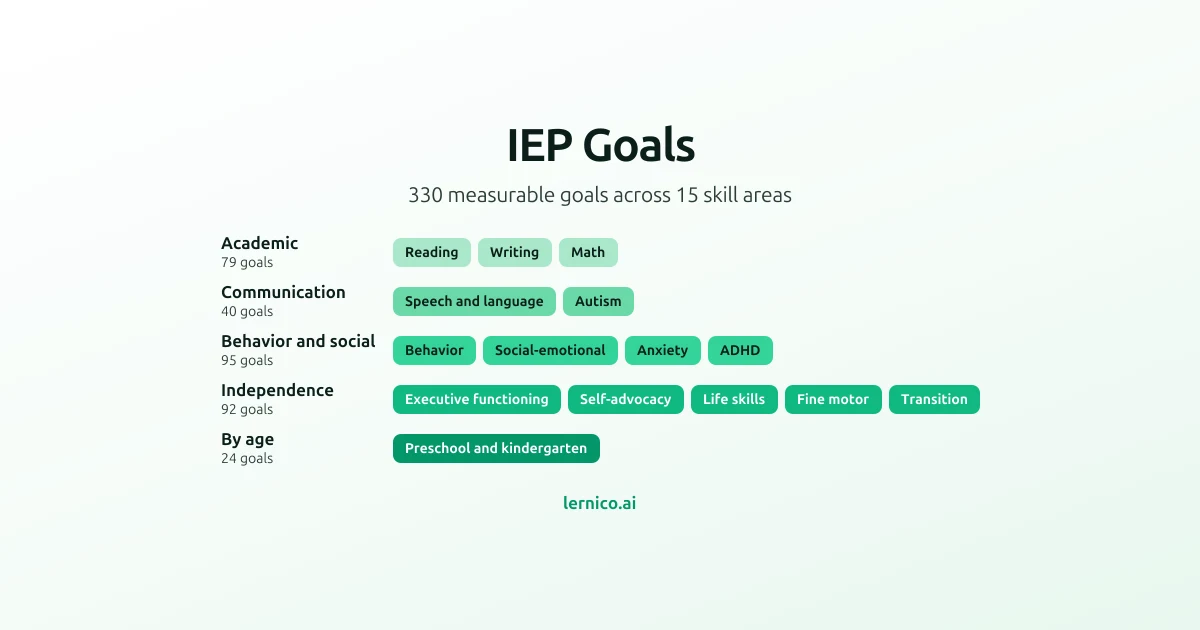
Every skill area at a glance
| Area | What it covers | Goals |
|---|---|---|
| Reading | Comprehension, fluency, decoding, vocabulary | 15 |
| Writing | Expression, structure, mechanics, revision | 12 |
| Math | Computation, problem solving, number sense, functional math | 52 |
| Speech and language | Articulation, fluency, receptive and expressive language, AAC | 30 |
| Behavior | Task completion, following directions, self-regulation | 12 |
| Social-emotional | Emotional identification, coping, peer interaction | 45 |
| Executive functioning | Organization, time management, planning, working memory | 10 |
| Self-advocacy | Asking, explaining, requesting, leading the meeting | 24 |
| Life skills | Home, community, health, money | 28 |
| Fine motor | Grasp, handwriting, tool use, keyboarding | 20 |
| Transition | Employment, postsecondary, independent living | 10 |
| Autism | Communication, social reciprocity, flexibility, sensory | 10 |
| ADHD | Attention, initiation, impulse control, organization | 20 |
| Anxiety | Recognising signs, strategies, remaining, participating | 18 |
| Preschool and kindergarten | Play, early language, early literacy, routines | 24 |
What makes an IEP goal measurable
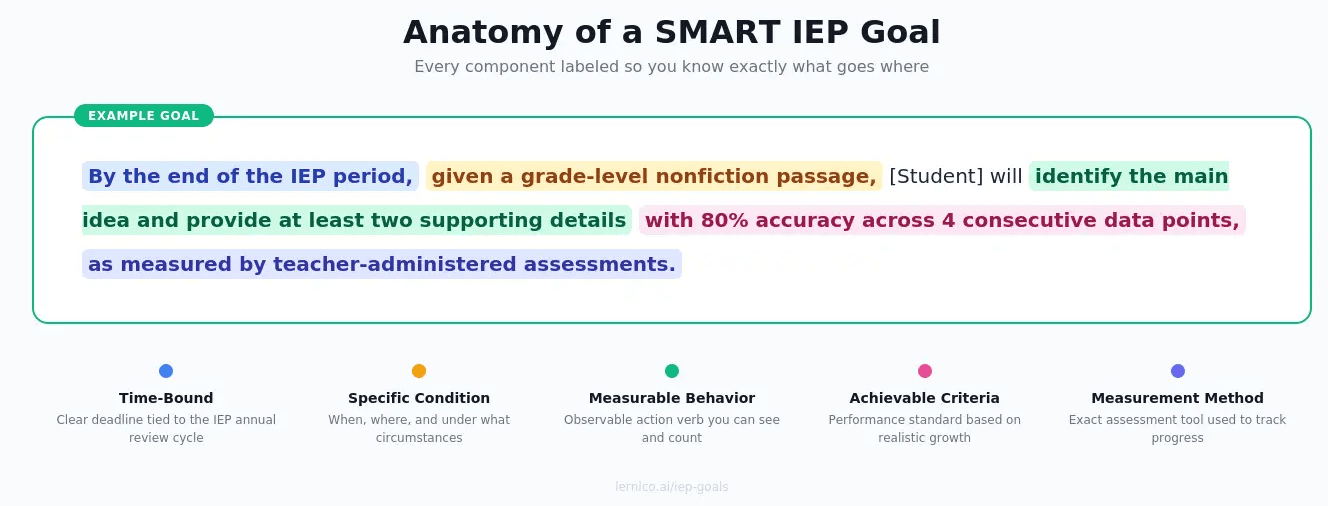
Four parts. Miss one and the goal cannot be progress-monitored, which is the finding that shows up most often in a compliance review.
- Condition — what is given, and with what support. "Given a graphic organizer" and "given a calculator" describe different goals.
- Observable behavior — what the student does, in words two people would score the same way. "Will understand" is not observable. "Will identify" is.
- Criterion — how well, how often, across how many opportunities. "80% accuracy" alone is not a criterion. "80% accuracy across 3 consecutive weekly probes" is.
- Measurement method — who collects the data, and how. If nobody can say how it will be measured, it will not be measured.
Academic goals
Reading IEP goals
Comprehension, fluency, decoding, phonics, vocabulary and inference, across elementary and secondary grade bands. Main idea, words correct per minute, text-based evidence, vocabulary in context, phonemic awareness. Write the goal for the actual breakdown — a comprehension goal for a student whose decoding is not yet fluent will produce unreliable data.
Writing IEP goals
Written expression, sentence and paragraph structure, spelling, mechanics, editing and revision. If the barrier is the physical act of writing rather than the composing, the goal belongs in fine motor instead, where an occupational therapist collects the data.
Math IEP goals
Computation fluency, word problem strategies, number sense, fractions, measurement, money and time. Keep fluency and accuracy goals separate — a student can be accurate and slow, and the instruction for each is different.
Communication goals
Speech and language IEP goals
Articulation and phonology, fluency, voice, receptive and expressive language, pragmatics and augmentative communication. Organised on the level ladder an SLP works from — isolation, word, phrase, sentence, conversation — because writing the goal two rungs above baseline is the commonest error in this area.
Autism IEP goals
Communication, social reciprocity, flexible thinking and sensory regulation. Name the communication modality in the goal; a goal that quietly assumes verbal speech is one the student cannot meet.
Behavior and social-emotional goals
Behavior IEP goals
On-task behavior, following directions, managing frustration, transitions and impulse control. Behavior goals need frequency, duration or latency data from the setting where the behavior actually happens, and where there is a functional behavior assessment, the goal belongs to its findings.
Social-emotional IEP goals
Emotional identification, self-regulation, coping strategies, social skills and peer interaction. The fix for an unmeasurable social goal is always the same: name the observable behavior that would be true if the internal state changed.
IEP goals for anxiety
Recognising the physical signs, using a strategy, remaining in the setting and taking part. Written as a graded sequence rather than one step, because avoidance returns as soon as the demand jumps.
IEP goals for ADHD
Attention, task initiation, impulse control and organization. Each target is paired with the recording method it needs — momentary time sampling for attention, latency for initiation — because the number in the goal has to be one that method can actually produce.
Independence and transition goals
Executive functioning IEP goals
Organization, time management, planning, working memory and self-monitoring. These goals fail most often because nobody defined what "organized" would look like on a data sheet.
Self-advocacy IEP goals
Asking for help, naming what helps, requesting an accommodation from someone who does not already know, and leading the meeting. Count unprompted requests only — a prompted request measures the adult.
Life skills IEP goals
Home, community, health and money, all written against a task analysis. The number that moves is the count of independent steps, not a percentage of a routine nobody can reconstruct later.
Fine motor IEP goals
Grasp and endurance, letter formation and legibility, tool use, and the keyboard route when handwriting is no longer the point. Score legibility with a reader who did not watch the student write.
Transition IEP goals
Work completion, independent functioning, self-determination and postsecondary preparation, for students 14 and up. IDEA requires these to be based on an age-appropriate transition assessment, and a transition goal written without one is what a state monitor looks for.
By age
Preschool and kindergarten IEP goals
Play and imitation, early language, early literacy, number sense, self-care and classroom routines. At this age the honest denominator is the routine — arrival, snack, circle — not a percentage of an unstructured morning.
What makes an IEP goal legally defensible
Three standards define this in the US.
IDEA (1997, amended 2004). Students with disabilities must have access to the general education curriculum, and annual goals must address needs arising from the disability that affect involvement and progress in it.
OSERS guidance (November 2015). The Office of Special Education and Rehabilitative Services clarified that IEP goals are aligned to grade-level standards — not to the student's current performance level, and not to a commercial curriculum's internal benchmarks.
Endrew F. v. Douglas County (2017). The Supreme Court held that an IEP must be reasonably calculated to enable a child to make progress appropriate in light of the child's circumstances. More than minimal benefit, in other words, and the standard applies to the goals themselves.
In practice: a sixth grader reading at a third-grade level still gets a goal tied to the sixth-grade standard. The standard sets what the goal points at. The student's baseline sets the number.
Writing goals from present levels
The examples above are structures. What none of them can do is read a set of present levels, an evaluation report and last year's progress data, and turn those into a goal that is measurable, aligned to your state's standards, and defensible a year from now.
Lernico's IEP goal generator drafts standards-aligned SMART goals from a student's present levels, across all 50 states' standards, and produces the specially designed instruction and accommodations language the general education teacher needs to deliver them. It is free, and you stay the author of every goal.
Book a 15-minute demo and bring a real student profile.
Frequently asked questions
What are IEP goals?
IEP goals are specific, measurable annual targets written into a student's Individualized Education Program under IDEA. Each one describes what the student will achieve within a year, how progress will be measured, and how often it will be reported to parents. The SMART framework — Specific, Measurable, Achievable, Relevant, Time-bound — is the usual checklist, and IDEA's own requirement is narrower: the goal must be measurable and must address a need arising from the disability.
What is the difference between IEP goals and IEP objectives?
IEP goals are the annual targets. Objectives, also called benchmarks or short-term objectives, are the intermediate steps toward them, usually quarterly. Under federal law they are required only for students who take alternate assessments, but many districts write them for every goal because they make the quarterly progress report mean something.
How many IEP goals should a student have?
There is no legal maximum, and most teams land between three and eight depending on need. More goals is not a better IEP. It is more data collection, more progress reports, and more chances for a goal nobody is tracking to turn up at the annual review with no data behind it.
Who writes IEP goals?
The team writes them together: the special education teacher or case manager, at least one general education teacher, the parent or guardian, a district representative, and the student where appropriate. Related service providers — speech-language pathologists, occupational therapists, school psychologists — draft the goals in their own areas, and the team adopts them.
Do IEP goals have to be aligned to grade-level standards?
Yes. The goal is aligned to the standard for the grade the student is enrolled in, not to the level they currently perform at. The criterion is then set from the student's own baseline. A sixth grader reading at a third-grade level still gets a goal tied to the sixth-grade standard, with a target that represents a year of ambitious growth.
How do I set the criterion in an IEP goal?
From baseline data, never from the example you copied. Curriculum-based measurement gives a rate, three weeks of work samples give an accuracy percentage, and frequency or duration data give a count. A goal set at 80% for a student currently performing at 15% is not ambitious, it is unattainable, and it is the first thing an advocate will ask about.
How often are IEP goals reviewed?
At least annually, at the IEP meeting. Progress toward each goal must be reported to parents at least as often as report cards go home for students without disabilities. If the data shows a student is not making adequate progress, the team should reconvene rather than wait for the annual review.
Related reading
- Specially Designed Instruction: 40 SDI Examples by Subject
- PLAAFP: 15 Present Levels Examples and How to Write One
- What Is in an IEP? The 8 Required Components
- IEP Goal Bank: 300 Measurable Goals by Skill Area and Grade
- IEP Goal Generator: Write SMART Goals in 2 Minutes
- IEP vs 504: 7 Key Differences and Who Qualifies
- Best Digital Lesson Planners for Teachers (2026)
- IEP Meeting: The 9 Steps and Who Does What
- Least Restrictive Environment: The 7 Placement Levels
- IEP Goals for Autism: 10 Measurable Examples for K-12
- Transition IEP Goals: 10 Measurable Examples for Students 14+
- Self-Advocacy IEP Goals: 24 Measurable Examples for K-12
- Speech and Language IEP Goals: 30 Measurable Examples
- Life Skills IEP Goals: 28 Functional Examples You Can Measure
- Preschool and Kindergarten IEP Goals: 24 Measurable Examples
- IEP Goals for ADHD: 20 Measurable Examples for K-12
- IEP Goals for Anxiety: 18 Measurable Examples for K-12
- Fine Motor IEP Goals: 20 Measurable Examples for K-12