

Published: · 6 min read
A team has written the goals and agreed the services, and now has to decide where the student will be taught. That decision is governed by one of the most misunderstood requirements in IDEA. Least restrictive environment is not a place, not a percentage, and not a program the district happens to run — it is a determination made individually for each student, and it has a legal standard attached.
What does least restrictive environment mean?
Least restrictive environment means that, to the maximum extent appropriate, students with disabilities are educated alongside students without disabilities. Removal from the general education classroom is permitted only when the nature or severity of the disability is such that education there, with the use of supplementary aids and services, cannot be achieved satisfactorily.
The phrase people skip is the one that decides most cases: with the use of supplementary aids and services. The question is never whether a student can succeed in the general education classroom as it currently exists. It is whether they could succeed there with the supports the district is capable of providing.
The legal standard
The requirement sits at 34 CFR 300.114. Two things follow from how it is written.
LRE is a presumption, not a preference. The general education classroom is the starting point for every student. The burden falls on justifying removal, not on justifying inclusion.
The justification must be specific to the student. "We don't have the staffing," "the program runs in the other building," and "students at this level are served in the resource room" are not LRE justifications. They are administrative facts, and none of them appear in the regulation.
A second requirement, at 34 CFR 300.116, is routinely overlooked: the student should be educated in the school they would attend if not disabled, unless the IEP requires otherwise, and placement should be as close as possible to the child's home. Sending a student across a district to reach a program is a decision that has to be justified on its own terms.
The 7 placement levels
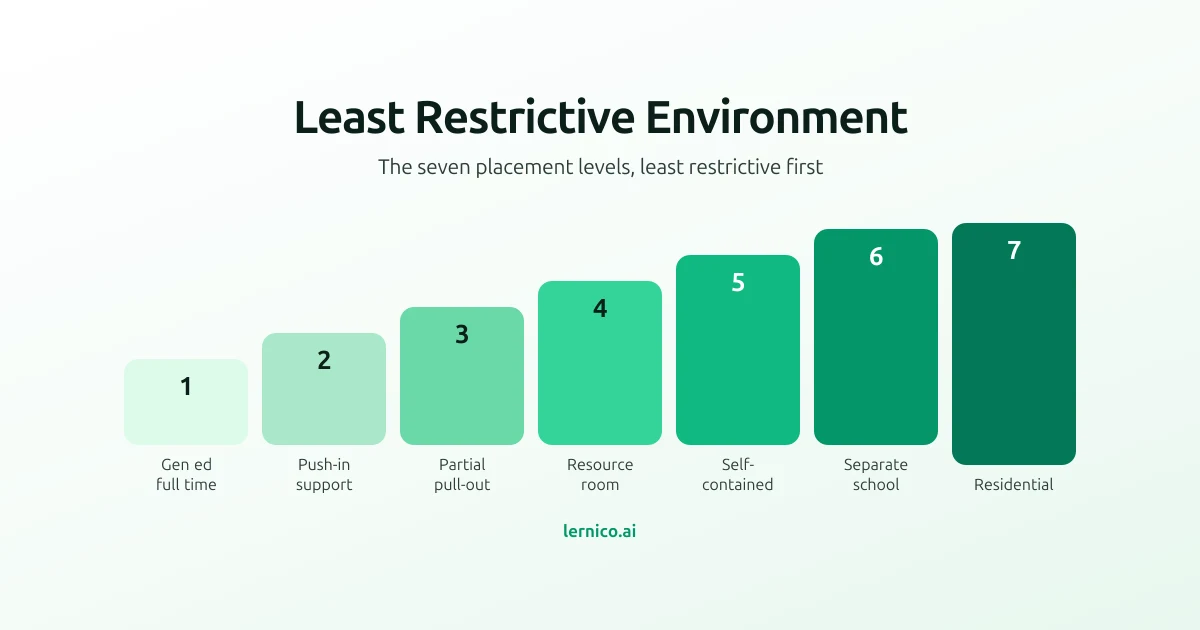
IDEA requires districts to make a continuum of alternative placements available (34 CFR 300.115). Districts describe it differently, but it runs in this order, least restrictive first.
1. General education classroom, full time, with supports Accommodations, supplementary aids, assistive technology, and consultation between the special education teacher and the general education teacher. The student is in the room all day.
2. General education with push-in support A special education teacher, paraprofessional, or related service provider delivers support inside the general education classroom. Co-teaching sits here.
3. General education with pull-out for part of the day The student spends most of the day in general education and leaves for targeted instruction — commonly a resource room for one or two subjects.
4. Resource room for a substantial part of the day Instruction in a smaller setting for multiple subjects, with the student returning to general education for the rest.
5. Separate special education classroom A self-contained class within a general education school. The student is educated primarily with other students with disabilities but shares the building, and typically non-academic settings.
6. Separate school A day school serving only students with disabilities.
7. Residential facility, home or hospital instruction The most restrictive settings, for students whose needs cannot be met in a day placement.
A student is not placed on a level. The team decides how much of the day is spent where, subject by subject. A student can be in general education for four subjects and a resource room for one; that is a single placement decision, not a compromise between two.
How teams decide
Placement is decided by a group knowledgeable about the student, the meaning of the evaluation data, and the placement options (34 CFR 300.116). Four things the regulation requires:
- Placement is based on the IEP — so goals and services are settled first, and the setting follows from them. Deciding placement first and writing goals to fit the available program inverts the process, and it is the single most common LRE finding.
- Placement is determined at least annually.
- Any potential harmful effect on the student or on the quality of services must be considered.
- A student is not removed from age-appropriate general education classrooms solely because of needed modifications to the general curriculum. That sentence appears in the regulation because it happens.
The practical test a team should be able to answer out loud: what supplementary aids and services did we try, or seriously consider, before concluding the general education classroom would not work? If the answer is none, the decision is not defensible.
It helps to remember that specially designed instruction describes what is taught and how, not the room it happens in. The same explicit phonics sequence can be delivered in a co-taught class, a push-in arrangement or a pull-out group — so a team reaching for a more restrictive setting should be able to say what about the instruction, rather than about the schedule, requires it.
Common mistakes
Treating LRE as a percentage target. A district-wide inclusion figure is a monitoring statistic. It is not a standard for an individual student, and chasing it produces bad placements in both directions.
Placement by available program. The continuum has to be available to fit the student. The student does not get fitted to the continuum the district happens to run.
Removing a student for behavior without a plan. If behavior impedes learning, the IEP team must consider positive behavioral interventions and supports. Restriction is not the first response.
Forgetting non-academic settings. LRE covers lunch, recess, assemblies, clubs and extracurriculars. A student can be in general education for every subject and still be excluded in practice.
Confusing LRE with full inclusion. LRE does not require every student to be in the general education classroom all day. It requires the team to justify time spent out of it. For some students, the appropriate placement is more restrictive — and reaching that conclusion honestly, with evidence, is exactly what the regulation asks for.
What is a special education classroom?
In common use, a "special education classroom" means a self-contained class — level 5 above — where a special education teacher delivers instruction to a small group of students with IEPs for most of the day, usually with paraprofessional support.
Three things are worth being precise about:
- It is a placement, not a category of student. Nothing about a disability label determines it.
- Students in self-contained settings are still entitled to participate with non-disabled peers to the maximum extent appropriate — which is why the IEP specifies which parts of the day are shared.
- A resource room is not the same thing. A resource room supplements general education instruction for part of the day; a self-contained classroom replaces it for most of the day.
Where goals and placement connect
Because placement follows from goals and services, the quality of the goals decides the quality of the placement decision. A vague goal cannot tell a team what setting a student needs, and a goal copied from last year cannot show whether the current placement is working.
Lernico generates standards-aligned IEP goals from a student's present levels across all 50 states' standards, and produces the specially designed instruction and accommodations language the general education teacher needs to deliver them — which is the evidence a team needs when it asks what supports were tried before considering removal.
Book a 15-minute demo and bring a real student profile.
Frequently asked questions
What does LRE stand for in special education?
Least Restrictive Environment. It is the IDEA requirement that students with disabilities be educated with non-disabled peers to the maximum extent appropriate, with removal from the general education classroom permitted only when education there cannot be achieved satisfactorily even with supplementary aids and services.
Is LRE the same as inclusion?
No. Inclusion describes a practice; LRE is a legal standard applied individually. LRE does not require every student to be in the general education classroom all day — it requires the team to justify any time spent outside it, based on that student's needs rather than on available programming.
Who decides a student's placement?
A group knowledgeable about the student, the evaluation data, and the placement options — in most districts the IEP team. Placement is based on the completed IEP, determined at least annually, and made as close to the student's home as possible, in the school they would attend if not disabled unless the IEP requires otherwise.
Can a school change a placement without parent agreement?
A district must provide prior written notice before changing placement, and parents can dispute it through mediation, a state complaint, or due process. If a due process hearing is requested, "stay put" generally keeps the student in the current placement until the dispute is resolved.
Does LRE apply outside academic classes?
Yes. It covers non-academic and extracurricular settings — lunch, recess, assemblies, clubs, athletics. A placement that includes a student academically but excludes them from everything else has not met the requirement.