

Published: · 10 min read
Ask five people in an IEP meeting to define specially designed instruction and you will get five answers, at least two of which are accommodations. That confusion is not academic. It is the difference between a service page a district can deliver and one that turns into a due-process complaint, and it is the single most common reason an IEP is technically complete and practically empty.
This page covers what SDI is under IDEA, how it differs from the three things it gets confused with, 40 examples by subject, a planning template you can use in a meeting, and where it belongs in the document.
What is specially designed instruction?
IDEA defines it at 34 CFR §300.39(b)(3). Specially designed instruction means adapting the content, the methodology, or the delivery of instruction — as appropriate to the needs of an eligible child — in order to:
- address the needs of the child that result from the child's disability, and
- ensure the child's access to the general curriculum, so that they can meet the educational standards that apply to all children in the jurisdiction.
Three words in that definition do most of the work.
Content — what is taught. Not a different curriculum, usually, but a different sequence, a prerequisite skill taught alongside the grade-level one, or a narrower set of exemplars.
Methodology — how it is taught. Explicit and systematic instead of inquiry-led, multisensory instead of verbal, a specific taught strategy instead of a general expectation that the student will find one.
Delivery — how instruction reaches the student. Group size, pacing, the number of practice opportunities, the way feedback is given, the prompting hierarchy and how it fades.
An adaptation that fits none of those three is probably not SDI. That is a useful test to run in a meeting when someone proposes "preferential seating" as specially designed instruction.
SDI vs accommodations vs modifications vs differentiation
This is the distinction worth getting right, because the four are governed differently and confusing them has consequences.
| What changes | Who it is for | Who plans it | Where it lives | |
|---|---|---|---|---|
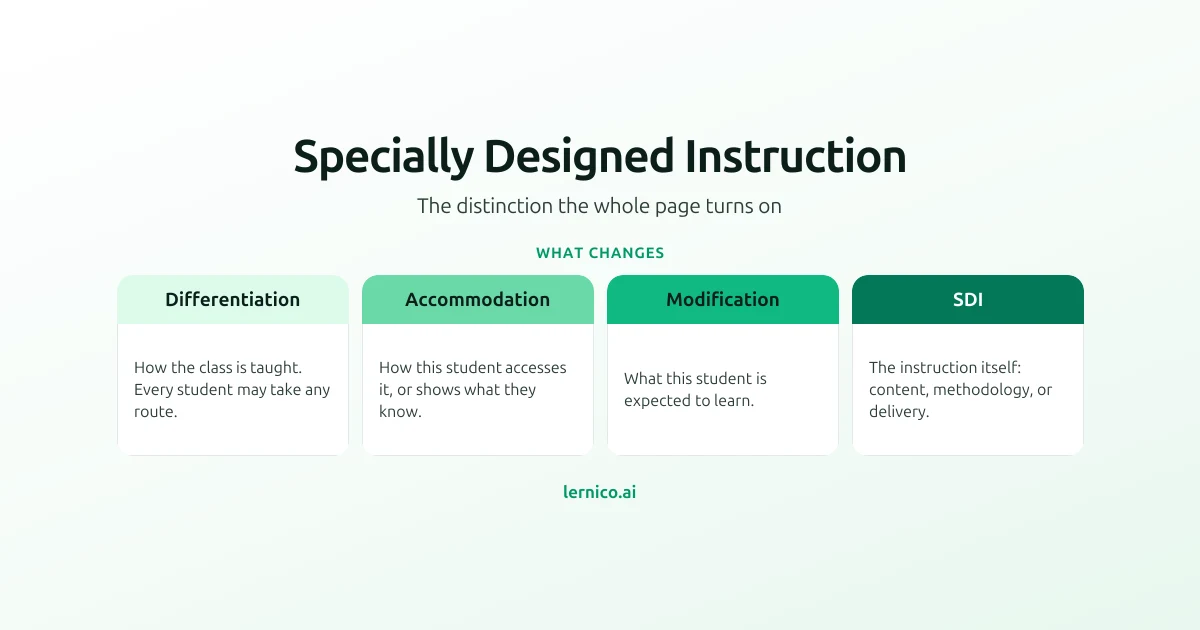
| Differentiation | How the class is taught | Every student in the room | General education teacher | Lesson plans |
| Accommodation | How the student accesses instruction, or shows what they know | This student | IEP or 504 team | IEP or 504 plan |
| Modification | What the student is expected to learn | This student | IEP team | IEP |
| SDI | The instruction itself — content, methodology or delivery | This student | IEP team, delivered by a special educator | IEP service statement |
Read across the "what changes" column and the logic falls out. A differentiated lesson offers three routes to the same standard, and every student may take any of them. An accommodation leaves the standard and the instruction alone and removes a barrier to reaching it. A modification lowers or changes the expectation itself. SDI leaves the standard where it is and changes the teaching.
Two consequences follow that teams get wrong.
Differentiation is not special education. It is good practice, it is available to everyone, and a student does not need an IEP to receive it. A district whose answer to "what specially designed instruction will this student receive?" is a description of good differentiation has not answered the question. Our guide to differentiated instruction strategies is about the general education half of this, and it is deliberately a separate page.
Accommodations are not interchangeable with SDI. Extended time does not teach anything. It removes a barrier so that whatever was taught can be demonstrated. A plan built entirely of accommodations is a plan in which nobody is teaching the student anything they could not already do — which is exactly the situation Endrew F. addressed. If the accommodations are all a student needs, the honest conclusion is usually a 504 plan rather than an IEP.
One caution on vocabulary. IDEA itself does not define "accommodation" or "modification" as a pair; the regulations use "accommodations" mainly in the assessment context, and "program modifications" at 300.320(a)(4)(iii) means something narrower than the everyday sense of a modified curriculum. The four-way distinction above is settled practice rather than statutory text, and states word it differently. Use your state's language in the document, and this table to think with.
Who delivers SDI, and where
Who. A special education teacher, or a related service provider working within their own licence — a speech-language pathologist delivering language instruction, an occupational therapist delivering a motor programme. A paraprofessional can support practice of a skill under that person's direction. A paraprofessional delivering SDI on their own is a common compliance finding, and the reasoning is simple: instruction stops being specially designed when nobody qualified is designing it.
Where. Anywhere. SDI describes what is taught and how, not the room it happens in. The least restrictive environment requirement pushes toward the general education setting, and co-teaching, push-in support and a small pull-out group can all carry the same instruction. A team that reaches for a more restrictive placement should be able to say what about the instruction requires it.
40 SDI examples by subject
Each of these adapts content, methodology or delivery. None of them is an accommodation, and that is the test each one had to pass.
Reading
- Explicit, systematic phonics instruction in a set scope and sequence, with cumulative review of previously taught patterns.
- Multisensory letter-sound instruction pairing a visual, a movement and the sound in each trial.
- Pre-teaching the three to five vocabulary words that gate the next passage, before the class reads it.
- Repeated reading of the same passage to a set rate criterion, with error correction after each read.
- Direct instruction in a syllable-division strategy, then guided practice on words drawn from that week's text.
- Teaching a fixed comprehension routine — predict, read, retell, check — and rehearsing it to independence.
- Chunking a grade-level text into labelled segments with a taught question stem for each.
- Modelled think-alouds in which the teacher makes the inference process audible, then fades to prompting.
- Teaching morphology directly — Greek and Latin roots — so unfamiliar academic vocabulary becomes decodable meaning.
- Increasing the number of teacher-scored response opportunities per minute in a small group, so errors surface the same day.
Writing
- Direct instruction in a sentence-expansion routine, moving from a kernel sentence to a complex one in taught steps.
- Teaching a paragraph frame explicitly, then fading the frame across a planned sequence of assignments.
- Sentence-combining practice targeting the specific structure missing from the student's own writing samples.
- Explicit instruction in a self-regulated writing strategy — plan, write, revise — with self-talk scripted and rehearsed.
- Spelling instruction organised by pattern rather than by weekly list, with cumulative review.
- Handwriting instruction using a taught formation sequence with immediate corrective feedback.
- Teaching the student to use their own scored rubric as a revision tool, one criterion at a time.
- Direct keyboarding instruction with distributed practice, where writing volume is the barrier.
Math
- Concrete-representational-abstract sequencing, taught in that order, for each new operation.
- Explicit instruction in a schema-based approach to word problems, sorted by problem type rather than by keyword.
- Timed fluency practice with a set error-correction procedure and a charted daily rate.
- Teaching a single worked-example format and using it consistently, so the format itself stops costing attention.
- Number-line instruction for fractions, taught before and alongside the procedural work.
- Pre-teaching the prerequisite skill for the coming unit during the preceding week.
- Reducing the number of problems while holding the difficulty, so practice stays at grade level and is completed.
- Direct instruction in checking strategies — estimate first, compare after — rehearsed until it is habitual.
Communication and language
- Articulation instruction at a named level of the production hierarchy, with a criterion for moving up.
- Explicit instruction in a taught conversational entry strategy, rehearsed in role play and then in the setting.
- Direct teaching of question forms in obligatory contexts, with modelled expansions.
- Aided language stimulation on the student's communication device, with the adult modelling on the device itself.
- Teaching a communication-repair routine — rephrase, then ask — and prompting it at the point of breakdown.
Behavior and social-emotional
- Direct instruction in a replacement behavior matched to the function identified in the functional behavior assessment.
- Teaching a self-monitoring procedure, then fading from teacher-matched ratings to independent recording.
- Explicit instruction in an emotion-identification vocabulary, using the same scale across every setting.
- Structured, rehearsed practice of a taught de-escalation step, run before it is needed rather than during a crisis.
- Teaching a break-request routine and reinforcing the request rather than the escape.
Executive functioning and independence
- Direct instruction in a task-initiation routine — read, restate, start — with latency charted.
- Teaching backwards planning on a real assignment, with the interim deadlines negotiated and then checked.
- Explicit instruction in a materials-organisation system, with a weekly check that fades to self-check.
- Teaching the student to name their own accommodations and request them, rehearsed with an unfamiliar adult.
An SDI planning template
Bring this to the meeting. It is four questions, and a service page that answers all four is one a district can actually deliver.
| Field | What goes in it | A weak answer |
|---|---|---|
| Need from the disability | The specific skill gap, from the present levels | "Struggles in reading" |
| What is adapted | Content, methodology, or delivery — name which | "Reading support" |
| The instruction | What will be taught, and by what method | "Small group" |
| Frequency, location, duration | Minutes, setting, and over what period | "As needed" |
| Who delivers it | The person, by role and qualification | "Staff" |
| How progress is measured | The probe, and how often it is run | "Teacher observation" |
The right-hand column is not a straw man. Every one of those phrases is common, and every one of them is unenforceable, because none of them tells a substitute, a new case manager or a hearing officer what was supposed to happen.
How to document SDI in the IEP
SDI belongs in the statement of special education and related services, at 34 CFR §300.320(a)(4) — with the frequency, location and duration recorded alongside it.
Three practices separate a service page that holds up from one that does not.
Name the instruction, not just the minutes. "150 minutes per week of specialised reading instruction" is a quantity. "150 minutes per week of explicit, systematic phonics instruction in a scope and sequence, in a group of no more than four, delivered by the special education teacher" is a service. The second one can be delivered by someone who has never met the student, which is the actual test.
Connect each SDI to a goal and a present level. If an adaptation traces back to no stated need, either the need is missing from the present levels or the service does not belong. Both are worth finding before the meeting ends.
Say where it happens, and be honest about it. Location is a required element, and "special education setting" as a blanket answer forecloses the LRE conversation the team is supposed to have.
Five ways teams get this wrong
Listing accommodations under SDI. Preferential seating, extended time and a copy of the notes are accommodations. They may all be right, and none of them is instruction.
Describing a place instead of a service. "Resource room" is a location. It says nothing about what will be taught there, and two students in the same room can receive entirely different SDI — or, when nobody wrote it down, the same generic help.
Letting a program stand in for the design. A purchased intervention can deliver SDI, but the IEP still has to say what this student needs from it. "Student will use [program name]" outsources the individualisation the law asks the team to do.
Handing delivery to a paraprofessional. Support under direction is fine. Sole delivery is not, and it is one of the more frequent findings in a state monitoring review.
Writing SDI that any student would benefit from. Good instruction is not the standard. The standard is instruction that addresses a need arising from this child's disability. If the whole class would benefit equally, it is differentiation and it belongs in the lesson plan.
Writing the SDI, not just the goals
The service page is the half of the IEP that gets least attention and does most of the work. A goal states where the student should be in a year; the SDI states what will actually be taught to get them there, and it is what the general education teacher has to be handed on the first day of term.
Lernico generates standards-aligned IEP goals from a student's present levels, across all 50 states' standards, and produces the specially designed instruction and accommodations language that goes with them — in the words a general education teacher can act on. You stay the author of every word.
Book a 15-minute demo and bring a real student profile.
Frequently asked questions
What is specially designed instruction?
Under IDEA, specially designed instruction means adapting the content, the methodology, or the delivery of instruction to address the needs that arise from a child's disability and to give that child access to the general curriculum. It is the thing that makes special education "special": a service, delivered by or under the direction of a special educator, not a setting and not a worksheet.
What is the difference between SDI and an accommodation?
An accommodation changes how a student accesses instruction or shows what they know — extended time, a read-aloud, a quiet room. SDI changes the instruction itself. A student given extra time on a test has been accommodated; a student taught a specific decoding strategy through explicit, cumulative practice has received specially designed instruction. Most IEPs need both, and the two are documented in different places.
Is differentiation the same as specially designed instruction?
No, and the distinction matters legally. Differentiation is good general education practice available to every student in the room, planned by the general education teacher. SDI is individualised, driven by the student's disability-related needs, written into the IEP, and delivered by or under the direction of a special educator. A district that offers only differentiation has not provided special education.
Can SDI be delivered in the general education classroom?
Yes, and often it should be. IDEA's least restrictive environment requirement pushes toward the general education setting, and SDI describes what is taught and how, not where. A co-taught class, a push-in arrangement and a small pull-out group can all carry the same specially designed instruction.
Who is qualified to deliver SDI?
A special education teacher, or a related service provider working within their own licence, delivers it — and a paraprofessional may support its practice under that person's direction. Handing SDI to a paraprofessional to deliver on their own is one of the more common compliance findings, because the instruction stops being specially designed the moment nobody qualified is designing it.
Where is SDI written in the IEP?
In the statement of special education and related services, at 34 CFR 300.320(a)(4) — including the frequency, location and duration. Naming a service minute count without describing what will be taught is what makes a service page unenforceable, and it is the gap a parent's advocate looks for first.
Does every student with an IEP receive SDI?
Yes. Specially designed instruction is what distinguishes special education from every other support a school offers. If a team cannot name what will be taught differently, the honest conclusion is usually that the student needs a Section 504 plan rather than an IEP.
Related reading
- Differentiated Instruction Strategies: 30 Examples
- 504 Accommodations: 60 Examples by Need and Setting
- IEP vs 504: 7 Key Differences and Who Qualifies
- IEP Goals: 330 SMART Examples Across 15 Skill Areas
- IEP Goal Bank: 300 Measurable Goals by Skill Area and Grade
- Least Restrictive Environment: The 7 Placement Levels