

Published: · 5 min read
An anxiety goal has a problem no reading goal has: the thing everyone actually wants to change is a feeling, and a feeling cannot be scored by two observers. So the goal has to be written about what the anxiety does — a student leaving the room, not raising a hand, not starting the test — and about the skills that change that.
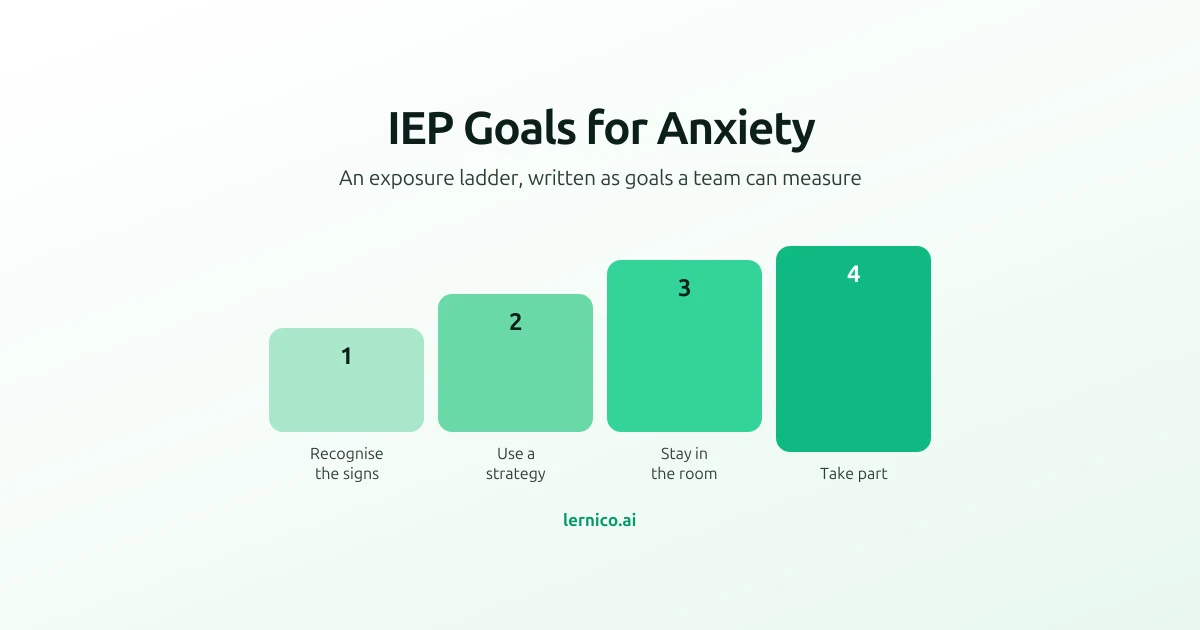
These 18 goals follow the sequence a school-based plan usually takes: notice the signs, use a strategy, stay in the setting, take part. Each has a condition, a criterion and a measurement method. For goals outside this area, see the IEP goal bank.
What a school goal can and cannot be
A school goal addresses access to education, not the condition. Specially designed instruction can teach a student to recognise their own physical signs and use a strategy. It is not therapy, and an IEP team should not write a goal that assumes a clinical protocol nobody on the team is qualified to run. Where a student is in outside treatment, the strongest plans are written with that clinician rather than in parallel to them.
Anxiety often points to a 504 rather than an IEP. If the team's answer to "what will we teach differently?" is "nothing, but she needs to test in a small group and to be allowed a break", that is a 504 plan. The goals below assume the team identified a skill to teach.
Graded steps beat one big one. A goal that jumps from leaving the room daily to full participation will be missed, and the miss will read as the student's failure rather than the plan's.
Recognising the signs
1. Naming the physical signs. By [date], [Student] will name the physical signs of their own rising anxiety — the sensations, in their own words — in 4 of 5 structured opportunities, as measured by counselor session data.
2. Rating on a fixed scale. By [date], when prompted, [Student] will rate their current state on the agreed 5-point scale in 8 of 10 opportunities, as measured by a student-kept log reviewed weekly.
3. Identifying a trigger. By [date], following an episode, [Student] will identify the situation that preceded it and one thing that would have helped, in 4 of 5 opportunities, as measured by a structured reflection scored by the counselor.
4. Reporting early. By [date], [Student] will tell a staff member they are struggling before leaving the setting, in 4 of 5 observed opportunities, as measured by a teacher-kept tally.
Using a regulation strategy
5. Independent strategy use. By [date], when they notice rising anxiety, [Student] will use a taught regulation strategy without an adult prompt in 4 of 5 observed opportunities across 3 consecutive weeks, as measured by a teacher-kept tally.
6. Choosing between strategies. By [date], given a situation, [Student] will select the strategy that fits it from among those taught, and use it, in 4 of 5 opportunities, as measured by counselor session data.
7. Using a strategy before an assessment. By [date], [Student] will apply a taught strategy before a graded assessment in 4 of 5 opportunities, as measured by a student-kept log reviewed with the counselor.
8. Requesting a break correctly. By [date], when needing a break, [Student] will use the agreed request rather than leaving without permission, in 4 of 5 opportunities across 3 consecutive weeks, as measured by a teacher-kept tally.
9. Returning from a break. By [date], after a break, [Student] will return to the setting within the agreed number of minutes in 8 of 10 opportunities, as measured by teacher-charted duration data.
Staying in and returning to the setting
10. Remaining in class. By [date], [Student] will remain in the general education classroom for the full period in 4 of 5 class periods across 3 consecutive weeks, as measured by teacher-charted duration data.
11. Reducing time out of the setting. By [date], [Student] will reduce time spent out of the classroom from a baseline of [X] minutes per day to no more than [Y] minutes per day across 3 consecutive weeks, as measured by teacher-charted duration data.
12. Entering a difficult setting. By [date], [Student] will enter the identified high-anxiety setting — the cafeteria, the assembly, the locker room — and remain for [X] minutes in 3 of 4 opportunities, as measured by a staff-kept log.
13. Attendance. By [date], [Student] will attend [X] percent of scheduled class periods across 3 consecutive weeks, as measured by school attendance records.
14. Starting the school day. By [date], [Student] will complete the arrival routine and be in first period within 10 minutes of the bell in 8 of 10 school days, as measured by attendance and staff records.
Participating and taking academic risks
15. Contributing in class. By [date], [Student] will contribute to a whole-class discussion at least once per period in 4 of 5 class periods, as measured by a teacher-kept tally.
16. Beginning a task despite uncertainty. By [date], given a task they are unsure about, [Student] will begin within 5 minutes rather than avoiding it, in 4 of 5 opportunities, as measured by a teacher-kept latency record.
17. Asking for clarification. By [date], when a task is unclear, [Student] will ask the teacher rather than disengaging, in 4 of 5 observed opportunities, as measured by a teacher-kept tally.
18. Presenting to a group. By [date], [Student] will deliver a prepared presentation to a group of the agreed size in 3 of 4 opportunities, as measured by teacher observation and a scored rubric.
How to customize these goals
Set the step size from the baseline, not from the destination. If the student currently lasts twelve minutes in the classroom, the goal is not the full period. Write the interim number and let the annual review raise it.
Decide in advance what a missed step means. These goals move non-linearly, and a bad fortnight is normal. Agreeing at the meeting what triggers a change — three flat data points, say — prevents a mid-year argument about whether the plan is working.
Do not write avoidance out of the data. A goal met because the demand was quietly removed is not met. If an accommodation changed during the period, note it beside the data; otherwise the trend line means nothing.
Keep the setting in the condition. "Will use a strategy" collected in a counselling office says nothing about fourth-period science. Name the room.
Coordinate with the behavior and social-emotional goals. Anxiety-driven avoidance is frequently written up as non-compliance in one section and as anxiety in another, and the two plans then contradict each other in front of the student.
Writing anxiety goals from present levels
Turning a rating scale, an attendance record and a fortnight of duration data into a goal that is measurable, appropriately paced, and defensible a year from now is the slow part.
Lernico generates standards-aligned IEP goals from a student's present levels, and produces the specially designed instruction and accommodations language the general education teacher needs to deliver them. You stay the author of every goal.
Book a 15-minute demo and bring a real student profile.
Frequently asked questions
Does anxiety qualify a student for an IEP?
It can, most often under Emotional Disturbance or Other Health Impairment, but only where the condition adversely affects educational performance and the student needs specially designed instruction. Many students with anxiety are appropriately served by a Section 504 plan instead, which provides accommodations without specialised instruction.
Is an IEP goal a substitute for treatment?
No. School services address how anxiety affects access to education; they are not clinical treatment, and an IEP team should not write a goal that assumes a therapeutic protocol it is not qualified to deliver. Where a student is in outside treatment, the school goals work best when they are written with that clinician's input rather than around it.
How do you measure an anxiety goal without guessing?
Measure behavior, not feeling. Counts of independent strategy use, minutes remaining in the setting, latency to return after leaving, and participation opportunities taken are all observable. A student's own rating on a fixed scale is useful too, and it is data as long as the scale is the same one every time.
Should a goal require the student to stop avoiding?
Not in one step. Avoidance reduces quickly and returns just as quickly when the demand jumps. Goals written as a graded sequence — tolerate, remain, participate — produce a defensible progression, and the team should agree in advance what happens when a step is too big.
Who collects the data on these goals?
Usually the school counselor or psychologist for the strategy and self-report goals, and the classroom teacher for the ones about remaining in and participating in the setting. Name both in the IEP. A goal about a general education classroom that is only ever scored in a counselling office measures the wrong room.