

Published: · 6 min read
Your student can sound out every word on the page but cannot tell you what the paragraph was about. Or they understand everything you read aloud but freeze when they have to decode independently. Reading IEP goals need to target the specific breakdown in the reading process, not just "reading" as a single skill. These 15 reading comprehension IEP goals cover the skill areas case managers write for most often: comprehension, fluency, decoding, vocabulary, and phonemic awareness. Each one is SMART-formatted and ready to adapt to your student's baseline and grade-level standards. For the other seven skill areas, start from the complete IEP goal examples.
Before You Write: Sequence Matters
Reading comprehension goals should only appear in an IEP after decoding and basic fluency are established. If a student is spending all their cognitive energy sounding out words, comprehension data will be unreliable. The student is not failing to comprehend. They are failing to decode, and comprehension breaks down as a result.
Assess the underlying skills first. Then write the goal that targets the actual breakdown. For a student below first grade, that sequence starts earlier still, with letter sounds and phoneme segmentation — see the preschool and kindergarten goals.
Reading Comprehension IEP Goals (Main Idea, Inference, and Retelling)
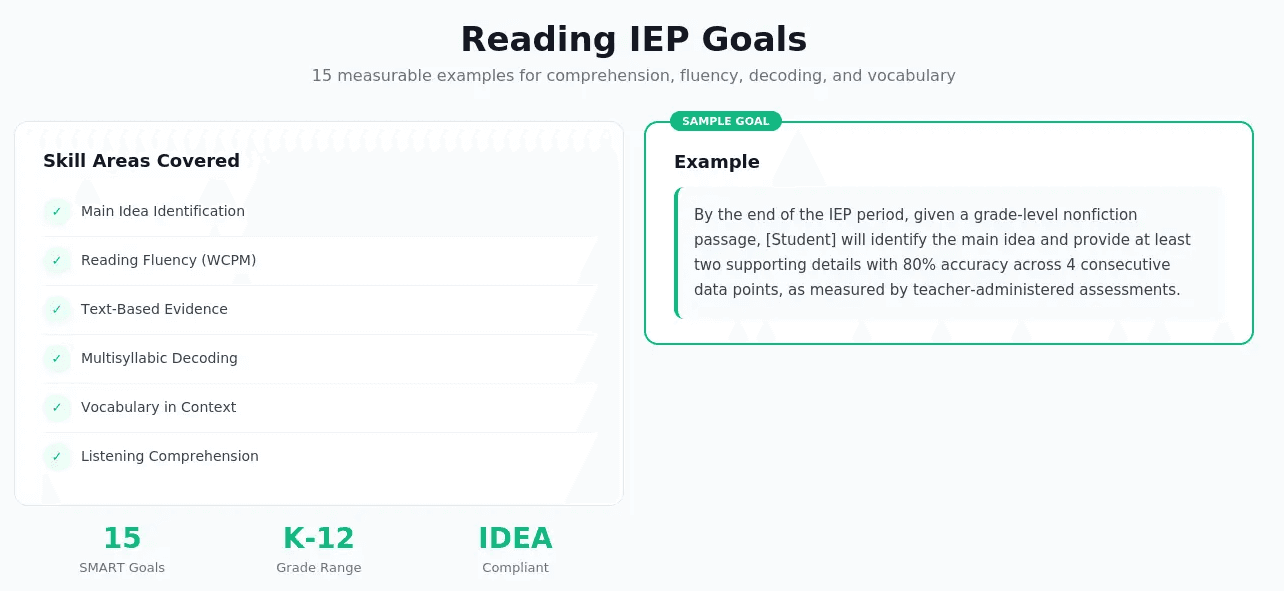
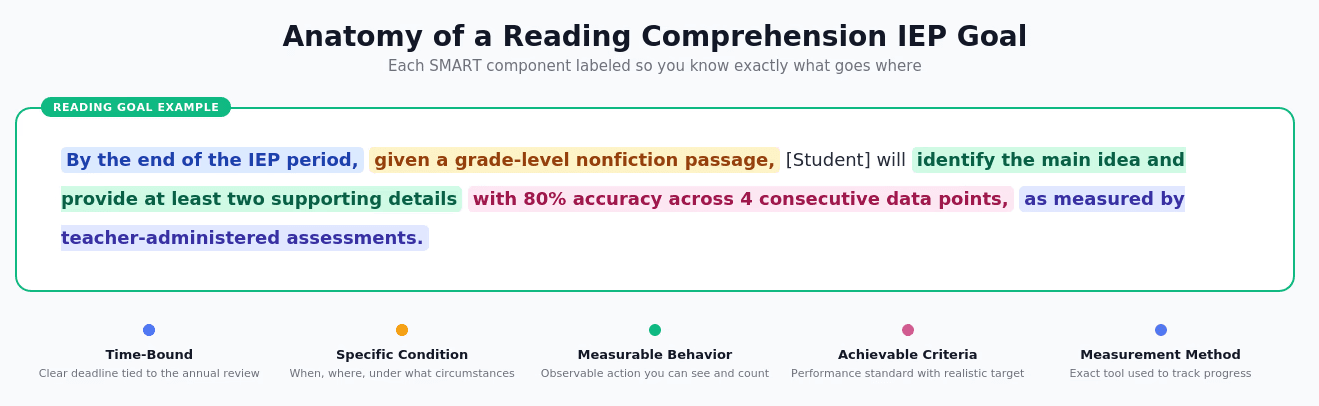
1. Main Idea Identification By the end of the IEP period, given a grade-level nonfiction passage, [Student] will identify the main idea and provide at least two supporting details with 80% accuracy across 4 consecutive data points, as measured by teacher-administered assessments.
2. Text-Based Evidence and Inference By [date], given a grade-level text, [Student] will support inferences with at least two pieces of text-based evidence with 80% accuracy in 3 out of 4 trials, as measured by written response rubric.
3. Retelling Key Story Elements By the end of the school year, after reading or listening to a fiction passage at instructional level, [Student] will retell the story including character, setting, problem, and solution in correct sequence in 4 out of 5 trials, as measured by teacher observation and checklist.
4. Answering Comprehension Questions By [date], given a grade-level passage and a set of literal and inferential questions, [Student] will answer correctly with 75% accuracy across 3 consecutive probes, as measured by curriculum-based assessment.
5. Summarizing Informational Text By the end of the IEP period, [Student] will write a 3-5 sentence summary of a grade-level informational text that includes the topic, key details, and a concluding statement with 80% accuracy in 4 out of 5 opportunities, as measured by written rubric.
Reading Fluency IEP Goals
6. Oral Reading Fluency (Words Correct Per Minute) By [date], [Student] will read a grade-level passage orally at [target] words correct per minute with 95% accuracy, as measured by three consecutive curriculum-based measurement probes.
7. Prosody and Expression By the end of the school year, [Student] will read grade-level prose and poetry orally with appropriate phrasing, expression, and attention to punctuation, scoring at least a 3 out of 4 on the NAEP Oral Reading Fluency Scale in 3 out of 4 trials, as measured by teacher observation.
8. Connected Text Reading By [date], [Student] will read connected text at instructional level with no more than 5 errors per 100 words in 4 out of 5 trials, as measured by running records.
Decoding and Phonics IEP Goals
9. Multisyllabic Word Decoding By the end of the IEP period, given a list of 40 multisyllabic words containing closed, open, vowel-consonant-e, and vowel team syllable types, [Student] will decode at least 36 out of 40 words correctly, as measured by teacher records.
10. Phonemic Awareness (Segmenting and Blending) By [date], [Student] will segment and blend words with up to 5 phonemes with 85% accuracy across 3 consecutive probes, as measured by curriculum-based phonological awareness assessment.
11. CVC and CCVC Word Reading By the end of the school year, given a list of 30 CVC and CCVC words, [Student] will read at least 27 correctly in 4 out of 5 trials, as measured by teacher-administered word reading assessment.
12. Sight Word Recognition By [date], [Student] will read [number] high-frequency sight words from the grade-level list with automaticity (within 3 seconds per word) with 90% accuracy, as measured by timed word reading probes.
Vocabulary IEP Goals
13. Context Clues for Unknown Words By the end of the IEP period, when encountering an unfamiliar word in a grade-level text, [Student] will use context clues to determine the word's meaning with 80% accuracy in 4 out of 5 opportunities, as measured by teacher observation and written response.
14. Academic Vocabulary Acquisition By [date], [Student] will demonstrate understanding of 20 new grade-level academic vocabulary words by correctly using each word in a sentence with 80% accuracy, as measured by vocabulary assessments administered biweekly.
15. Listening Comprehension (for students whose decoding limits text access) By the end of the school year, after listening to a grade-level passage read aloud, [Student] will answer literal and inferential comprehension questions with 80% accuracy in 4 out of 5 trials, as measured by teacher-administered assessment.
How to Customize These Goals for Your Student
Every goal above is a template. Before it goes into an IEP, you need to adjust four things:
Baseline. Replace the criteria with numbers that reflect realistic growth from the student's current performance. If the student currently reads 45 words correct per minute, a goal of 120 is not achievable in one year. Use growth norms for your assessment tool to set a target that is ambitious but realistic.
Grade-level standard. Tie the goal to the specific state standard for the student's enrolled grade, not their instructional level. A 6th grader reading at a 3rd-grade level still needs a goal tied to 6th-grade ELA standards. That is the federal requirement under the 2015 OSERS guidance.
Measurement tool. Specify the exact assessment you will use to measure progress. "Teacher observation" is acceptable for some goals but weak for reading fluency, where curriculum-based measures like DIBELS, AIMSweb, or easyCBM provide more defensible data.
Frequency of measurement. State how often you will collect data. Weekly probes give you enough data points to identify trends. Monthly is the minimum for most reading goals.
If you want the structure handled automatically, Lernico's IEP goal generator produces standards-aligned reading goals with all four components built in. You enter the grade, skill area, and focus, and get a draft in under two minutes. Then you adjust the baseline to match your student.
Progress Monitoring Tips for Reading Goals
Track reading goals using curriculum-based measurement (CBM) probes at least every two weeks. For fluency goals, use timed oral reading probes on passages at the student's goal level (not instructional level). For comprehension goals, use a mix of oral retelling and written response to avoid measuring writing ability instead of comprehension. Chart the data visually so you can spot trends across 4-6 data points rather than reacting to single probes.
Build Your Student's Reading Comprehension IEP Goals Faster
You now have 15 reading comprehension IEP goals covering every major reading skill area. Pick the goals that fit your student's reading profile, adjust the baselines, and tie them to your state's grade-level ELA standards. Or let the tool handle the formatting: generate a reading IEP goal in under 2 minutes.
Frequently asked questions
What are reading comprehension IEP goals?
Reading comprehension IEP goals are specific, measurable objectives that target a student's ability to understand, interpret, and respond to written text. They are part of the student's Individualized Education Program and are required whenever a reading disability affects the student's access to the general education curriculum.
Should reading IEP goals be at grade level or instructional level?
IEP goals must be tied to grade-level state standards, per the 2015 OSERS guidance and the Endrew F. ruling. The goal should point toward the grade-level standard, even if the student is currently performing below grade level. Scaffolding, supports, and short-term objectives help bridge the gap between the student's current level and the grade-level target.
How do I measure progress on reading fluency IEP goals?
Use curriculum-based measurement (CBM) probes. The student reads a grade-level passage aloud for one minute. You record words correct per minute (WCPM) and errors. Common tools include DIBELS, AIMSweb, and easyCBM. Administer probes weekly or biweekly and chart the results to track growth over time.
What if my student cannot decode well enough for comprehension goals?
Write decoding and phonics goals first. Comprehension goals are unreliable when decoding is still fragile because the student's cognitive energy is consumed by word-level processing, leaving nothing for meaning-making. Once decoding reaches a functional level (approximately 95% accuracy on grade-level text), add comprehension goals.
Can AI help write reading IEP goals?
Yes. AI tools can generate a properly formatted SMART goal with standards alignment, measurable criteria, and a progress monitoring plan in seconds. The case manager still needs to adjust the baseline and criteria to match the individual student's data. Lernico's IEP goal generator is built for this workflow.