

Published: · 7 min read
Most explanations of what is in an IEP list the sections on a state's own form. That is useful right up until you change states, at which point the section names change and the reader has no idea which parts were legally required and which were the form designer's preference.
This page works from the federal requirement instead. Seven components at 34 CFR §300.320(a), an eighth at 300.320(b) once the student turns 16 — what each one has to say, who writes it, and the gap that turns up in each.
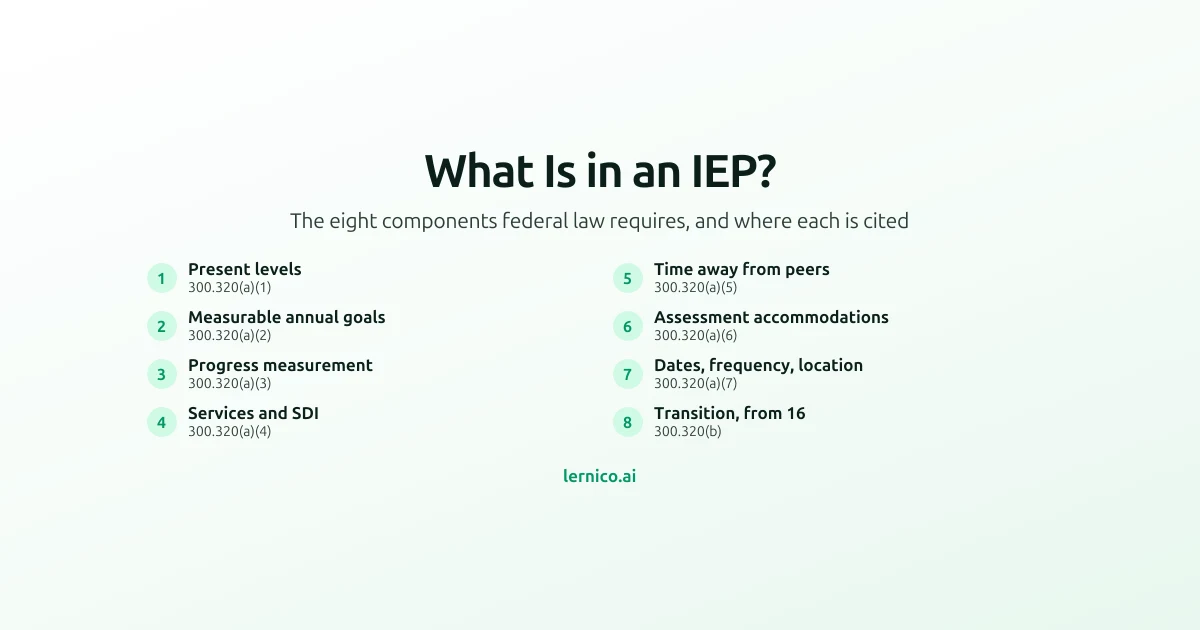
The eight components at a glance
| # | Component | Citation | The usual gap |
|---|---|---|---|
| 1 | Present levels of academic achievement and functional performance | 300.320(a)(1) | Describes the disability, not the performance |
| 2 | Measurable annual goals | 300.320(a)(2) | Not measurable; no baseline behind the number |
| 3 | How progress is measured, and when it is reported | 300.320(a)(3) | "Teacher observation", no schedule |
| 4 | Special education, related services and supplementary aids | 300.320(a)(4) | Minutes without instruction |
| 5 | Explanation of time not spent with nondisabled peers | 300.320(a)(5) | Left blank, or a placement name |
| 6 | Assessment accommodations | 300.320(a)(6) | Copied from instruction, never checked against the test |
| 7 | Projected dates, frequency, location and duration | 300.320(a)(7) | "As needed" |
| 8 | Transition services, from age 16 | 300.320(b) | No age-appropriate transition assessment behind it |
1. Present levels
The statement of present levels of academic achievement and functional performance — PLAAFP in most states, PLOP in some — has to say how the disability affects the student's involvement and progress in the general education curriculum. For preschool children, how it affects participation in appropriate activities.
This is the foundation, and everything after it is supposed to derive from it. A goal that addresses a need not described here has nothing to be measured against. A service justified by a need not described here cannot be justified at all.
The gap: present levels that describe the diagnosis rather than the performance. "Has a specific learning disability in reading" is a category. "Reads 62 words correct per minute on grade-level passages against a class median of 118, and answers 2 of 5 literal comprehension questions after reading independently" is a present level. Only the second one sets a goal. Our PLAAFP guide works through the difference with examples.
2. Measurable annual goals
Academic and functional goals, designed to meet the needs arising from the disability so the student can be involved in and progress in the general curriculum, and to meet each of the student's other educational needs arising from the disability.
Benchmarks or short-term objectives are federally required only for students who take alternate assessments against alternate achievement standards. Many districts write them for everyone anyway, and it is usually a good decision — they are what make a quarterly progress report mean anything.
The gap: goals that cannot be scored the same way by two people. "Will improve reading" has no condition, no criterion and no measurement method. The IEP goal bank has 300 written with all four.
3. How progress is measured and reported
Two distinct requirements in one component: how progress toward each annual goal will be measured, and when periodic reports will go to parents — which must be at least as often as report cards go to parents of nondisabled students.
The gap: "teacher observation" as a measurement method, with no probe and no schedule. It is not wrong so much as empty; nobody can reproduce it, and at the annual review there is nothing to show.
4. Special education, related services and supplementary aids
The statement of what the school will actually provide — special education, related services, supplementary aids and services, and program modifications or supports for school personnel — based on peer-reviewed research to the extent practicable.
Note that last phrase in the regulation: "program modifications or supports for school personnel" means training and support for the adults. It is narrower than the everyday sense of "modification", and the two get conflated constantly.
The gap: a service page of minutes with no description of the instruction. "150 minutes per week of specialised reading instruction" is a quantity a substitute cannot deliver. What belongs here is specially designed instruction — what will be taught, and how.
5. Explanation of time away from nondisabled peers
An explanation of the extent, if any, to which the student will not participate with nondisabled children in the regular class and in extracurricular and nonacademic activities.
The regulation puts the burden in one direction. Inclusion is the default; removal is the thing requiring an explanation. Nobody has to justify keeping a student in the general education classroom.
The gap: a placement name in the box instead of an explanation. "Resource room, 2 periods" says where, not why. What belongs here is the reason the general education classroom would not work with supplementary aids and services — see least restrictive environment.
6. Assessment accommodations
Any individual accommodations necessary to measure the student's academic achievement and functional performance on state and districtwide assessments. If the team decides the student takes an alternate assessment, the IEP must state why the regular assessment is not appropriate and why the particular alternate assessment is.
The gap: accommodations copied from the instructional list without checking them against the assessment's own rules. Some accommodations invalidate some state tests, and finding that out in April is too late. Check the state's accessibility manual at the meeting, not after it.
7. Projected dates, frequency, location and duration
The projected start date for the services in component 4, plus their anticipated frequency, location and duration.
Location is required, and it is the element most often skipped. Its absence makes a service unenforceable and quietly removes the LRE conversation, because a service with no location can be delivered anywhere without anyone appearing to have decided.
The gap: "as needed", "as available", or a start date of "upon parent signature" with no end.
8. Transition services, from age 16
Beginning not later than the first IEP in effect when the student turns 16 — younger if the team decides it is appropriate, and many states set 14 — the IEP must include appropriate measurable postsecondary goals based upon age-appropriate transition assessments related to training, education, employment and, where appropriate, independent living skills; and the transition services, including courses of study, needed to reach them.
The gap: postsecondary goals written without a transition assessment behind them. The regulation names the assessment explicitly, which makes its absence one of the easiest findings a state monitor can make. Transition goals covers what goes in this section.
What is not federally required, but is on your form
State forms carry more than the eight. Most of the extras are good practice, and some are state law — but knowing which is which changes what you can negotiate at a meeting.
- Parent concerns. Considered in the development of the IEP under 300.324, and a required box on most forms.
- Special factors — behavior, limited English proficiency, braille, communication needs, assistive technology. The team must consider these under 300.324(a)(2).
- Extended school year. Determined under 300.106, recorded on the form.
- Placement. A separate decision under 300.116, made after the IEP is written, not before.
- Signatures and meeting participants. Attendance sheets are documentation, not IEP content.
The order the document is written in
The form's order is not the drafting order, and teams that follow the form usually rewrite half of it.
- Present levels first, from data — not from last year's IEP with the dates changed.
- Needs, named explicitly, drawn from those present levels.
- Goals, one to three per need.
- Services and SDI that will meet those goals.
- Placement, last, decided from the services rather than the other way round.
Deciding placement before writing goals inverts the process and is the most common finding in this area, because it makes the IEP fit the program the district already runs.
Writing the parts that take longest
Two of the eight take most of the time: present levels, and the service statement that says what will actually be taught.
Lernico drafts standards-aligned goals from a student's present levels, across all 50 states' standards, and produces the specially designed instruction and accommodations language the general education teacher needs to deliver them. You stay the author of every word.
Book a 15-minute demo and bring a real student profile.
Frequently asked questions
What are the required components of an IEP?
Federal law lists seven at 34 CFR 300.320(a): present levels, measurable annual goals, how progress is measured and reported, the statement of special education and related services, an explanation of any time spent away from nondisabled peers, assessment accommodations, and the projected dates for services. An eighth, transition services, is added at 300.320(b) from the first IEP in effect when the student turns 16.
How long is an IEP?
Length is not regulated and varies enormously by state form — twelve pages is common, thirty is not unusual. Length is a poor proxy for quality. A long IEP with unmeasurable goals and a service page that names minutes but not instruction is weaker than a short one that answers all eight requirements clearly.
Which part of the IEP comes first?
Present levels, and not only because they are listed first. Everything downstream is supposed to derive from them: a goal with no matching need in the present levels has nothing to be measured against, and a service with no need behind it cannot be justified. Teams that draft goals before present levels usually end up rewriting both.
Can parents ask for something to be added to the IEP?
Yes. Parents are members of the IEP team, and the team decides content together. A district is not obliged to agree, but it must consider the request, and if it refuses it must send prior written notice explaining what was refused and why. A refusal with no notice is itself a procedural violation.
What is the difference between the IEP and the evaluation report?
The evaluation establishes whether a student is eligible and describes their functioning. The IEP is the plan that follows from it. They are separate documents on separate cycles — reevaluation is at least every three years, the IEP is reviewed at least annually — and the IEP's present levels should summarise the evaluation rather than repeat it wholesale.
Does the IEP have to say where services happen?
Yes. Location is a required element of the service statement at 300.320(a)(7), alongside frequency and duration. Naming a service without its location is one of the more common findings, because it makes the service unenforceable and quietly forecloses the least restrictive environment discussion.
Related reading
- IEP Goals: 330 SMART Examples Across 15 Skill Areas
- Specially Designed Instruction: 40 SDI Examples by Subject
- IEP Meeting: The 9 Steps and Who Does What
- IEP vs 504: 7 Key Differences and Who Qualifies
- Least Restrictive Environment: The 7 Placement Levels
- Transition IEP Goals: 10 Measurable Examples for Students 14+