

Published: · 6 min read
Early-childhood IEP goals go wrong in a particular way: they are written in the language of development rather than of measurement. "Will improve social skills" and "will develop language" describe a hope. A four-year-old's goal has to say what an adult will count, in a routine that happens anyway.
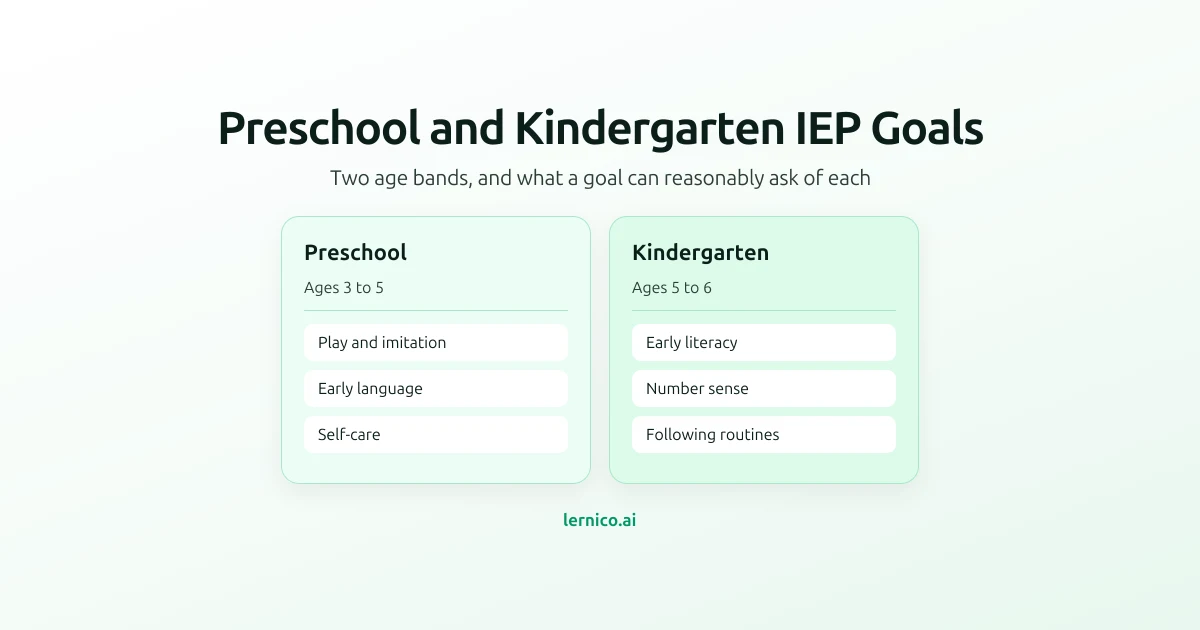
These 24 goals are split by the two bands that behave differently — preschool at three to five, kindergarten at five to six. Each has a condition, a criterion and a measurement method. For goals outside this age range, see the IEP goal bank.
Count routines, not percentages
At this age the usable unit is the routine or the trial: arrival, snack, circle, choice time, dismissal. Those happen every day whether anyone is collecting data or not, which is exactly why they make good denominators.
A goal written as "70% of the morning" cannot be scored the same way twice. The same goal written as "in 4 of 5 arrival routines" can be scored by the paraprofessional, the teacher and the parent, and the numbers will agree.
Preschool IEP goals, ages 3 to 5
Play and social interaction
1. Parallel to associative play. By [date], during choice time, [Student] will play beside a peer using the same materials for 5 continuous minutes in 4 of 5 opportunities, as measured by teacher observation data.
2. Turn-taking. By [date], during a structured game, [Student] will take turns without adult prompting in 4 of 5 opportunities, as measured by teacher observation data.
3. Imitating a peer. By [date], [Student] will imitate a peer's action during a play routine in 8 of 10 opportunities, as measured by teacher-recorded probe data.
Early language and communication
4. Requesting. By [date], [Student] will request a preferred item using a word, sign or device selection in 8 of 10 opportunities across 3 consecutive sessions, as measured by SLP session data.
5. Following a direction. By [date], [Student] will follow a one-step direction during a classroom routine without a gestural prompt in 8 of 10 opportunities, as measured by teacher-recorded probe data.
6. Answering a question. By [date], [Student] will answer "who" and "what" questions about a familiar activity with 80% accuracy across 3 consecutive sessions, as measured by SLP session data.
Pre-academic skills
7. Letter recognition. By [date], given 10 upper-case letters, [Student] will name 8 correctly across 3 consecutive probes, as measured by teacher-recorded probe data.
8. Counting with one-to-one correspondence. By [date], given up to 10 objects, [Student] will count them touching each once and state the total in 4 of 5 opportunities, as measured by teacher-recorded probe data.
9. Sorting and matching. By [date], given a set of objects, [Student] will sort them by a stated attribute with 80% accuracy in 4 of 5 opportunities, as measured by teacher-scored classwork.
Self-care and routines
10. Handwashing. By [date], [Student] will complete a 4-step handwashing routine with no more than one verbal prompt in 4 of 5 opportunities, as measured by a task-analysis data sheet.
11. Outerwear. By [date], [Student] will put on and fasten outerwear independently in 4 of 5 opportunities, as measured by a task-analysis data sheet.
12. Transitioning between activities. By [date], given the classroom signal, [Student] will stop the current activity and move to the next within 2 minutes in 8 of 10 opportunities, as measured by teacher-charted latency data.
Kindergarten IEP goals, ages 5 to 6
Early literacy
13. Letter sounds. By [date], given 26 upper- and lower-case letters in random order, [Student] will produce the corresponding sound for [X] of 26 within one minute across 3 consecutive weekly probes, as measured by curriculum-based measurement.
14. Segmenting phonemes. By [date], given a spoken one-syllable word, [Student] will segment it into its individual sounds in 8 of 10 trials across 3 consecutive sessions, as measured by teacher-recorded probe data.
15. Decoding CVC words. By [date], given a list of 20 CVC words, [Student] will decode 18 correctly across 3 consecutive probes, as measured by curriculum-based measurement.
16. Retelling a story. By [date], after a read-aloud, [Student] will retell the story including character, setting and two events in 4 of 5 opportunities, as measured by a teacher-scored retell rubric.
Number sense
17. Counting to 20. By [date], given a set of up to 20 objects, [Student] will count them and state the total with 90% accuracy across 3 consecutive probes, as measured by curriculum-based measurement.
18. Writing numerals. By [date], [Student] will write the numerals 0 to 20 legibly and in order in 4 of 5 opportunities, as measured by work samples.
19. Comparing quantities. By [date], given two sets of objects, [Student] will state which has more, fewer or the same with 80% accuracy in 4 of 5 opportunities, as measured by teacher-recorded probe data.
20. Addition within 10. By [date], given a one-step addition problem within 10 and manipulatives, [Student] will solve it with 80% accuracy across 3 consecutive probes, as measured by curriculum-based measurement.
Routines, attention and self-regulation
21. Attending to group instruction. By [date], [Student] will remain seated and attending during a 10-minute whole-group lesson in 4 of 5 opportunities, as measured by teacher observation data.
22. Following a classroom routine independently. By [date], given a picture schedule, [Student] will complete a 3-step arrival routine with no more than one prompt in 8 of 10 school days, as measured by a teacher-kept checklist.
23. Using a calming strategy. By [date], when frustrated, [Student] will use a taught calming strategy before escalating in 4 of 5 observed opportunities across 3 consecutive weeks, as measured by teacher observation data.
24. Asking for help. By [date], when [Student] cannot complete a task, they will raise a hand or use the agreed signal in 4 of 5 observed opportunities, as measured by a teacher-kept tally.
How to customize these goals
Use your state's early learning standards, not the kindergarten ones. Most states publish standards for ages three to five. Borrowing kindergarten expectations for a four-year-old produces a goal that looks rigorous and cannot be met, which is the same failure as writing one too low.
Write the goal into a routine that already exists. Data that requires a staff member to set up a special session gets collected in September and abandoned by November. Data attached to arrival, snack and circle gets collected all year.
Name the prompt level. Independent, gestural, verbal and hand-over-hand are four different results. A preschool goal without a prompt hierarchy will be scored generously by one adult and strictly by another.
Expect communication goals to gate the rest. If a child cannot request, the play and pre-academic goals will move slowly regardless of how they are written. The speech and language goals usually come first for a reason.
Plan the kindergarten transition in the preschool IEP. The receiving team needs to know which supports made the difference, not only which goals were met.
Writing early-childhood goals from present levels
Turning developmental screening results, a language sample and a classroom observation into a goal that is measurable, aligned to your state's early learning standards, and defensible a year from now is the slow part.
Lernico generates standards-aligned IEP goals from a student's present levels, and produces the specially designed instruction and accommodations language the general education teacher needs to deliver them. You stay the author of every goal.
Book a 15-minute demo and bring a real student profile.
Frequently asked questions
Do preschoolers have IEPs or IFSPs?
Part C of IDEA covers birth to age three through an IFSP, which is family-centred and written around the household. Part B takes over at three, and from then on it is an IEP with annual goals for the child. Some states allow an IFSP to continue to age five, so the answer can depend on where you are.
What areas do preschool IEP goals usually cover?
Early language and communication, play and social interaction, pre-academic skills such as letters and counting, fine and gross motor, and self-care. Preschool IEPs are more likely than later ones to be dominated by communication and adaptive goals, because those are the skills that gate everything else at that age.
How do you make an early-childhood goal measurable?
Count opportunities, not percentages of a session. At this age the honest unit is the trial or the routine — "in 4 of 5 arrival routines", "in 8 of 10 requesting opportunities" — recorded by the adult who is already in the room. A percentage across an unstructured morning cannot be reproduced by a second observer.
Should preschool IEP goals be aligned to standards?
To your state's early learning standards, which most states publish for ages three to five. They are not the kindergarten standards, and using kindergarten expectations for a four-year-old produces a goal that reads rigorous and is unattainable.
What is the difference between a preschool and a kindergarten IEP goal?
Preschool goals lean toward communication, play and self-care, and they are usually written around routines. Kindergarten goals shift toward the academic starting line — letter sounds, number sense, writing — and toward sustaining attention in a group, because that is what the general education setting now requires.