

Published: · 5 min read
Most IEP goals written for ADHD describe what the student should stop doing. That is understandable and it does not work, because "will reduce off-task behavior" gives a teacher nothing to teach on Monday morning.
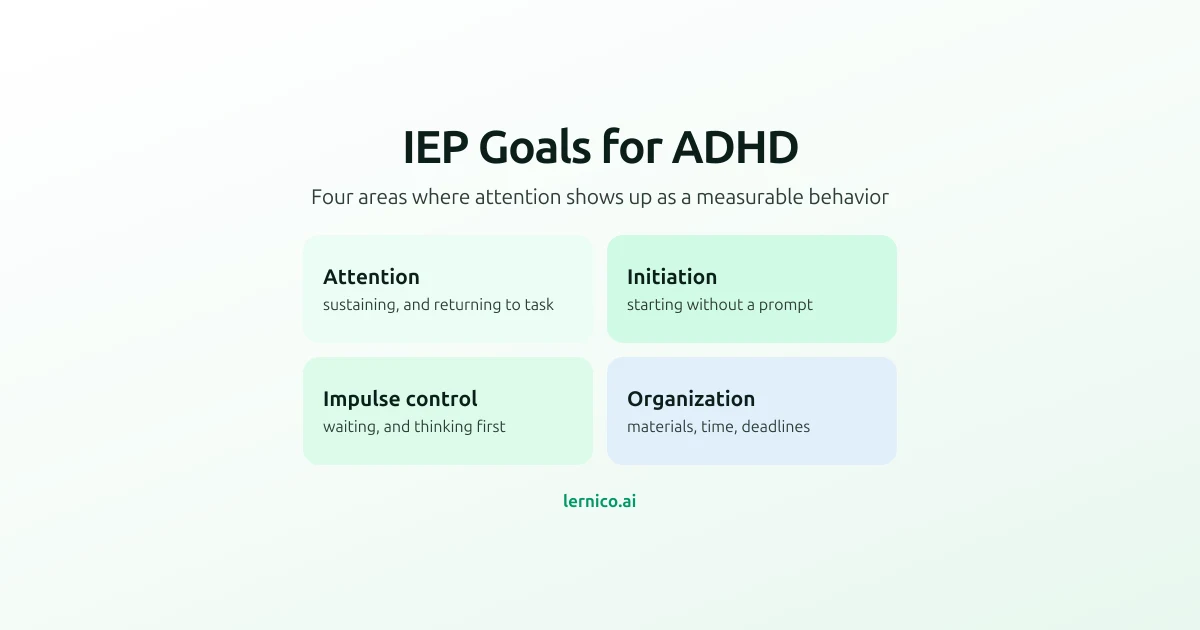
These 20 goals name a skill instead: sustaining attention, starting without a prompt, waiting before acting, keeping track of materials and deadlines. Each has a condition, a criterion and a measurement method. For goals outside this area, see the IEP goal bank.
First, whether it is an IEP at all
ADHD is not one of IDEA's thirteen eligibility categories. A student with ADHD who needs specially designed instruction usually qualifies under Other Health Impairment, and only where the condition adversely affects educational performance.
A great many students with ADHD do not meet that bar and are served under a Section 504 plan instead — accommodations without specialised instruction. If the team's answer to "what will we teach differently?" is "nothing, but he needs more time and a quiet room", that is a 504, and the 504 accommodations list is the more useful page.
The goals below assume the answer was something.
Attention and sustained focus goals
1. Sustaining attention to a task. By [date], during a 20-minute independent work period, [Student] will be on task at 80% of momentary time-sampling checks across 3 consecutive weeks, as measured by interval recording.
2. Returning to task after a distraction. By [date], following a distraction, [Student] will return to the assigned task within 60 seconds without adult redirection in 8 of 10 observed opportunities, as measured by a teacher-kept tally.
3. Attending during group instruction. By [date], [Student] will remain oriented to the speaker and follow along during a 15-minute whole-group lesson in 4 of 5 opportunities, as measured by interval recording.
4. Using a self-monitoring system. By [date], [Student] will self-record on-task behavior at fixed intervals and match the teacher's rating in 4 of 5 sessions, as measured by paired self-monitoring records.
5. Managing the environment. By [date], given a choice of work settings and tools, [Student] will select the one that supports attention for that task and stay in it for the work period, in 4 of 5 opportunities, as measured by teacher observation data.
Task initiation and completion goals
6. Starting on time. By [date], given a direction to begin, [Student] will start the task within 3 minutes without an additional prompt in 8 of 10 opportunities across 3 consecutive weeks, as measured by a teacher-kept latency record.
7. Beginning the posted warm-up. By [date], [Student] will arrive to class and begin the posted warm-up within 3 minutes of the bell in 8 of 10 school days, as measured by a teacher-kept latency record.
8. Finishing what was started. By [date], [Student] will complete an assigned classroom task within the allotted period in 8 of 10 opportunities, as measured by work samples.
9. Breaking down a long task. By [date], given an assignment expected to take more than one period, [Student] will divide it into steps with a target for each session in 3 of 4 opportunities, as measured by work samples.
10. Submitting work. By [date], [Student] will submit completed assignments by the due date in 8 of 10 opportunities across 3 consecutive weeks, as measured by the online gradebook.
Impulse control goals
11. Waiting to be called on. By [date], [Student] will raise a hand and wait to be called on in 8 of 10 opportunities across 3 consecutive weeks, as measured by a teacher-kept frequency chart.
12. Waiting a turn. By [date], during a structured group activity, [Student] will wait their turn without interrupting in 4 of 5 opportunities, as measured by teacher observation data.
13. Checking before submitting. By [date], given a completed assignment, [Student] will check it against a 3-item checklist before submitting in 4 of 5 opportunities, as measured by work samples.
14. Pausing before responding. By [date], when given corrective feedback, [Student] will use a taught pause strategy before responding in 4 of 5 observed opportunities, as measured by teacher observation data.
15. Staying in the assigned area. By [date], [Student] will remain in the assigned area for a 30-minute work period in 4 of 5 opportunities across 3 consecutive weeks, as measured by teacher-charted duration data.
Organization and materials goals
16. Recording assignments. By [date], given an assignment, [Student] will record it with its due date in 8 of 10 opportunities across 3 consecutive weeks, as measured by weekly planner checks.
17. Arriving prepared. By [date], [Student] will arrive at class with the required materials in 8 of 10 observed days across 3 consecutive weeks, as measured by a teacher-kept checklist.
18. Keeping a usable system. By [date], [Student] will maintain an organized binder or digital folder passing a weekly check in 8 of 10 weeks, as measured by a teacher-scored organization rubric.
19. Tracking missing work. By [date], [Student] will check the gradebook weekly and list any missing assignments in 8 of 10 weeks, as measured by a student-kept log reviewed by the case manager.
20. Estimating time. By [date], given a task and a timer, [Student] will estimate how long it will take, then compare that to the actual time, in 4 of 5 opportunities, as measured by a student-kept log.
How to customize these goals
Pick a data method before you pick a number. Momentary time sampling for attention, latency for initiation, frequency for calling out, a checklist for materials. The number in the goal has to be one that method can actually produce — a percentage of a work period cannot come from a frequency count.
Baseline in the setting that is hardest. Attention data collected in a small resource group and applied to a goal about a thirty-student science class produces a target that is met on paper and nowhere else.
Teach the skill; do not only measure it. Every goal here implies specially designed instruction — an explicit strategy, taught, rehearsed and then faded. A goal with no matching instruction is a wish with a percentage attached.
Separate the skill from the accommodation. If the student has extended time, the goal about completing work within the period is either wrong or deliberately about the unaccommodated setting. Say which.
Watch for the executive-function overlap. Most of these goals also sit in the executive functioning area, and there is no need to write both. Pick the framing your team will actually collect data on.
Writing ADHD goals from present levels
Turning a rating scale, two weeks of interval data and a gradebook full of missing assignments into a goal that is measurable and defensible a year from now is the slow part.
Lernico generates standards-aligned IEP goals from a student's present levels, and produces the specially designed instruction and accommodations language the general education teacher needs to deliver them. You stay the author of every goal.
Book a 15-minute demo and bring a real student profile.
Frequently asked questions
Does ADHD qualify a student for an IEP?
Not automatically. ADHD is not one of IDEA's thirteen categories by name; a student usually qualifies under Other Health Impairment, and only if the condition adversely affects educational performance and the student needs specially designed instruction. Many students with ADHD are served through a Section 504 plan instead, which provides accommodations without specialised instruction.
What is the difference between an ADHD IEP goal and a 504 accommodation?
A goal says what the student will learn to do; an accommodation says how the environment changes so they can show what they know. Extended time is an accommodation. Starting a task within three minutes without a prompt is a goal. A plan built only of accommodations teaches nothing, and a plan built only of goals leaves the student without access in the meantime.
How do you measure an attention goal?
With interval recording or latency, not with an impression. Momentary time sampling — checking on-task at fixed intervals through a work period — is the standard classroom method and needs only a timer and a tally. Latency, the seconds between the direction and the start, is the better measure for task initiation.
Should ADHD goals be behavior goals?
Some are, but framing every ADHD goal as behavior misses what the student needs. Attention, initiation and organization are executive-function skills that can be taught, and a goal written as "will stop being disruptive" tells nobody what to teach. Write the replacement skill.
Can medication be part of an IEP goal?
No. Schools cannot require medication as a condition of attendance or services, and a goal cannot depend on it. Write the goal against the behavior in the setting, and let the data reflect whatever the student's medical care actually is.
Related reading
- IEP Goals: 330 SMART Examples Across 15 Skill Areas
- IEP Goal Bank: 300 Measurable Goals by Skill Area and Grade
- Executive Functioning IEP Goals: 10 Measurable Examples
- Behavior IEP Goals: 12 Measurable Examples for K-12
- IEP vs 504: 7 Key Differences and Who Qualifies
- 504 Accommodations: 60 Examples by Need and Setting