

Published: · Updated: · 9 min read
Your student can memorize math facts but falls apart on word problems. Or they understand the concept when you explain it but cannot remember the procedure independently the next day. Math IEP goals need to separate what is breaking down: is it number sense, procedural fluency, word problem comprehension, or the ability to apply math in real-world contexts? These 52 math IEP goals cover the skill areas that show up most often in K-12 special education, from basic computation through multi-step problem solving to functional math for daily living. Writing goals in other areas as well? Every skill area is covered in the full IEP goals guide.
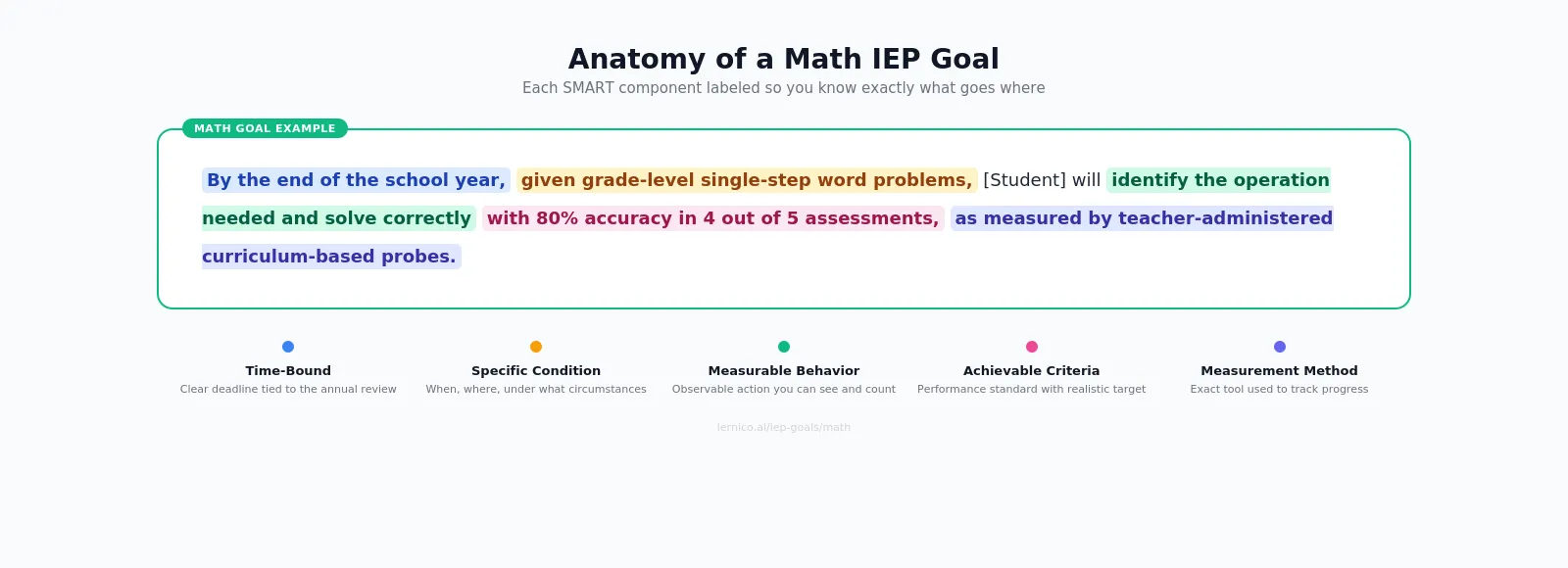
Every goal below follows the same structure, because that is what makes a goal measurable and defensible: condition, observable behavior, criterion, and measurement method. Swap the student's name, adjust the numbers to their present levels, and keep the structure.
A goal without a condition ("when given a calculator", "using a number line") and without a measurement method ("as measured by curriculum-based probes") is not measurable, and it is the most common finding in a compliance review.
Computation
Grades K–2
- By [date], when given 10 single-digit addition problems with sums to 10, [Student] will solve them with 80% accuracy across 3 consecutive weekly probes, as measured by curriculum-based measurement.
- By [date], when given 10 subtraction problems within 10 using manipulatives, [Student] will solve them with 80% accuracy across 3 consecutive sessions, as measured by work samples.
- By [date], given a two-digit addition problem without regrouping, [Student] will solve it correctly in 4 of 5 opportunities across 3 consecutive weeks, as measured by teacher-charted data.
- By [date], when presented with 20 addition facts to 20, [Student] will write the correct sum for 16 of 20 within 3 minutes across 3 consecutive probes.
Grades 3–5
- By [date], given 10 multi-digit addition problems requiring regrouping, [Student] will solve them with 80% accuracy across 3 consecutive weekly probes.
- By [date], given 10 subtraction problems with regrouping across zeros, [Student] will solve them with 80% accuracy in 3 of 4 consecutive sessions.
- By [date], when given single-digit multiplication problems, [Student] will solve 18 of 20 correctly within 4 minutes across 3 consecutive probes.
- By [date], given a two-digit by one-digit multiplication problem, [Student] will apply the standard algorithm correctly in 4 of 5 opportunities across 3 consecutive weeks.
- By [date], given a three-digit by one-digit division problem with no remainder, [Student] will solve it correctly in 4 of 5 trials across 3 consecutive sessions.
- By [date], when given 10 problems involving order of operations with two operations, [Student] will solve them with 80% accuracy across 3 consecutive probes.
Grades 6–8
- By [date], given 10 problems requiring operations with integers, [Student] will solve them with 80% accuracy across 3 consecutive weekly probes.
- By [date], given 10 problems involving decimal addition and subtraction to the hundredths place, [Student] will solve them with 85% accuracy in 3 of 4 consecutive sessions.
- By [date], given a percent problem in context, [Student] will calculate the correct answer in 4 of 5 opportunities across 3 consecutive weeks.
Number sense
- By [date], when given a set of objects up to 20, [Student] will count them accurately using one-to-one correspondence in 4 of 5 trials across 3 consecutive sessions.
- By [date], given two numbers within 100, [Student] will identify which is greater using the symbols >, < or = with 80% accuracy across 3 consecutive probes.
- By [date], given a three-digit number, [Student] will identify the value of each digit by place with 80% accuracy in 4 of 5 opportunities.
- By [date], when given a number within 1,000, [Student] will round it to the nearest ten and hundred with 80% accuracy across 3 consecutive weekly probes.
- By [date], given a number line marked in intervals, [Student] will place a given number in the correct position in 4 of 5 trials across 3 consecutive sessions.
- By [date], given a set of five numbers including fractions and decimals, [Student] will order them from least to greatest with 80% accuracy across 3 consecutive probes.
- By [date], when asked to skip count by 2s, 5s and 10s to 100, [Student] will do so accurately in 4 of 5 opportunities across 3 consecutive sessions.
- By [date], given a quantity, [Student] will estimate whether a stated answer is reasonable and explain why in 4 of 5 opportunities, as measured by a teacher-scored rubric.
Math fluency
- By [date], when given a one-minute addition fact probe, [Student] will answer 20 digits correct per minute across 3 consecutive probes, as measured by curriculum-based measurement.
- By [date], when given a one-minute subtraction fact probe, [Student] will answer 20 digits correct per minute across 3 consecutive probes.
- By [date], when given a one-minute mixed multiplication probe covering facts 0–12, [Student] will answer 30 digits correct per minute across 3 consecutive probes.
- By [date], given division facts through 12, [Student] will answer 25 digits correct per minute across 3 consecutive one-minute probes.
- By [date], given 20 mixed-operation fact problems, [Student] will identify the correct operation and solve with 85% accuracy within 5 minutes across 3 consecutive sessions.
Problem solving
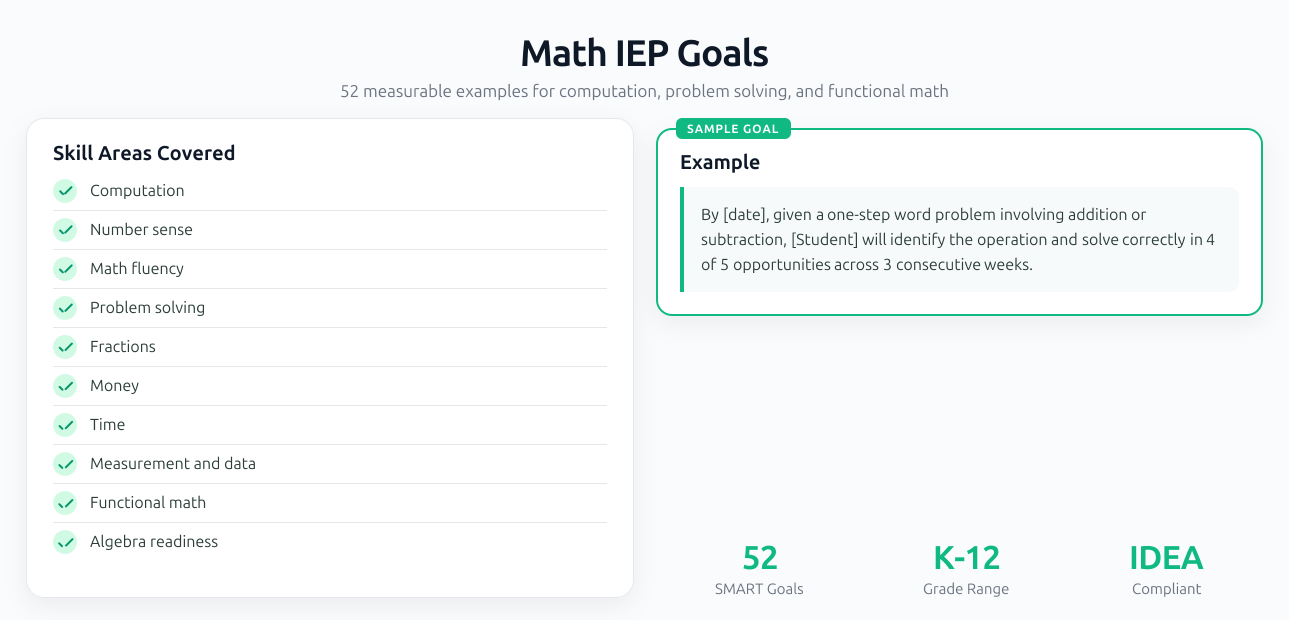
- By [date], given a one-step word problem involving addition or subtraction, [Student] will identify the operation and solve correctly in 4 of 5 opportunities across 3 consecutive weeks.
- By [date], given a two-step word problem, [Student] will show both steps and arrive at the correct answer with 80% accuracy across 3 consecutive weekly probes.
- By [date], given a word problem containing extraneous information, [Student] will identify the relevant information and solve correctly in 4 of 5 trials.
- By [date], given a multi-step problem, [Student] will use a visual model (bar model, number line, or drawing) to represent it before solving in 4 of 5 opportunities, as measured by work samples.
- By [date], after solving a word problem, [Student] will explain the strategy used in one or two sentences in 4 of 5 opportunities, as measured by a teacher-scored rubric.
- By [date], given a word problem with an unreasonable answer, [Student] will identify that the answer is unreasonable and explain why in 3 of 4 opportunities.
Fractions
- By [date], given a visual model, [Student] will identify the fraction represented with 80% accuracy across 3 consecutive probes.
- By [date], given two fractions with unlike denominators, [Student] will compare them using >, < or = with 80% accuracy in 3 of 4 consecutive sessions.
- By [date], given 10 problems adding fractions with like denominators, [Student] will solve them with 85% accuracy across 3 consecutive weekly probes.
- By [date], given a fraction, [Student] will convert it to a decimal and a percent with 80% accuracy in 4 of 5 opportunities.
- By [date], given a real-world problem involving fractions, [Student] will solve it correctly in 3 of 4 opportunities across 3 consecutive weeks.
Money
- By [date], given a set of coins and bills, [Student] will identify each by name and value with 90% accuracy across 3 consecutive sessions.
- By [date], given a group of mixed coins totaling under $1.00, [Student] will count the total with 80% accuracy in 4 of 5 trials.
- By [date], given a purchase price under $20 and a $20 bill, [Student] will calculate the correct change in 4 of 5 opportunities across 3 consecutive weeks.
- By [date], given a menu and a budget, [Student] will select items totaling at or below the budget in 4 of 5 opportunities, as measured by work samples.
- By [date], given a simulated paycheck and a list of expenses, [Student] will determine whether income covers expenses in 3 of 4 opportunities.
Time
- By [date], given an analog clock, [Student] will tell time to the nearest five minutes with 80% accuracy across 3 consecutive sessions.
- By [date], given a start time and a duration, [Student] will determine the end time with 80% accuracy in 4 of 5 opportunities.
- By [date], given a daily schedule, [Student] will identify what activity occurs at a stated time in 4 of 5 trials across 3 consecutive weeks.
Measurement and data
- By [date], given a ruler, [Student] will measure objects to the nearest quarter inch with 80% accuracy in 4 of 5 opportunities.
- By [date], given a bar graph or pictograph, [Student] will answer three comprehension questions about the data with 80% accuracy across 3 consecutive sessions.
- By [date], given a set of data, [Student] will calculate the mean and identify the range with 80% accuracy in 3 of 4 opportunities.
Functional math
- By [date], given a recipe requiring doubling, [Student] will calculate the adjusted quantities for four of five ingredients across 3 consecutive opportunities.
- By [date], given a store advertisement showing a percentage discount, [Student] will calculate the sale price with 80% accuracy in 4 of 5 opportunities, as measured by work samples.
Algebra readiness
- By [date], given a one-step equation with whole numbers, [Student] will solve for the variable with 80% accuracy across 3 consecutive weekly probes.
- By [date], given a pattern of numbers or shapes, [Student] will identify the rule and extend the pattern correctly in 4 of 5 opportunities.
How to adapt these to your student
A goal is only measurable if the baseline is real. Pull the student's current performance from curriculum-based measurement, a recent evaluation, or three weeks of work samples before setting the criterion — a goal written to "80% accuracy" when the student is at 15% is not ambitious, it is unattainable, and Endrew F. requires progress appropriate in light of the child's circumstances, not a number copied from a bank.
Three checks before the goal goes in the IEP:
- Condition. What is given, and under what support? "With a calculator" and "using a number line" change the goal entirely.
- Criterion. How well, how often, and across how many opportunities. "80% accuracy" alone is not a criterion — 80% across how many trials, over what period?
- Measurement method. Who collects the data, how, and how often. If nobody can say how it will be measured, it will not be measured.
Generate a math IEP goal with standards alignment and measurement criteria in under two minutes.
Build Math IEP Goals That Target the Real Breakdown
You now have 52 math IEP goals covering computation, problem solving, number sense, and functional math. Pick the goals that match your student's assessment data, adjust baselines and targets, and tie them to grade-level standards. Or generate a math IEP goal in under 2 minutes.
Frequently asked questions
How many math IEP goals should a student have?
Most students have one to three goals per area of need. IDEA requires goals to address needs arising from the disability that affect involvement in the general curriculum — not every skill deficit. More goals mean more progress monitoring, and goals nobody tracks are a compliance risk.
What makes a math IEP goal measurable?
Four parts: the condition under which the skill is performed, an observable behavior, a criterion for mastery, and a stated measurement method. If two people reading the goal would collect data differently, it is not measurable.
Can I copy IEP goals from a goal bank?
Use a bank for the structure and the skill wording, then set the criterion from the student's actual baseline. A goal copied whole, including its numbers, is the pattern Endrew F. v. Douglas County addressed — an IEP must be reasonably calculated to enable progress appropriate to the individual child.
How often should math IEP goals be progress monitored?
Whatever interval the IEP states, and it must be at least as often as report cards go to parents of non-disabled students. For math computation and fluency goals, weekly or biweekly curriculum-based probes are common because they produce a trend line early enough to change course.
What are math IEP goals?
Math IEP goals are measurable objectives that target a student's specific math skill deficits, from basic computation through problem solving to functional math applications. They are required when a student's disability affects their ability to meet grade-level math standards. The National Council of Teachers of Mathematics provides the standards frameworks that most state math standards are built on.
How do I choose between computation goals and problem-solving goals?
Start with diagnostic assessment data. If the student lacks procedural fluency (cannot compute accurately or quickly enough), prioritize computation goals first. If computation is adequate but the student cannot apply skills to word problems, prioritize problem-solving goals. Many students need both.
What are functional math IEP goals?
Functional math goals target real-world math applications: counting money, making change, reading a clock, measuring ingredients, understanding a pay stub. They are most common for students with intellectual disabilities or significant learning disabilities who need math skills for daily living and future employment.
Can AI help write math IEP goals?
Yes. Lernico's IEP goal generator drafts standards-aligned math goals with built-in criteria, measurement tools, and suggested accommodations in under two minutes. Adjust the baseline and target to match your student's data.