

Published: · Updated: · 8 min read
You are running the meeting, six people are in the room, one of them is upset, and the document has to be legally defensible when it is finished. This is the sequence that keeps an IEP meeting on track: nine steps in order, who is required to be there, what to have ready, and the mistakes that turn a routine annual review into a dispute.
What happens at an IEP meeting?
An IEP team reviews the student's present levels, decides whether the current goals and services are working, and writes the plan for the coming year. The meeting produces a legal document specifying measurable annual goals, the special education and related services the district will provide, and how progress will be measured and reported.
It is a decision-making meeting, not a presentation. Everything in the document is meant to be arrived at by the team, including the parents, during the meeting itself.
What the meeting has to produce is fixed by federal law rather than by your district's form — the eight required IEP components covers what each one must say, which is worth knowing before you are asked to sign one.
Who must attend
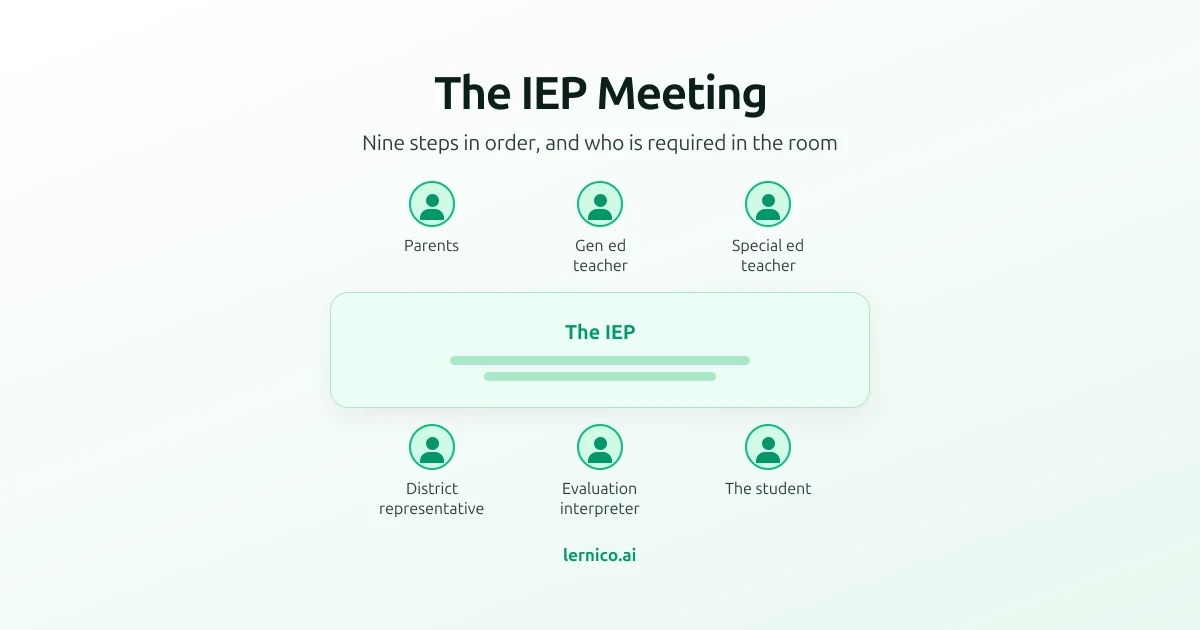
IDEA specifies the team in statute (34 CFR 300.321). The required members are:
- The parents
- At least one general education teacher, if the student is or may be participating in the general education environment
- At least one special education teacher or special education provider
- A district representative qualified to provide or supervise special education, knowledgeable about the general curriculum and about the availability of district resources
- Someone who can interpret the instructional implications of evaluation results — this can be one of the people already listed
- The student, whenever appropriate, and always when transition services are being discussed
Parents may bring anyone with knowledge or special expertise about the child, including an advocate or an outside evaluator. They do not need permission and are not required to give advance notice, though most do.
The district representative matters more than people expect. This is the person who can commit resources. If nobody in the room can say yes to a service, the meeting cannot make a decision and will have to be reconvened.
The 9 steps
1. Introductions and purpose. Names, roles, and why the team is meeting — annual review, reevaluation, or an amendment. State the purpose out loud; it frames everything that follows.
2. Procedural safeguards. Confirm the parents received the notice and ask whether they have questions about it. This is a requirement, not a formality.
3. Present levels of academic achievement and functional performance. The PLAAFP. Current data on where the student is, including how the disability affects involvement and progress in the general education curriculum. Everything downstream is built on this section, and a weak PLAAFP is the root of most weak IEPs.
4. Progress on current goals. Goal by goal, with data. State plainly which goals were met, which were not, and what the trend line showed. A goal that was not met is information, not a failure to be managed.
5. Parent and student input. Ask directly, and leave silence for the answer. Their concerns must be considered in developing the IEP, and this is the point in the meeting where that happens.
6. New annual goals. Measurable, tied to the needs identified in the PLAAFP, with the method and schedule for reporting progress. One to three per area of need is typical.
7. Services, accommodations and supports. Special education services, related services, supplementary aids, program modifications, and supports for school personnel — each with frequency, location and duration.
8. Placement and least restrictive environment. The extent to which the student will participate with non-disabled peers, and a justification for any removal. Placement is decided after goals and services, never before.
9. Meeting close. Summarise decisions, note any disagreements in the record, confirm what happens next and by when, and give the parents a copy of the IEP.
What to prepare
Bring data, not conclusions. The team writes the IEP; you arrive with the evidence.
- Progress-monitoring data on every current goal, charted where possible. A trend line makes a five-minute conversation out of a twenty-minute one.
- Current work samples across settings.
- Input from every general education teacher who works with the student, collected in advance. A gen-ed teacher who is hearing the goals for the first time in the meeting cannot contribute to them.
- Draft goals marked as drafts. Bringing a draft is allowed and sensible. Presenting a finished IEP is predetermination, and it is a procedural violation.
- Evaluation results with someone present who can interpret them.
- The prior IEP, so the team can see what changed and why.
Excusing a team member
A required member may be excused only if the parent agrees in writing, and if the member's area is being discussed they must submit written input beforehand (34 CFR 300.321(e)).
Verbal agreement in the doorway is not consent. This is one of the most common procedural findings, and it is entirely avoidable.
The agenda, and how long each part takes
A meeting that runs to an agenda finishes. One that does not spends forty minutes on present levels and rushes placement, which is the decision with the most consequences.
| # | Agenda item | Typical time | Who leads |
|---|---|---|---|
| 1 | Introductions and purpose | 3 min | Chair |
| 2 | Parent concerns, taken first | 5 min | Parent |
| 3 | Evaluation results, if this is an eligibility meeting | 10 min | Evaluator |
| 4 | Present levels, by area | 12 min | Each provider |
| 5 | Needs, named explicitly | 5 min | Chair |
| 6 | Goals, one to three per need | 15 min | Case manager |
| 7 | Services and SDI, with frequency, location, duration | 10 min | Case manager |
| 8 | Accommodations, and assessment accommodations | 5 min | Team |
| 9 | Placement and LRE, decided last | 8 min | Team |
| 10 | Next steps, dates, who does what | 4 min | Chair |
Taking parent concerns second, before any data is presented, changes the meeting. It stops the parent spending the first hour waiting for a turn, and it tells the team which parts of the draft are going to be contested.
A pre-meeting checklist
Run this the week before. Every item on it is something that, missing, either derails the meeting or invalidates it.
Ten days out
- Notice sent, stating purpose, time, location and who will attend
- Parent asked whether they want anyone else present, and whether an interpreter is needed
- Evaluation report, if any, complete and shared
Three days out
- Draft present levels written from current data, not last year's document
- Draft goals matched to a named need in those present levels
- Service page drafted with frequency, location and duration filled in
- Each provider has contributed their own area in writing
- Draft sent to the parent — a draft is not a decision, and sharing it early shortens the meeting
The day before
- Required members confirmed; any excusal has written parental consent in hand
- Assessment accommodations checked against the state's accessibility manual
- Room booked with enough chairs, and a screen if anyone is joining remotely
- Blank data available for anything the team may need to look up live
In the room
- Someone assigned to take notes who is not the chair
- Parent given the procedural safeguards notice
- Placement discussed after goals and services, not before
- Every decision recorded with who is responsible and by when
Common mistakes
Predetermination. Arriving with completed goals and services and walking the parents through them. Drafts are fine; decisions made before the meeting are not.
A PLAAFP with no data. "Struggles with reading comprehension" is not a present level. A present level says where the student is, measurably, and how the disability affects access to the general curriculum.
Goals copied forward. Repeating last year's goals with the date changed is the pattern Endrew F. v. Douglas County School District addressed — an IEP must be reasonably calculated to enable a child to make progress appropriate in light of the child's circumstances.
Deciding placement first. Placement follows goals and services. Starting from the available program and writing goals to fit it inverts the process.
Losing the general education teacher. They deliver most of the accommodations. If they are silent through the meeting, the accommodations will be silent in the classroom.
No record of disagreement. If the parents disagree, write it down. An unrecorded disagreement resurfaces as a due process complaint.
Deadlines to know
- Annual review. The IEP must be reviewed at least once a year (34 CFR 300.324(b)).
- Reevaluation. At least once every three years, unless the parent and district agree it is unnecessary — and not more than once a year unless both agree (34 CFR 300.303).
- Initial evaluation. Within 60 days of receiving parental consent, unless the state has established a different timeframe (34 CFR 300.301). Check your state — many set a shorter clock.
- Meeting notice. Parents must be notified early enough to attend, at a mutually agreed time and place (34 CFR 300.322).
- Transition services. Must be in effect by the first IEP that will be in effect when the student turns 16, or younger if the state requires it (34 CFR 300.320(b)).
Does a student qualify for an IEP?
IDEA eligibility is a two-part test: the student must have a disability in one of 13 categories and, by reason of it, need special education and related services. A diagnosis alone does not qualify a student — if accommodations are sufficient and no specially designed instruction is needed, the student is typically served under Section 504 instead.
The full test, the 13 categories, and how the two paths differ: IEP vs 504: 7 key differences and who qualifies.
The part that takes the longest
Most of the work in an IEP meeting happens before it. Turning present levels, evaluation data and last year's progress into goals that are measurable, aligned to your state's standards, and defensible twelve months from now is the slow part — and it is the part that decides whether the meeting goes well.
Lernico generates standards-aligned IEP goals from a student's present levels across all 50 states' standards, produces the specially designed instruction and accommodations language the general education teacher needs, and creates a plain-language summary parents can read before they walk in.
Book a 15-minute demo and bring a real student profile.
Frequently asked questions
How long does an IEP meeting take?
An annual review typically runs 45 to 90 minutes. Initial eligibility meetings and reevaluations take longer. If the team cannot finish, it is better to reconvene than to rush placement decisions — and the meeting can be continued rather than concluded.
Can parents bring someone to an IEP meeting?
Yes. IDEA permits parents to include any individual with knowledge or special expertise about the child, including an advocate, attorney, outside evaluator, or family member. No permission or advance notice is required, though notice is a courtesy that helps the team prepare.
Can a teacher be excused from an IEP meeting?
Only with the parent's written agreement. If the excused member's area of the curriculum or services is being discussed, they must also provide written input to the team beforehand. Verbal agreement is not sufficient and is a common procedural finding.
What if parents disagree with the IEP?
Record the disagreement in the meeting notes. Parents can request mediation, file a state complaint, or request a due process hearing. They may also consent to parts of the IEP while disputing others. Documenting the disagreement accurately protects both the student and the district.
Should a student attend their own IEP meeting?
Whenever appropriate, and always when transition services are discussed. Students who attend and speak about their own goals practise the self-advocacy they will need after the IEP ends — protections under Section 504 continue into college, but the IEP does not.
How long does an IEP meeting take?
An annual review commonly runs 60 to 90 minutes; an initial eligibility meeting runs longer because the evaluation has to be presented and discussed. Meetings that overrun usually do so because placement was left until the clock had gone, which is the decision that most deserves the time.
Can I bring someone to my child's IEP meeting?
Yes. Parents may bring anyone with knowledge or special expertise about the child, including an advocate or an attorney. Districts often ask for notice as a courtesy, and some states require it if an attorney will attend. Nobody needs the district's permission.
What should the team do first in the meeting?
After introductions, take parent concerns — before any data is presented. It stops the parent waiting an hour for a turn, and it tells the team immediately which parts of the draft will be contested, which is the most useful thing anyone can know at minute five.