

Published: · 6 min read
Four different things get called differentiation, and only one of them is. The confusion matters, because two of the other three are legal obligations with different requirements — and a teacher who thinks they are differentiating when they are actually modifying has changed what a student is expected to learn without a team decision. This covers the distinction, then 30 strategies organized by what they actually change.
What is differentiated instruction?
Differentiated instruction is adjusting how a lesson is taught so that students at different readiness levels, interests, and learning profiles can all access the same learning goal. The goal stays fixed. The route to it varies.
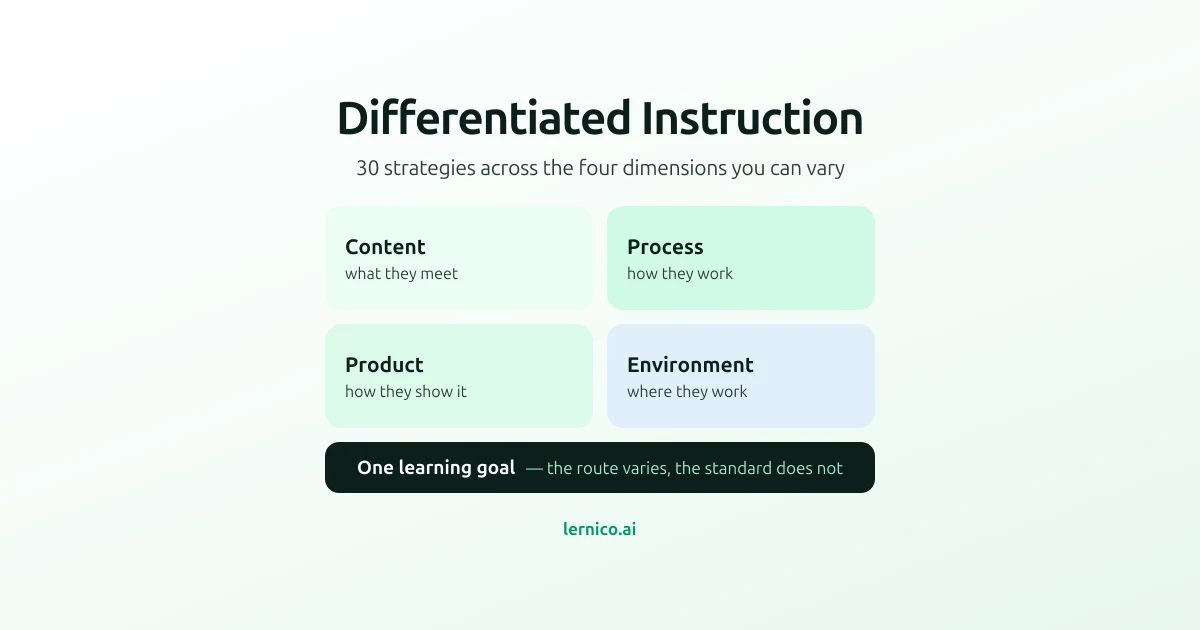
The standard framework distinguishes four things a teacher can vary: content (what students engage with), process (how they work with it), product (how they show what they know), and learning environment (the conditions they work in). Every strategy below fits one of those four.
The four things people conflate
This is the part that matters most in a special education context, and the part generic guidance skips.
Differentiation is good instruction for every student. It is not disability-specific, not written into any plan, and not legally required. A teacher differentiates because a class of 28 contains 28 readiness levels.
Accommodation changes how a student accesses instruction or demonstrates learning. The standard and the expectation stay identical. Extended time, text-to-speech, a separate testing room. Accommodations are documented in an IEP or a 504 plan and the school is obligated to provide them.
Modification changes what a student is expected to learn — fewer problems assessing the same skill is an accommodation; a lower-grade-level standard is a modification. This is a team decision recorded in the IEP, and it has consequences for grading and sometimes for diploma track. A teacher cannot make this call alone.
Specially designed instruction (SDI) is the IDEA term, defined at 34 CFR 300.39(b)(3) as adapting the content, methodology, or delivery of instruction to address needs arising from the child's disability and to ensure access to the general curriculum. SDI is what makes special education special education rather than extra help — and it is delivered by or under the direction of a qualified provider. If that is the row you are actually trying to fill in, 40 SDI examples by subject sets out what adapting content, methodology and delivery looks like in practice, and where it belongs in the IEP.
The practical test:
| If you are changing… | It is… | Who decides |
|---|---|---|
| How the lesson is taught, for everyone | Differentiation | The teacher |
| How one student accesses or responds | Accommodation | The IEP or 504 team |
| What one student is expected to learn | Modification | The IEP team |
| Content, methodology or delivery for a disability-related need | SDI | The IEP team |
A teacher who quietly gives one student easier work has not differentiated. They have modified, without a team decision, and the student's IEP no longer describes what is happening. The middle two rows are the pair that gets confused most often, and accommodations vs modifications works through twenty needs handled each way.
Content strategies
Varying what students engage with, while the learning goal stays the same.
- Provide the same text at multiple readability levels
- Offer an audio version alongside the print text
- Pre-teach vocabulary to students who need it before the whole-class lesson
- Supply a summary or abstract for students who need the gist before the detail
- Use visual and graphic representations of the same concept
- Provide anchor texts at different complexity levels for the same topic
- Curate a short menu of source materials and let students choose
- Front-load background knowledge for students without it
- Highlight or annotate key passages in advance for some students
Process strategies
Varying how students work with the material.
- Flexible grouping that changes by task, not fixed ability groups
- Tiered activities at three levels of complexity toward one goal
- Learning stations rotating through modes of engagement
- Think-pair-share before whole-class discussion
- Graphic organizers matched to the thinking required
- Structured choice of practice format
- Scaffolded questioning that starts where the student is
- Vary pacing — extension tasks for some, more guided practice for others
- Model the thinking aloud, then release responsibility gradually
- Provide worked examples for students who need to see the process first
- Allow collaborative or independent work on the same task
Product strategies
Varying how students demonstrate learning.
- Offer alternative formats — written, oral, visual, recorded, built
- Provide a rubric with every option so the standard is visibly the same
- Let students propose their own format against the rubric
- Vary length rather than depth where the skill assessed is not writing
- Use portfolios to show growth alongside single-point assessment
- Allow revision and resubmission against the rubric
Learning environment strategies
Varying the conditions students work in.
- Flexible seating with quiet and collaborative zones
- Predictable routines with visual schedules posted
- Noise-reducing headphones available to anyone
- A designated low-stimulation workspace available without asking aloud
Tiered instruction
Tiered instruction is the most misused strategy on this list. Done properly, all tiers work toward the same learning goal and differ in complexity, support, or abstraction. Done badly, the bottom tier is a different, easier goal — which is a modification, not differentiation.
A working test: if you removed the tier labels, could you assess all three tiers against the same standard? If not, the tiers are not tiers.
Tiered instruction is also distinct from RTI/MTSS tiers, which describe levels of intervention intensity across a school rather than levels within a single lesson. The shared word causes real confusion in meetings.
Differentiated reading instruction
Reading is where differentiation and SDI overlap most, and where the distinction is easiest to lose.
Differentiating reading means varying text complexity, pre-teaching vocabulary, providing audio, and grouping flexibly by current skill rather than by fixed level. All of that is available to any student.
A student with a specific learning disability in reading needs something different. Structured, explicit, systematic instruction in the underlying skill — phonological awareness, decoding, fluency — delivered by a qualified provider, is specially designed instruction. Giving that student an easier text differentiates the lesson but does not address the disability.
Both can be true at once: differentiate the class lesson, and deliver SDI for the disability-related need.
Planning it without doubling the work
Three things make differentiation sustainable rather than aspirational:
- Differentiate one dimension at a time. Varying content, process, product and environment in the same lesson produces four lessons and no planning time.
- Design from the goal backward. Write the learning goal first, then the routes. Starting from activities produces variety without alignment.
- Write down which students get which route and why. For students with IEPs, that record is also evidence that accommodations were delivered.
For students with IEPs, the accommodations and SDI in the plan are not optional additions to differentiation — they are obligations, and they should be visible in the lesson plan rather than remembered in the moment.
Lernico produces the specially designed instruction and accommodations language a general education teacher needs to deliver an IEP goal in the classroom, alongside the goal itself, so the plan and the lesson describe the same thing.
Book a 15-minute demo and bring a real student profile.
Frequently asked questions
What are the four types of differentiated instruction?
Content, process, product, and learning environment. Content is what students engage with, process is how they work with it, product is how they demonstrate learning, and environment is the conditions they work in. The learning goal stays constant across all four — only the route varies.
What is the difference between differentiation and accommodation?
Differentiation is instructional practice available to every student and decided by the teacher. An accommodation is documented in an IEP or 504 plan, changes how one student accesses instruction or demonstrates learning without changing the standard, and the school is legally obligated to provide it.
Is differentiation the same as specially designed instruction?
No. SDI is defined in IDEA as adapting the content, methodology, or delivery of instruction to address needs arising from a child's disability. It is decided by the IEP team and delivered by or under the direction of a qualified provider. Differentiation is general good teaching and carries no legal obligation.
What is tiered instruction?
Tasks at different levels of complexity or support, all working toward the same learning goal. If the tiers assess different standards, they are modifications rather than tiers. Note that lesson-level tiers are distinct from RTI/MTSS tiers, which describe intervention intensity across a school.
How do you differentiate without creating three lesson plans?
Vary one dimension at a time, plan backward from a single learning goal, and reuse structures — a tiered questioning sequence or a product menu works across many lessons once built. Differentiating all four dimensions simultaneously is what makes it unsustainable.