

Published: · 7 min read
A behavior intervention plan fails in one of two ways. It is written without knowing why the behavior happens, so the interventions are guesses. Or it is written correctly and lives in a drawer, so the people who meet the behavior have never read it.
This page covers when IDEA actually requires a plan, the seven parts a usable one has, a template you can fill in at a meeting, and 12 worked examples organised by function — because the function is what determines the intervention.
When a BIP is required
IDEA does not impose a blanket "write a BIP" rule. Two provisions do the work.
Behavior that impedes learning. At 34 CFR §300.324(a)(2)(i), the IEP team must, in the case of a child whose behavior impedes the child's learning or that of others, consider the use of positive behavioral interventions and supports and other strategies to address that behavior. Consider is the verb. The team has to document that it did, and a plan is the usual result.
After a manifestation determination. At 34 CFR §300.530(f), where the team determines the conduct was a manifestation of the disability, it must conduct a functional behavior assessment — unless one was already done — and implement a behavioral intervention plan. If a plan already exists, the team reviews and modifies it.
Many states add their own triggers, and some require a BIP at a set number of removals. Check your state's rule; the federal floor is the minimum, not the ceiling.
The seven parts of a usable plan
| Part | What it says | Weak version |
|---|---|---|
| 1. Operational definition | The behavior in observable terms two people would count identically | "Disrespectful" |
| 2. Baseline | Frequency, duration or latency, from the FBA | "Happens a lot" |
| 3. Function hypothesis | Why it happens, from the data | "Seeks attention" with no data |
| 4. Antecedent strategies | What changes before, to make the behavior unnecessary | "Redirect the student" |
| 5. Replacement behavior | The skill that gets the same result, taught explicitly | "Will make better choices" |
| 6. Consequence strategies | What adults do when it happens, and when the replacement happens | "Send to the office" |
| 7. Data and review | Who records what, how often, and what triggers a change | Nothing |
Two of those carry most of the weight.
The operational definition is what makes the plan implementable by someone who was not at the meeting. "Aggression" is not a definition; "hits, kicks or pushes another person with enough force to be heard or seen from across the room" is.
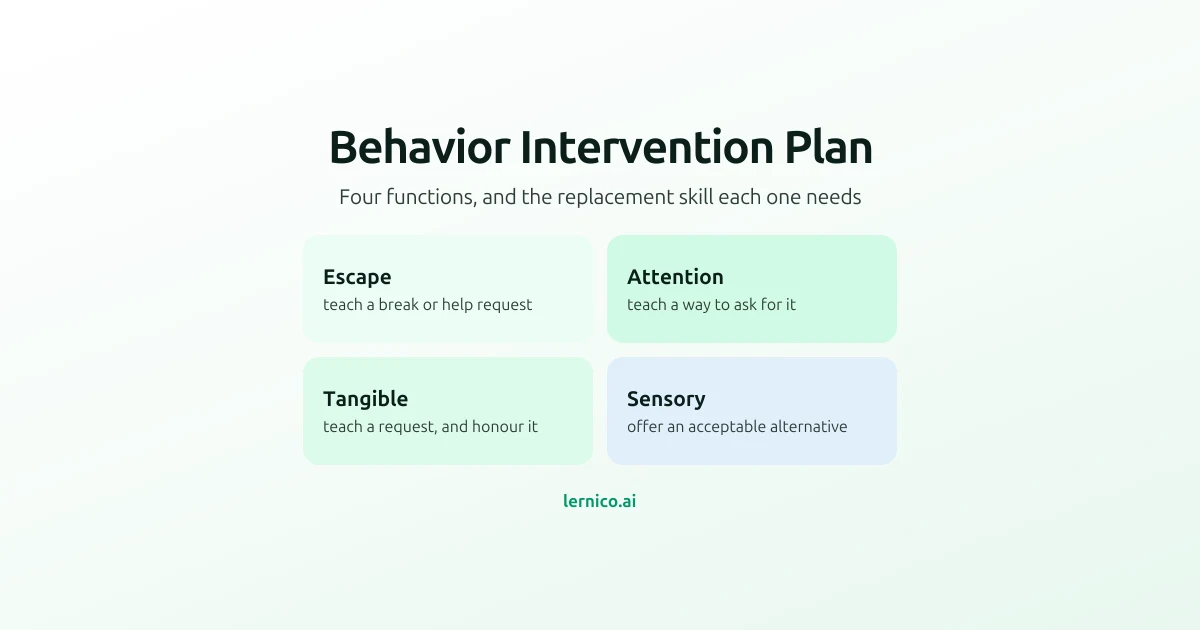
The replacement behavior has to serve the same function. This is the single most common design error. If the behavior gets a student out of a maths worksheet, a replacement that earns them a sticker will not be used — it does not do the same job. The replacement for escape is a taught, honoured break or help request.
The template
Bring this to the meeting. A plan that answers all seven is one a substitute can follow.
| Field | Fill in |
|---|---|
| Behavior, operationally defined | |
| Baseline: measure, number, dates | |
| Setting events and antecedents | |
| Function hypothesis | |
| Replacement behavior to be taught | |
| How the replacement will be taught, by whom | |
| Antecedent strategies | |
| Reinforcement for the replacement | |
| Response when the behavior occurs | |
| Crisis response, if needed | |
| Who records data, on what, how often | |
| Review date and change criterion |
12 behavior intervention plan examples by function
Each names the behavior, the hypothesised function, and the three moves that follow from it.
Escape or avoidance
1. Task refusal in maths. Behavior: puts head down and stops working within two minutes of an independent worksheet. Function: escape from a task perceived as too hard. Antecedent: pre-teach the day's skill; reduce the problem count while holding difficulty. Replacement: taught "I need help with number ___" card, honoured within 60 seconds. Consequence: help delivered on request; no removal from the task on head-down.
2. Leaving the classroom. Behavior: exits without permission a mean of 4 times weekly, most often after an unannounced schedule change. Function: escape from unpredictability. Antecedent: posted schedule, previewed at arrival, with changes flagged before they happen. Replacement: taught break card exchanged for a two-minute walk with a named adult. Consequence: break granted on the card; return prompted at two minutes, no discussion of the exit until later.
3. Work avoidance through negotiation. Behavior: asks a series of off-topic questions at the start of independent work. Function: escape by delay. Antecedent: a written first step on the desk before the direction is given. Replacement: one clarifying question, taught and permitted, then start. Consequence: the one question answered; further questions deferred with "after the first three".
4. Refusal on writing tasks. Behavior: verbal refusal on any task requiring more than two sentences. Function: escape from a task where output is effortful. Antecedent: provide a keyboard or scribe for extended writing. Replacement: taught request for the alternative format. Consequence: alternative honoured; refusal met with the choice restated once, not with an escalating demand.
Attention
5. Calling out. Behavior: speaks without raising a hand a mean of 14 times per period. Function: adult attention. Antecedent: scheduled non-contingent attention — a check-in at the start of the period and at ten minutes. Replacement: hand raised, acknowledged within 20 seconds. Consequence: raised hand reliably answered; call-outs not responded to in the moment.
6. Peer-directed disruption. Behavior: comments to peers during instruction, drawing laughter. Function: peer attention. Antecedent: structured role in the lesson that provides a legitimate audience. Replacement: taught turn-taking in a partner routine. Consequence: the structured role reliably given; disruptive comments not commented on by the adult.
7. Frequent minor complaints. Behavior: reports minor physical complaints to the teacher a mean of 6 times daily. Function: adult attention. Antecedent: two scheduled check-ins that do not depend on a complaint. Replacement: taught check-in request card. Consequence: nurse referral by protocol only; check-ins delivered on schedule regardless of behavior.
Access to a tangible or activity
8. Difficulty ending a preferred activity. Behavior: protests and refuses to transition from the computer. Function: continued access. Antecedent: visual timer, two-minute and one-minute warnings, and a stated next opportunity. Replacement: taught request for two more minutes, granted once. Consequence: the granted extension honoured exactly; the activity ends at the stated time regardless of protest.
9. Taking materials from peers. Behavior: takes items from other students' desks without asking. Function: access to the item. Antecedent: own set of the high-demand materials available at the desk. Replacement: taught borrowing script, rehearsed with peers. Consequence: the script honoured by peers and adults; the item returned without a lecture.
10. Food-related behavior at lunch. Behavior: takes food from other trays. Function: access to preferred food. Antecedent: preferred item included in the lunch plan, at a known time. Replacement: taught request to a named adult. Consequence: request honoured within the plan; taking met with a neutral return.
Automatic or sensory
11. Repetitive vocalisation during instruction. Behavior: audible humming during whole-group lessons. Function: automatic sensory input. Antecedent: seat with reduced auditory load; movement break scheduled before the lesson. Replacement: taught use of a permitted alternative — chewable, fidget, or headphones. Consequence: alternative freely available; no verbal correction of the humming itself.
12. Sensory-driven elopement. Behavior: leaves the room during assemblies and in the cafeteria. Function: escape from sensory input. Antecedent: noise-reducing headphones offered before entry; seat at the perimeter. Replacement: taught signal to step out with an adult for a set two minutes. Consequence: the signal honoured immediately; re-entry supported, not required to be immediate.
Five ways plans fail in practice
Nobody implementing it has read it. The lunch aide, the bus driver and every specialist teacher meet this behavior. A plan distributed only to the case manager is not in effect.
The replacement does not match the function. A reinforcement system for a behavior maintained by escape teaches the student that the reinforcement is not worth the task, which they already knew.
The plan changes weekly. Behavior data is noisy. Set a review date and a change criterion in advance, and hold to them unless there is a safety reason not to.
It has no antecedent strategies. A plan made entirely of responses waits for the behavior every time. The antecedent column is where the number actually comes down.
The data sheet is too heavy to keep. A teacher with 28 students will not run continuous duration recording all day. Pick the lightest measure that answers the question, and check after two weeks whether it is actually being filled in.
The assessment behind the plan
None of the above works without knowing the function, and the function comes from data rather than intuition. Our guide to the functional behavior assessment covers the six steps and the ABC recording sheet that produces the hypothesis this plan depends on.
Once the plan is written, the goals that go with it belong in the IEP — see behavior IEP goals for measurable examples, and specially designed instruction for what teaching the replacement behavior actually looks like.
Lernico drafts standards-aligned IEP goals from a student's present levels and produces the specially designed instruction language that goes with them. You stay the author of every word.
Book a 15-minute demo and bring a real student profile.
Frequently asked questions
What is a behavior intervention plan?
A behavior intervention plan, or BIP, is a written plan that describes a specific behavior, states why it is happening, and sets out what adults will do differently — before the behavior, instead of it, and after it. It is built on a functional behavior assessment, and a plan written without one is a guess with a document around it.
When does IDEA require a BIP?
IDEA never uses the phrase "behavior intervention plan" as a blanket requirement. Two provisions drive it: at 34 CFR 300.324(a)(2)(i) the team must consider positive behavioral interventions and supports whenever behavior impedes learning, and at 300.530(f) a BIP is required after a manifestation determination finds the conduct was a manifestation of the disability. Many states add their own triggers.
What are the four functions of behavior?
Escape or avoidance, attention, access to a tangible item or activity, and automatic or sensory reinforcement. Every plan in this guide is organised by function because the function determines the intervention — the same behavior maintained by escape and by attention needs two different plans.
What is a replacement behavior?
A skill that gets the student the same result as the problem behavior, more efficiently and acceptably. If the behavior gets them out of a task, the replacement has to get them out of the task too — usually a taught break request. A replacement that does not serve the same function will not be used.
Who writes the BIP?
The IEP team, usually with a school psychologist or behavior specialist drafting it from the FBA data. Everyone who will implement it needs to have seen it, which is the step most often skipped: a plan the lunch aide and the bus driver have never read is not being implemented.
How do you know if a BIP is working?
By comparing the same measure the FBA baselined — frequency, duration or latency — on the same recording sheet. Decide before implementation what counts as progress and what will trigger a change, and give it enough time to show: judging a plan after four days of data is how good plans get abandoned.