

Published: · 6 min read
Accommodations vs modifications is a distinction most staff rooms treat as interchangeable, and the substitution is harmless right up to the moment it is not — at a grading dispute, a state assessment, or a graduation audit where a student turns out not to be on a diploma track.
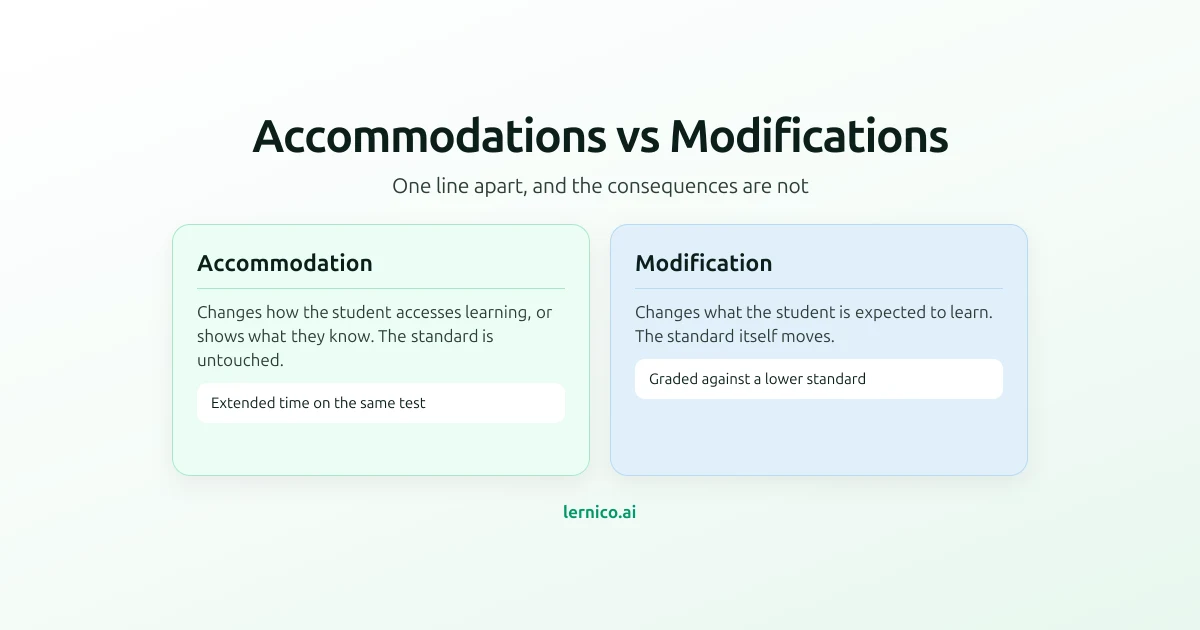
The distinction is one line. An accommodation changes how a student accesses learning or shows what they know. A modification changes what they are expected to learn. This page covers what follows from that, and 20 needs handled both ways, side by side.
The distinction, and what hangs off it
| Accommodation | Modification | |
|---|---|---|
| What changes | The route to the standard | The standard itself |
| The expectation | Identical to peers | Altered |
| Who decides | IEP or 504 team; teachers implement | IEP team only |
| Effect on grading | None — same standard, same grade meaning | Grade may reflect a different standard |
| State assessment | Generally permitted | Generally not; usually invalidates the score |
| Diploma track | Unaffected | May affect it, depending on the state |
Three consequences are worth stating plainly, because they are the ones that catch teams out.
A grade means something different. A student who takes a test with extended time and scores 80% has met the same standard as everyone else. A student graded against a reduced standard and given 80% has not, and the transcript does not say so. Districts handle this with a notation, a rubric annotation, or nothing at all — find out which before the grade is issued.
State tests treat them differently. Most state accessibility manuals list permitted accommodations and separately identify supports that change what is being measured. Using the second kind can invalidate the score. Check the manual at the meeting; some supports that are entirely appropriate in daily instruction are not permitted in assessment, and April is a bad time to discover it.
Modifications can accumulate quietly. No single decision looks consequential. Four years of them can end in a certificate of completion rather than a diploma, and the family finds out in the senior year. The team's obligation is to raise it early, in the meeting, while the choice is still live.
Where SDI sits in all this
Neither of these is teaching. That is the part the pairing hides.
Specially designed instruction adapts the content, methodology or delivery of instruction to address a disability-related need — while keeping the grade-level standard where it is. An accommodation removes a barrier to a standard nobody is teaching toward differently; a modification lowers the standard; SDI changes the teaching so the student can reach it.
A plan made entirely of accommodations and modifications contains no instruction at all. It is manageable for the student and closes no gap, which is precisely the situation Endrew F. addressed.
20 needs, handled both ways
Each row is the same student need. The middle column keeps the standard; the right-hand column changes it.
Reading
| Need | As an accommodation | As a modification |
|---|---|---|
| Cannot decode grade-level text | Text-to-speech, or the passage read aloud | A below-grade-level text on the same topic |
| Slow reading rate | Extended time; pre-reading the passage | Fewer passages, assessed against a lower standard |
| Loses place in dense text | Line guide, larger print, chunked layout | A summarised version of the text |
| Struggles with test passage volume | Extra time, breaks between passages | Fewer comprehension questions, easier question types |
Writing
| Need | As an accommodation | As a modification |
|---|---|---|
| Illegible handwriting | Keyboard, scribe, speech-to-text | Shorter written product accepted for full credit |
| Cannot organise a long response | Graphic organiser, sentence starters | Two paragraphs graded against the five-paragraph standard |
| Spelling blocks composition | Spellchecker, word bank | Spelling not assessed at grade-level expectation |
| Slow written output | Extended time, notes provided | Reduced number of required responses at a lower standard |
Math
| Need | As an accommodation | As a modification |
|---|---|---|
| Poor fact retrieval | Multiplication chart, calculator on non-fact items | Problems that avoid multi-digit operations entirely |
| Loses track in multi-step problems | Worked example on the desk, graph paper | Single-step problems in place of multi-step |
| Cannot finish the problem set | Fewer problems assessing the same skills | Fewer problems at an easier difficulty |
| Reading blocks word problems | Problem read aloud | Word problems replaced with computation |
Assessment and demonstration
| Need | As an accommodation | As a modification |
|---|---|---|
| Anxiety in the test setting | Small group, separate room, breaks | Project substituted for the exam |
| Processing speed | Extended time, extra day | Fewer items covering less content |
| Difficulty writing at length | Oral response, typed response | Multiple choice in place of constructed response |
| Cannot sustain a long assessment | Test split across sessions | A shorter test covering fewer standards |
Attention, behavior and access
| Need | As an accommodation | As a modification |
|---|---|---|
| Cannot sustain attention for a period | Scheduled breaks, chunked tasks, seat placement | Reduced expectations for work completed |
| Distracted by the room | Headphones, alternative seating, quiet space | Alternative, lower-demand activity during the lesson |
| Difficulty following multi-step directions | Written steps, one direction at a time | Fewer steps, and a simpler task |
| Vision or hearing access | Large print, braille, FM system, preferential seating | Reduced content presented |
Note the fourth row of the last table. Access supports are almost never modifications — braille, an FM system, large print and interpreters deliver the same content, at the same standard, by another route. They come up as a "modification" in conversation more often than they should.
The test to apply in the meeting
Three questions, in order.
- Is the student being asked to learn the same thing? If yes, and only the route changed, it is an accommodation.
- Would a grade earned this way mean the same as a peer's? If no, it is a modification, whatever the form calls it.
- Have we said what will be taught differently? If nobody can answer, the plan has no SDI in it, and neither an accommodation nor a modification will close the gap.
A useful sharpener on question one: fewer problems assessing the same skills is an accommodation, and fewer problems, made easier is a modification. Teams write both as "reduced work", which is why the form so often does not say what is happening.
What the regulation actually says
Worth knowing, because the vocabulary is less settled than the staff-room usage suggests. IDEA does not define "accommodation" and "modification" as a matched pair. The regulations use accommodations mainly in the assessment context, at 34 CFR §300.320(a)(6), and the phrase program modifications at 300.320(a)(4)(iii) means supports for school personnel — training and assistance for the adults — which is narrower than the everyday sense of a modified curriculum.
The four-way distinction between differentiation, accommodation, modification and SDI is settled practice rather than statutory text, and states word it differently. Use your state's language in the document. Use this page to decide what you mean before you write it.
Building the plan around instruction
Accommodations belong in the plan and so, sometimes, do modifications. Neither substitutes for deciding what will be taught.
Lernico drafts standards-aligned IEP goals from a student's present levels and produces the specially designed instruction and accommodations language a general education teacher can act on — the part that closes the gap rather than managing it. You stay the author of every word.
Book a 15-minute demo and bring a real student profile.
Frequently asked questions
What is the difference between an accommodation and a modification?
An accommodation changes how a student accesses instruction or shows what they know, while the expectation stays identical to their peers'. A modification changes the expectation itself — what the student is being asked to learn or demonstrate. Extended time is an accommodation. Grading a five-paragraph essay against a two-paragraph standard is a modification.
Does a modification affect a student's diploma?
It can, and this is the consequence teams most often discover too late. States differ, but where a modified curriculum means a student is not being assessed against the standards a standard diploma requires, the outcome may be a certificate of completion instead. Ask your district what its policy is before agreeing to modifications, not at the graduation audit.
Can a teacher decide to modify work on their own?
No. A modification changes what the student is expected to learn, which is an IEP team decision with grading and diploma consequences. A teacher who quietly hands one student easier work has modified without a team decision, and the IEP no longer describes what is happening in the room. Accommodations, by contrast, are implemented by teachers as written.
Are modifications allowed on state tests?
Generally no — most states distinguish accommodations, which are permitted and do not invalidate a score, from modifications, which change what is being measured and usually do. Check your state's accessibility manual before the IEP meeting; some supports allowed in instruction are not allowed in assessment.
Is a modification the same as specially designed instruction?
No. Specially designed instruction adapts the content, methodology or delivery of teaching to address a disability-related need while keeping the grade-level standard. A modification lowers or changes the standard itself. A student can receive intensive SDI and no modifications at all, and that is often the better plan.
Should an IEP have more accommodations or more modifications?
There is no target ratio, but a plan heavy with modifications and light on instruction is worth questioning. Modifications make current work manageable; they do not close a gap. If the team cannot name what is being taught to move the student toward the standard, the modifications are managing the symptom.