

Published: · 12 min read
More than half of America's teachers are burned out. Not frustrated. Not tired at the end of a long week. Burned out in the clinical sense: exhausted, emotionally depleted, and seriously questioning whether they can keep doing this job. The teacher burnout statistics for 2026 put a number on something most educators already feel in their bones. This article pulls the most current data from primary sources (RAND, the Learning Policy Institute, NCES, and Pew) to show where things stand, who is being hit hardest, what it is costing districts, and what the research says actually reduces burnout rather than just talking about it.
Teacher Burnout Statistics in 2026: The Current Numbers
The most comprehensive data on teacher burnout comes from RAND's annual State of the American Teacher survey, which surveys thousands of K-12 public school teachers across the United States each year. The 2025 edition, covering the 2024-2025 school year, is the most current primary source available.
Here is what the data shows.
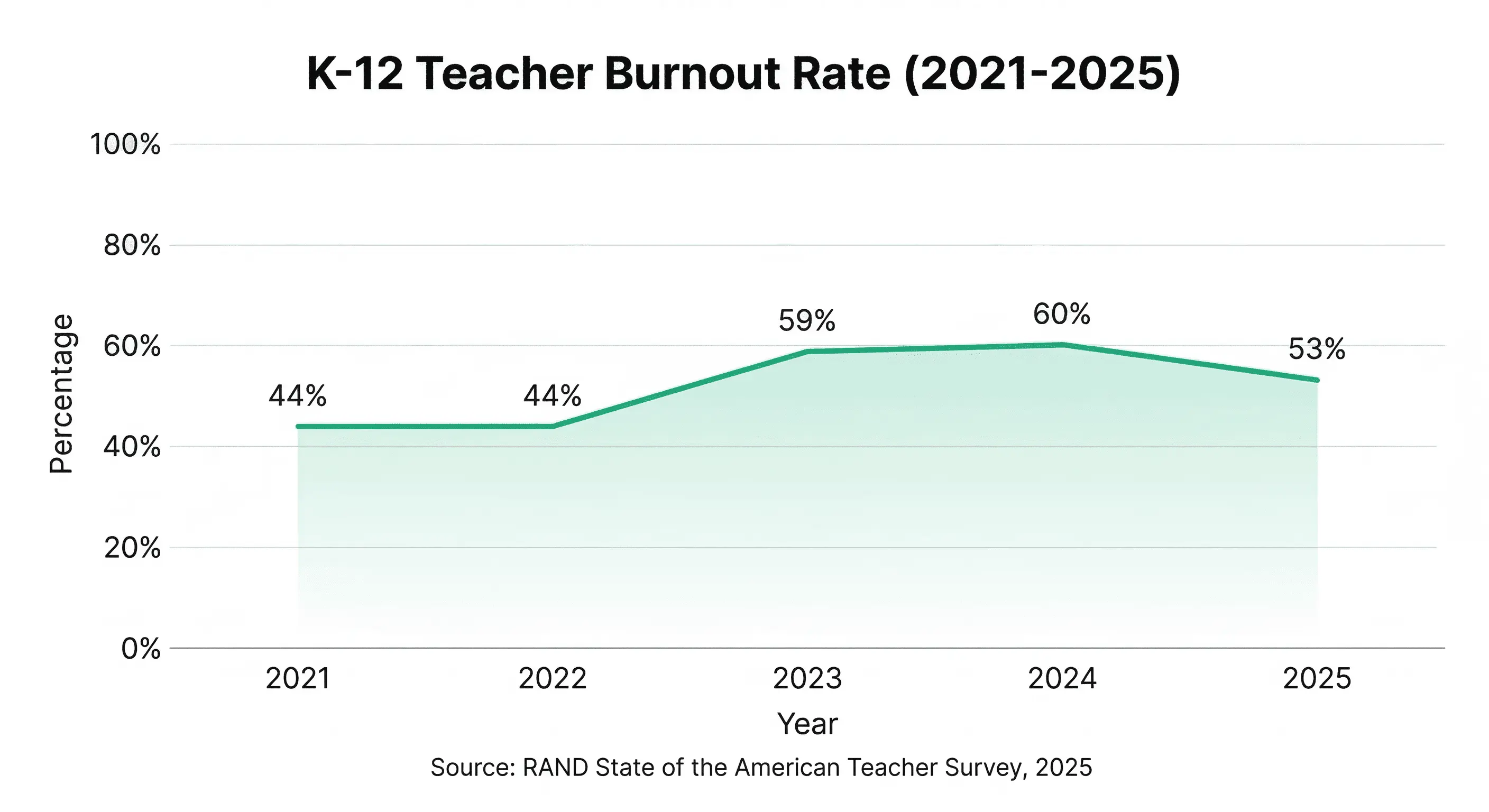
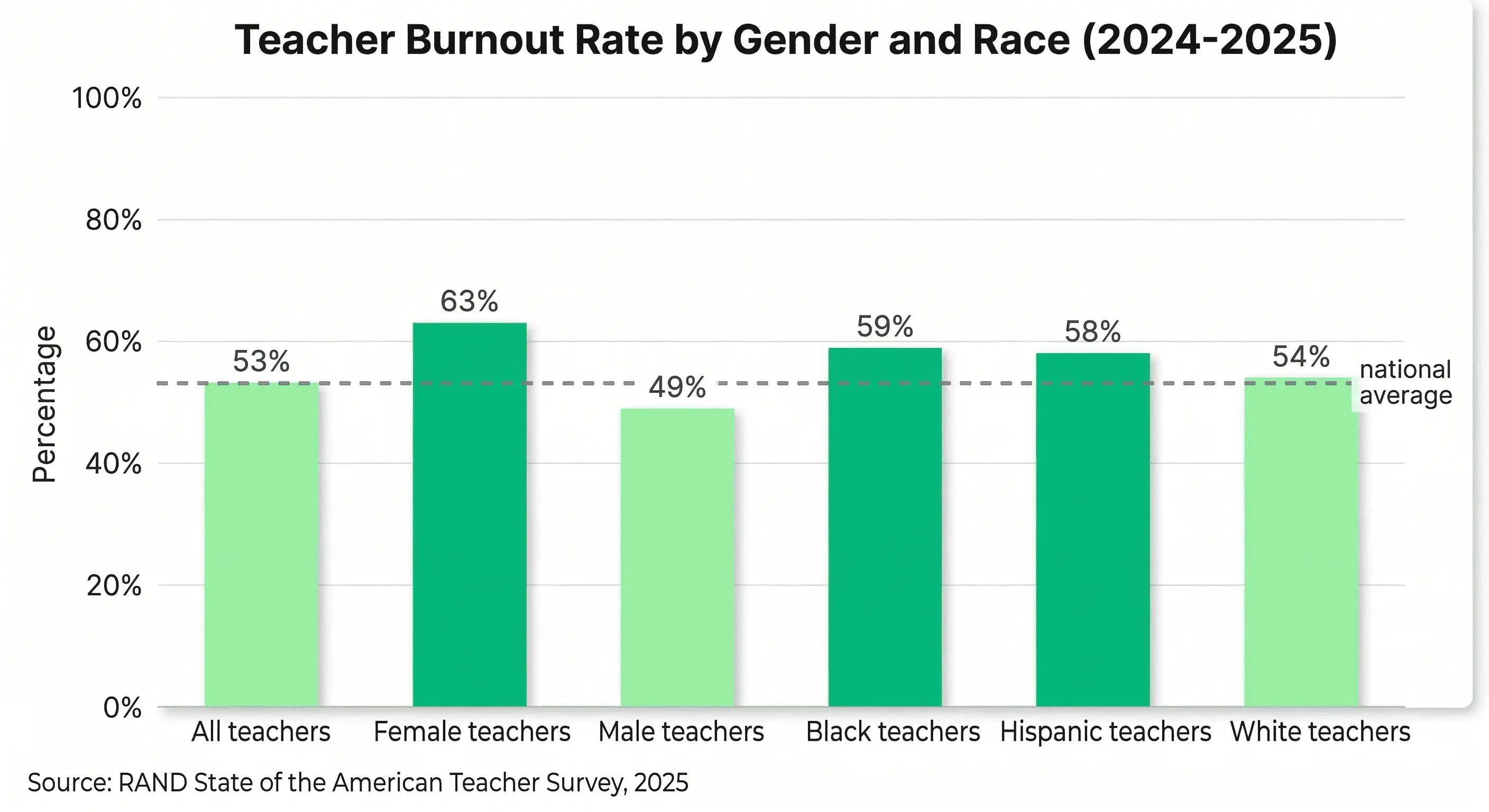
53% of K-12 teachers report feeling burned out. That is a meaningful drop from 60% in 2024 and the lowest figure since the immediate post-pandemic spike. But it still means more than half the teachers in American classrooms are operating in a state of serious exhaustion.
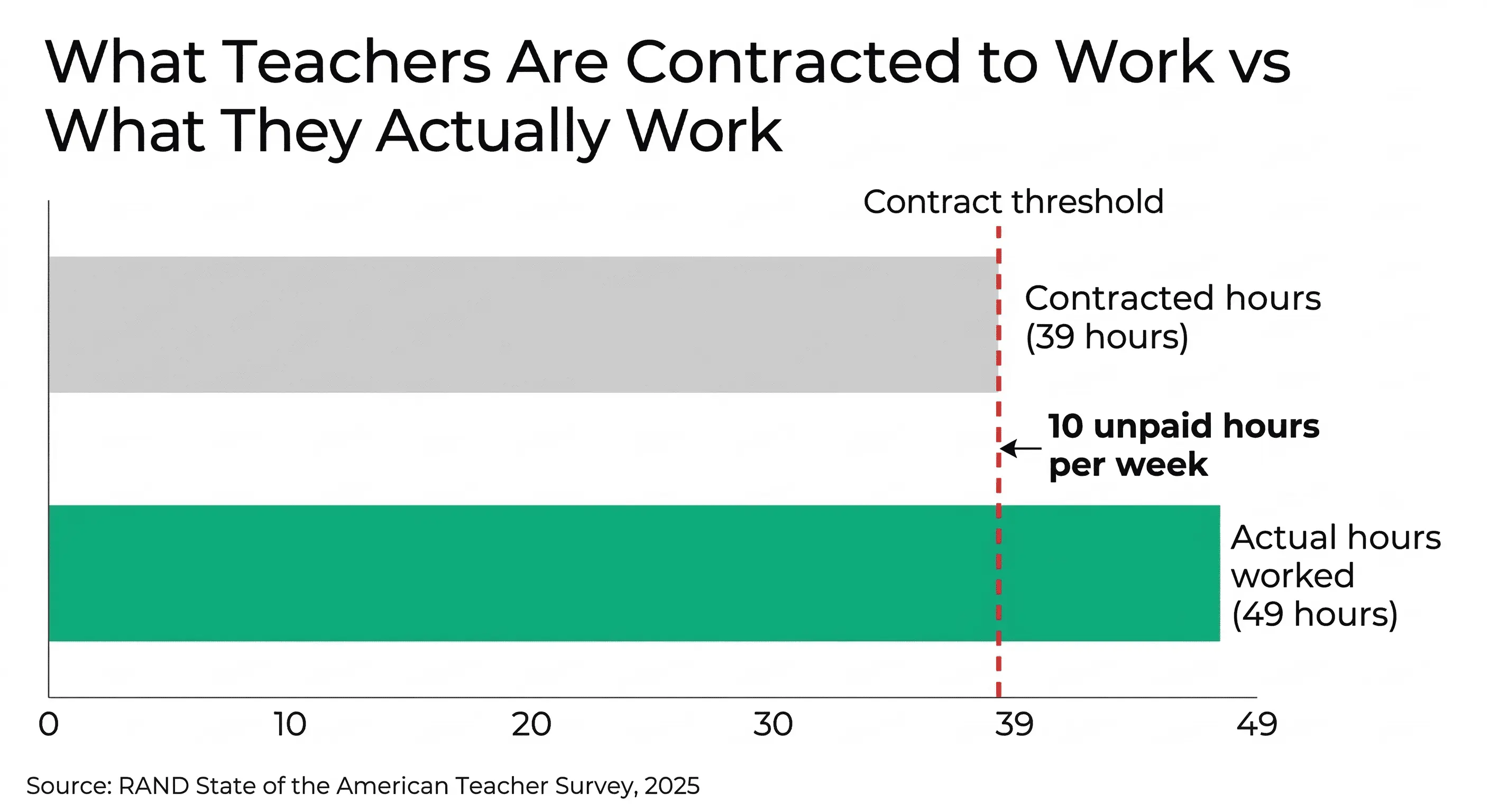
Teachers work 49 hours per week on average, 10 hours above their contracted hours. The gap between what teachers are paid to do and what they actually do has persisted for years without closing.
21% of teachers find it difficult to cope with job-related stress, significantly more than comparable working adults. Stress and burnout are different things, but unmanaged stress is the most direct path to it.
16% of teachers intended to leave their jobs in 2025, down from 22% in 2024. That decline matters. But 1 in 6 teachers considering leaving in any given year still represents enormous instability for schools and students.
70% of K-12 teachers report that their school is understaffed, according to a 2024 Pew Research survey of 2,531 US public school teachers. Understaffing and burnout feed each other. When teachers leave, the ones who stay absorb more work, which accelerates burnout in those who remained.
82% of public schools needed to fill two or more teaching vacancies before the start of the 2024-2025 school year, according to the National Center for Education Statistics. By mid-2025, the Learning Policy Institute estimated that over 411,000 teaching positions were either vacant or staffed by under-certified educators, roughly one in eight teaching positions in the United States.
These numbers have improved slightly from their post-pandemic peak. But improving from the worst point on record is not the same as being okay.
What Is Causing Teacher Burnout
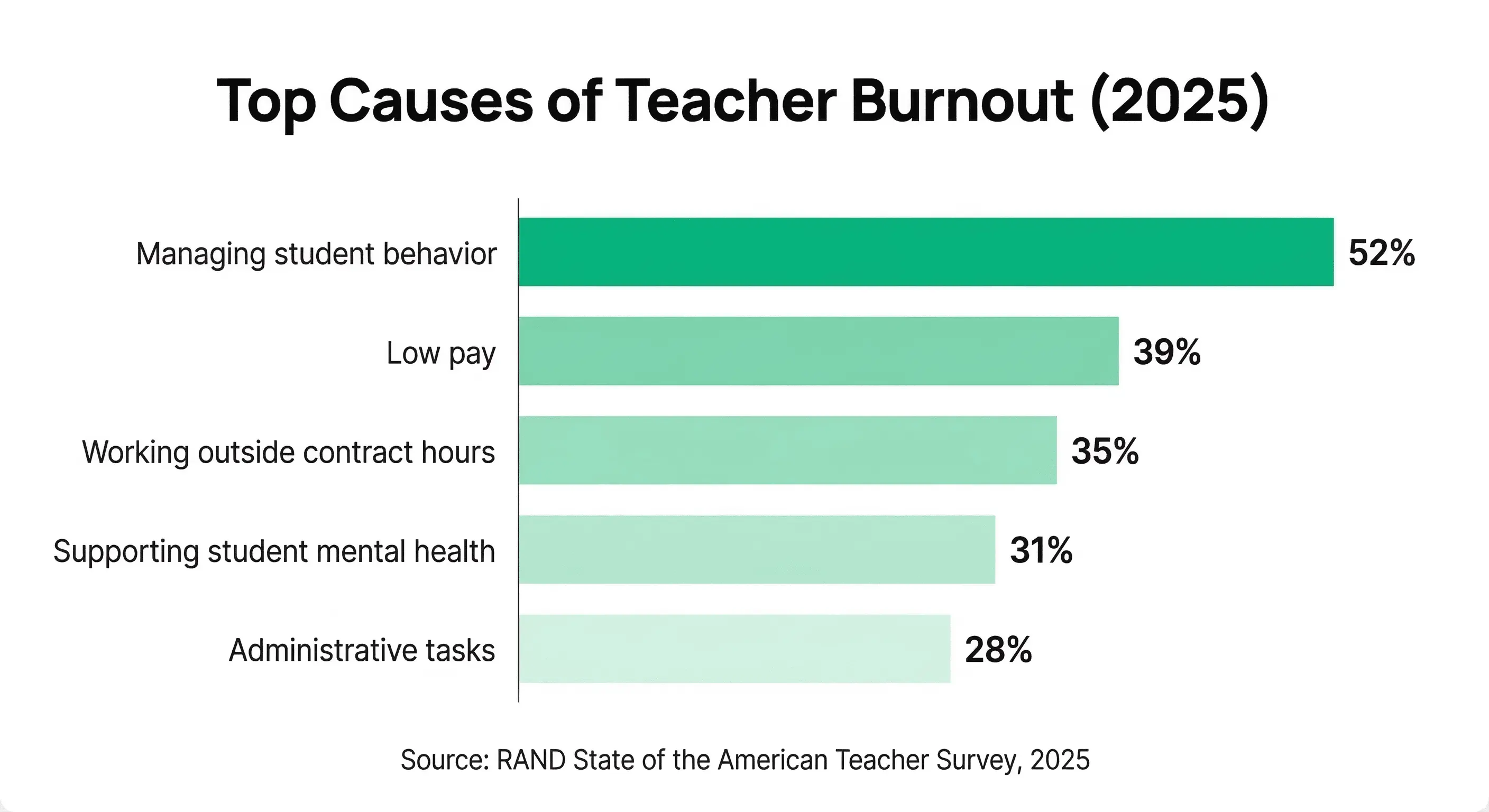
Burnout is not a personality flaw. It is a predictable response to conditions that are structurally unsustainable. The RAND 2025 survey asked teachers directly about their sources of stress, and the results are specific.
52% of teachers cited managing student behavior as their primary stressor. Classroom discipline has intensified post-pandemic. Student mental health needs are higher, social skills development was disrupted during remote learning, and teachers have fewer support staff to help when a student is in crisis during a lesson.
39% cited low pay as a significant stressor. The average teacher base salary in 2025 was $73,000 according to RAND, with major variation by state. Teachers in states where collective bargaining is prohibited earned an average of $60,300. And 52% of teachers in those states received no pay increase in the 2024-2025 school year.
Working outside contracted hours was consistently flagged across surveys. The core math: teachers are contracted for an average of 39 hours per week. They work 49. That 10-hour gap amounts to roughly 380 unpaid hours per school year, close to 10 full work weeks.
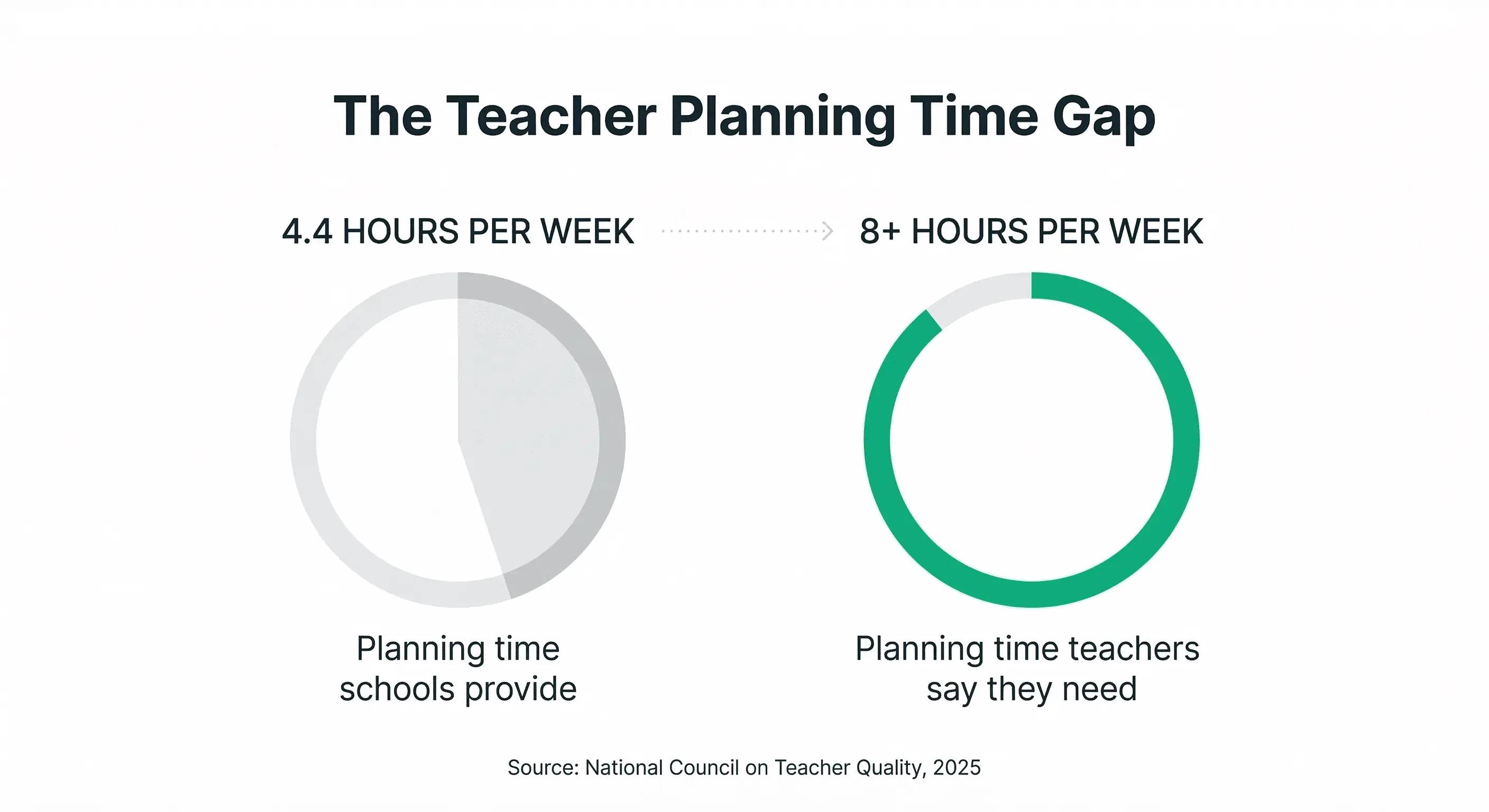
Planning time is chronically insufficient. According to research from the National Council on Teacher Quality, public schools provide teachers with an average of 266 minutes (about four hours and 26 minutes) of dedicated planning time per week. Elementary teachers get even less. Most lesson planning, grading, and parent communication happens before school, after school, and on weekends.
Supporting students' mental health was a top stressor in RAND's 2024 survey and remained prominent in 2025 data. Teachers are increasingly asked to address student trauma, anxiety, and social-emotional needs that go well beyond the curriculum they were trained to teach.
Administrative tasks outside of teaching were flagged consistently. NCTQ's 2025 research on teacher time found that 92% of teachers have contracts requiring 21-40 hours of work per week, but 88% report actually working 41 to more than 80 hours per week. The gap is filled almost entirely by administrative tasks, documentation, and planning the contract does not account for.
Job inflexibility compounds everything. According to RAND's 2025 data, 46% of teachers reported being unable to enjoy their private life due to work demands, compared to just 13% of similar working adults.
Who Is Burning Out Most: Gender, Race, and Experience
Teacher burnout statistics do not fall equally across the profession. Disaggregated data shows significant disparities.
Female teachers report higher burnout than male teachers consistently. The 2025 RAND data shows this pattern has held every year since 2021. In 2024, female teachers reported a burnout rate of 63%, compared to around 49% for male teachers. The gap is widening, not narrowing.
Teachers of color report disproportionately high burnout and stress. In the 2024-2025 school year: 59% of Black teachers reported burnout, 5+ percentage points above white teachers. 58% of Hispanic teachers reported burnout. 25% of both Black and Hispanic teachers reported symptoms of depression, compared to 18% of white teachers. According to RAND's 2025 data, Black teachers earned $4,400 less on average than their white counterparts. Teachers of color are also more likely to work in high-need schools with fewer resources and less institutional support.
New teachers are burning out and leaving fastest. According to the Education Resource Strategies 2025 analysis of teacher turnover, 30% of first-year teachers left their school in the 2022-2023 school year. New teachers carry the highest workload relative to their experience, have the fewest established routines, and receive the least institutional support.
What Teacher Burnout Costs School Districts
Burnout is not just a teacher wellbeing issue. It is a financial and operational crisis for school districts. The numbers make this concrete.
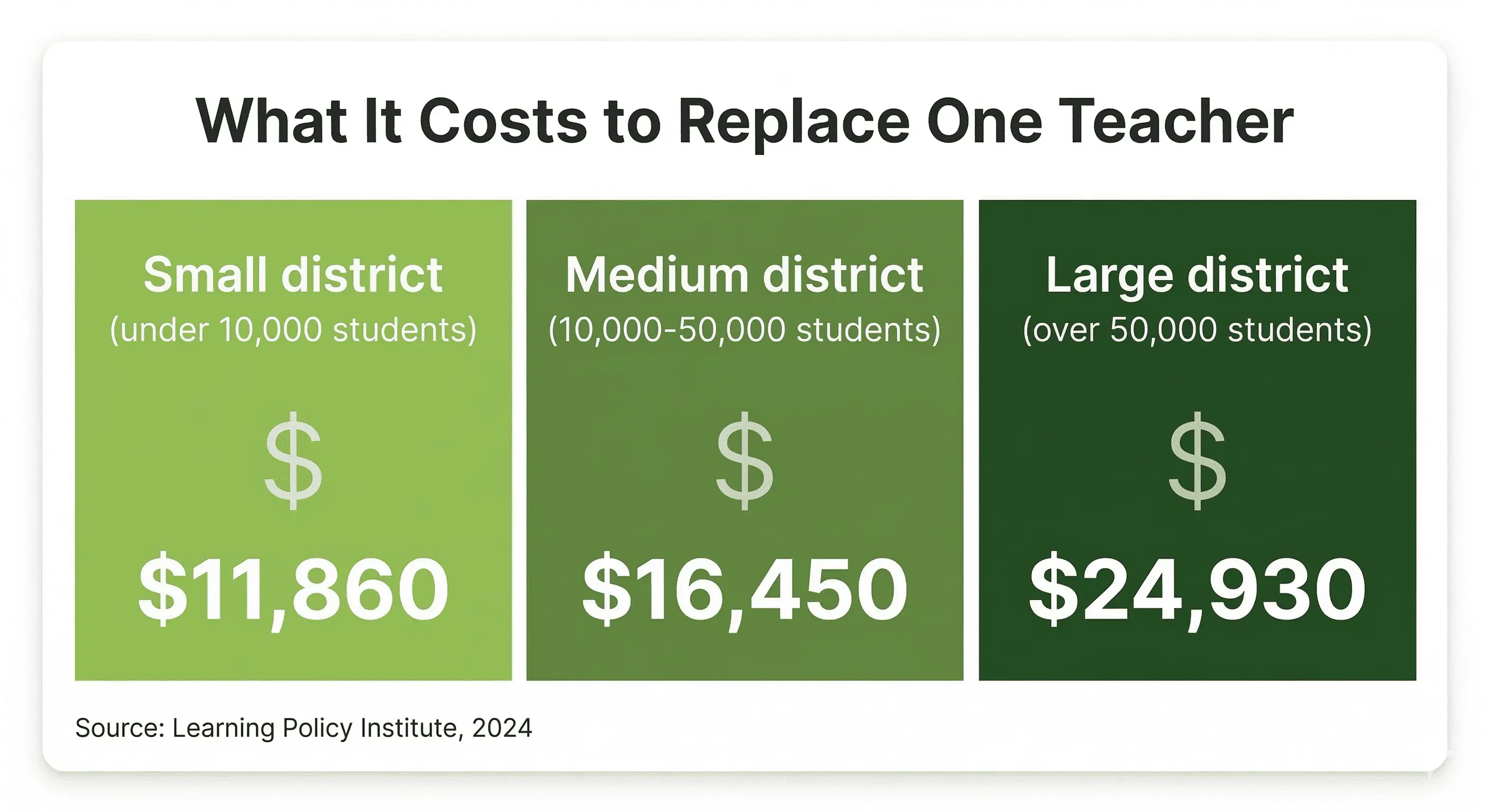
Replacing a single teacher costs between $11,860 and $24,930, depending on district size, according to the Learning Policy Institute's 2024 teacher turnover cost update. These figures cover separation, recruitment, hiring, and training. They do not include the harder-to-quantify costs: lost institutional knowledge, reduced student performance during vacancies, and the extra burden placed on teachers who absorb the workload while a position goes unfilled.
District size
Cost per teacher replaced
Under 10,000 students
$11,860
10,000 to 50,000 students
$16,450
More than 50,000 students
$24,930
At a national scale, teacher turnover costs school districts an estimated $2.2 billion per year, according to research by University of Pennsylvania professor Richard Ingersoll. Given inflation and the post-pandemic acceleration in attrition, the current figure is almost certainly higher.
The student impact is also measurable. Teacher turnover negatively affects student academic performance in both reading and math, according to multiple studies cited in the Learning Policy Institute's technical supplement. High-turnover schools, often in high-poverty districts that are already under-resourced, face the steepest compounding damage.
Only one-fifth of teachers leaving are retiring. The other 80% are leaving mid-career, citing low pay, difficult working conditions, and burnout. Every one of those departures represents a trained educator whose preparation the system funded and whose institutional knowledge the district now has to replace.
What the Research Says Actually Reduces Teacher Burnout
Most teacher wellness content fails teachers. It recommends mindfulness apps and self-care routines while ignoring the structural conditions that cause burnout in the first place. The research is more direct about what actually works.
Reducing non-teaching administrative load is the single most impactful lever. The RAND 2025 State of the American Teacher report found that teachers who felt their workload was manageable reported significantly lower burnout. The problem is that reducing administrative load requires institutional decisions: fewer mandatory meetings, streamlined documentation, consolidated reporting requirements. Individual behavior change alone does not move this needle.
Increasing dedicated planning time reduces stress. Research from NCTQ found that teachers who received more uninterrupted planning time reported lower burnout and higher job satisfaction. The target teachers themselves consistently identify as adequate: at least one class period per day of uninterrupted planning time. Most schools currently fall well short of that.
Autonomy matters more than salary alone. Teachers who reported greater control over curriculum, pacing, and instructional decisions consistently reported lower burnout, even after controlling for pay level. Being told exactly how to teach every lesson, in what order, with what materials, is demoralizing for people who trained specifically to make those professional judgments.
Administrative support is the difference between teachers staying and leaving. The University of Missouri's 2025 survey of 500 public school teachers found that 78% cited limited administrative support as a major contributing factor to burnout. Principals who protect teachers' planning time, back them up on discipline decisions, and reduce unnecessary paperwork make a measurable difference in retention.
AI tools are reducing planning time for early adopters. Teachers who use AI-assisted lesson planning report spending significantly less time on planning documentation. A Gallup and Walton Family Foundation survey from 2024 found that teachers using AI tools weekly gained nearly six extra hours per week, equivalent to six full weeks of time over the school year. That does not solve every burnout factor. But it directly addresses the non-teaching administrative load that shows up at the top of teacher stress surveys every year.
Lernico's AI lesson planner generates standards-aligned lesson plans in under two minutes. Teachers who use it report cutting their Sunday planning sessions from three hours to under 45 minutes. It is not a cure for burnout. But it is two-plus hours per week back in teachers' lives, every week.
Teacher-led professional learning communities reduce isolation. Burnout is partly a function of feeling like you are the only one struggling, with no one to consult when a lesson falls apart or a student is in crisis. Structured time for teachers to meet, share, and problem-solve together is one of the cheapest and most consistently effective burnout interventions in the research.
What Teachers Can Do Right Now
The structural changes above require institutional action. But there are things individual teachers can do that the research supports: not wellness-industry self-care, but concrete boundary-setting that has been shown to reduce burnout symptoms.
Set a hard stop on school work at a specific time each day. Not "try to stop around 7pm," but an actual, fixed time you commit to. Research on recovery from work stress shows the critical variable is psychological detachment: the ability to fully stop thinking about work during personal time. A hard stop makes that possible.
Audit your workload for tasks that could be batched or cut. Most teachers have never done a systematic accounting of how their 49 hours per week are spent. Identifying tasks that are low-impact and high-time is the first step to either eliminating them or moving through them faster.
Use AI tools for the documentation load. Lesson plans, IEP goal writing, rubric creation, parent communication drafts: these are all areas where AI produces a solid draft in seconds that you then edit rather than write from scratch. See Lernico's AI lesson planner, IEP goal generator, and AI rubric generator for tools built specifically for K-12 teachers.
Name burnout when you see it in yourself. One of the most damaging patterns in burnout research is minimizing or normalizing it: telling yourself you are just tired, that all teachers feel this way, that summer will fix it. Burnout is a clinical condition with a trajectory. The longer it goes unaddressed, the longer recovery takes. Talking to a counselor, a trusted colleague, or your school's employee assistance program is not a sign of weakness. It is the same advice you would give a student who was struggling.
Advocate for structural change. Individual adaptation only goes so far. The research is consistent: burnout declines when working conditions improve. That means showing up to contract negotiations, advocating for planning time in school governance conversations, and making the case to administrators that replacing one teacher costs between $11,860 and $24,930, far more than most of the investments that actually reduce burnout.
Frequently Asked Questions
What percentage of teachers experience burnout in 2026? According to RAND's 2025 State of the American Teacher survey, the most current primary source as of 2026, 53% of K-12 teachers reported feeling burned out. This is down from 60% in 2024 but still represents the majority of the profession. Rates are higher among female teachers (consistently above 60%) and teachers of color (58-59% for Black and Hispanic teachers in the 2024-2025 school year).
What are the main causes of teacher burnout? RAND's 2025 data identifies managing student behavior (52% of teachers), low pay (39%), working outside contract hours, insufficient planning time, and supporting students' mental health needs as the leading causes. The underlying issue is that the scope of the teaching job has expanded significantly while resources, time, and compensation have not kept pace.
How many hours per week do teachers actually work? According to RAND's 2025 State of the American Teacher survey, teachers work an average of 49 hours per week, 10 hours above their contracted hours. NCTQ's 2024 research found that 88% of teachers report working 41 to more than 80 hours per week, despite most contracts specifying 21-40 contracted hours.
What does teacher burnout cost school districts? The Learning Policy Institute's 2024 update puts the cost of replacing a single teacher at $11,860 for small districts, $16,450 for medium districts, and $24,930 for large districts. At a national scale, teacher turnover costs school systems an estimated $2.2 billion per year. These figures do not include the student achievement impact, which research consistently shows declines in high-turnover schools.
What actually reduces teacher burnout? Research points to reducing non-teaching administrative workload, increasing dedicated planning time, giving teachers more autonomy over instructional decisions, providing strong administrative support, and creating structured peer collaboration time. At the individual level, setting hard stops on work hours, cutting low-value administrative tasks, using AI tools to reduce documentation load, and addressing burnout early rather than waiting until it is entrenched are all evidence-supported strategies.
The Administrative Load Is One Part You Can Fix This Week
Teacher burnout has structural causes that need structural solutions: better pay, more planning time, stronger admin support. Those changes take time and institutional will that individual teachers cannot always control.
But the documentation load? The Sunday planning sessions? The hours spent writing lesson plans from scratch for five different classes? That part is solvable this week.
Lernico generates standards-aligned lesson plans in under two minutes. Enter your grade, subject, standard, and topic. Get a complete, differentiated plan ready to review and teach. Teachers using Lernico report cutting their weekly planning time from three hours to under 45 minutes.
That is time back in your life, every single week, for the rest of the school year.