

Published: · 12 min read
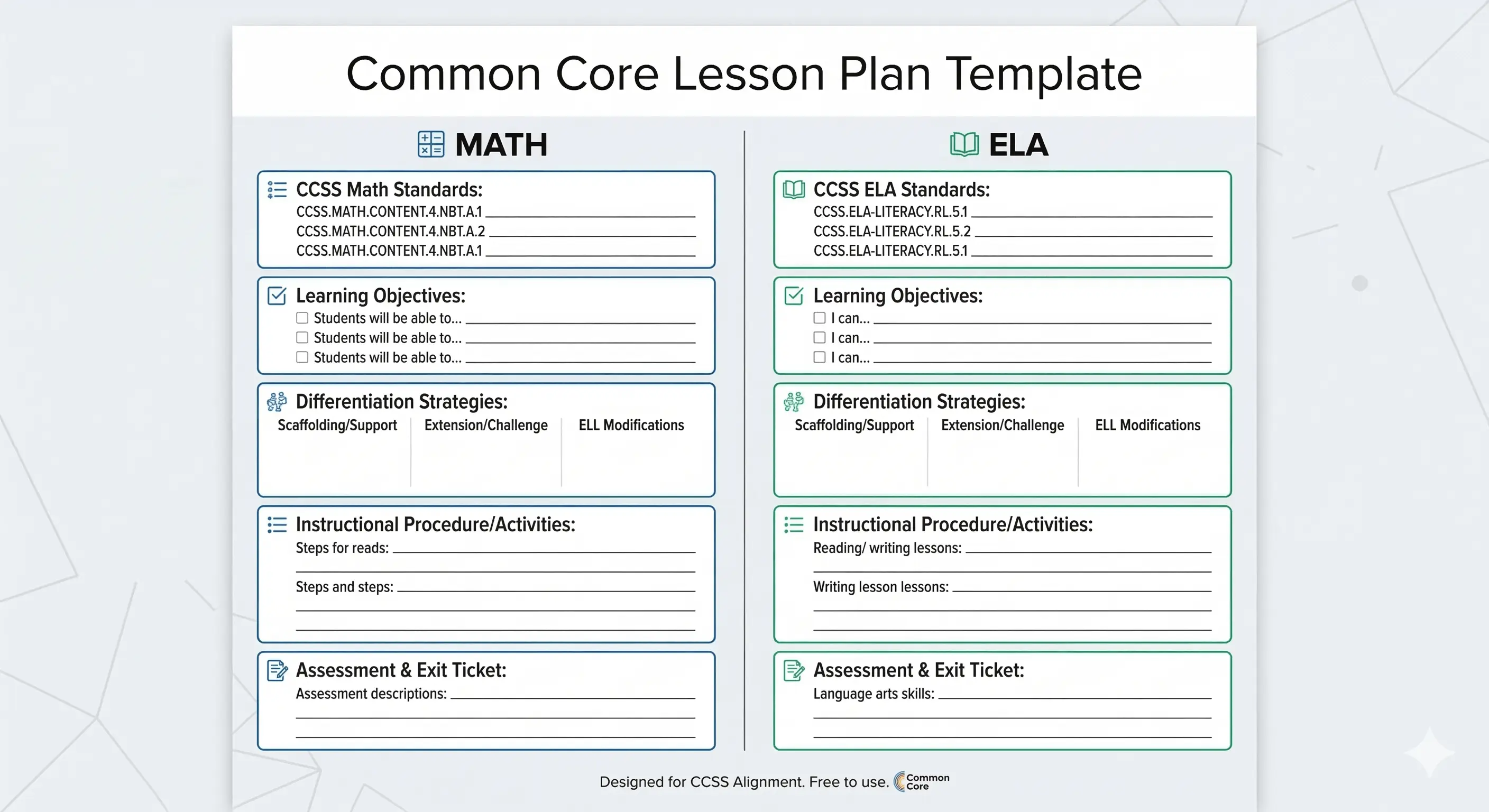
Writing Common Core lesson plans from scratch takes time you don't have. You need something standards-aligned, ready to hand to an observer, and actually useful in the classroom. These free Common Core lesson plan templates give you exactly that, two Google Docs you can copy and use today, covering both math and ELA, built around what CCSS actually requires.
Get the free templates:
Click the link, then go to File > Make a copy. The template is yours to edit.
ّIncludes SMP checkboxes, conceptual task field, differentiation columns, and exit ticket
Includes text complexity fields, text-dependent question rows, evidence-based discussion, and writing task
What Makes a Common Core Lesson Plan CCSS-Aligned
"CCSS-aligned" means more than pasting a standard code into the header.
A genuinely Common Core lesson plan connects the standard to every major decision you make the learning objective, the tasks students complete, the questions you ask, and how you assess understanding. If you can swap out the standard code without changing anything else in the plan, the lesson isn't aligned. It's just labeled.
The Common Core State Standards were written to emphasize depth over coverage. In math, that means fewer topics explored more thoroughly, with a focus on conceptual understanding alongside procedural fluency. In ELA, it means reading complex texts closely, writing from evidence, and building knowledge across content areas.
Your lesson plan template needs to reflect that emphasis. A template designed for a different standards framework won't cut it even if it looks similar on the surface.
Here's what every CCSS lesson plan template should include:
- The full standard code and text (not just the code, write out what the standard actually says)
- A student-facing objective written in plain language ("I can..." statements work well)
- A clear connection between the standard and the task, what students are doing that demonstrates the standard
- Formative assessment built into the lesson, not added as an afterthought
- A closing activity that checks whether students hit the objective
Common Core Lesson Plan Templates by Grade Band
Different grade bands have different demands. A K-2 template looks nothing like a 9-12 template the standard complexity, reading load, and scaffolding expectations are completely different.
Use the template for your grade band as a starting point, then adjust based on your students' needs.
Elementary Common Core Lesson Plan Template (K–5)
Best for: Grades K–5, both math and ELA Length: 45–60 minute lessons Templates: Math · ELA both work for K–5, just adjust the standard and materials
Template sections:
Field
What to include
Standard
Full CCSS code + standard text (e.g., CCSS.MATH.CONTENT.3.OA.A.1)
Objective
"Students will be able to..." — one measurable skill
Materials
Everything students and the teacher need
Vocabulary
3–5 key terms with student-friendly definitions
Warm-up (5–10 min)
Activates prior knowledge; connects to the standard
I Do (10–15 min)
Teacher models the skill explicitly
We Do (10–15 min)
Guided practice — teacher and students together
You Do (10–15 min)
Independent practice aligned to the standard
Formative check
Exit ticket, whiteboard response, or quick oral check
Differentiation
At least one support and one extension for the same task
For K-2, add a "Vocabulary visuals" field CCSS ELA standards at those grades explicitly require building academic language, and a picture-supported word wall entry for each lesson keeps that visible.
Middle School Common Core Lesson Plan Template (6–8)
Best for: Grades 6–8, ELA and math Length: 50–60 minute periods Templates: Math ·ELA the discussion protocol and evidence-based writing fields in both templates are designed with middle school complexity in mind
Middle school CCSS standards increase in complexity significantly. Your template needs space for text-based evidence in ELA and multi-step reasoning in math.
Additional fields beyond the K-5 template:
Field
What to include
Complex text or problem
The specific passage, problem set, or task (not just the topic)
Discussion protocol
How students will talk about the content (think-pair-share, Socratic seminar, numbered heads)
Evidence-based writing prompt
For ELA: the prompt students will respond to using textual evidence
Error analysis section
Common misconceptions for this standard and how you'll address them
High School Common Core Lesson Plan Template (9–12)
Best for: Grades 9–12, ELA and math Length: 55–90 minute blocks Templates: Math · ELA add an "anchor standard connection" and "college/career connection" row for high school use
High school CCSS standards assume students can read, discuss, and write with sophistication. Your lesson plan template should reflect that.
Key additions at this level:
Field
What to include
Anchor standard connection
Which anchor standard does this grade-specific standard roll up to?
Text complexity
Quantitative measure (Lexile or equivalent) + qualitative assessment
Writing task
The specific prompt, mode (argumentative/explanatory/narrative), and audience
College/career connection
One sentence on how this skill applies beyond school — optional but useful for buy-in
Common Core Math Lesson Plan Templates
CCSS math has three components: conceptual understanding, procedural fluency, and application. Your common core math lesson plan template should address all three though not necessarily in equal weight every day.
The Standards for Mathematical Practice (SMPs) are the other piece most lesson plans miss. These aren't content standards they describe how students should think and work mathematically. A strong CCSS math lesson plan calls out which SMPs students are engaging in.
Common Core Math Lesson Plan Template fields (beyond the base template):
Field
What to include
Content standard
Full CCSS.MATH code + text
Mathematical Practice standards
Which 1–3 SMPs does this lesson emphasize? (e.g., MP.3: Construct viable arguments)
Conceptual task
The problem or exploration that builds understanding before procedure
Procedural component
The skill practice — but after students understand why it works
Application problem
A real-world context that requires using the skill
Number talk or fluency activity
A 5-minute routine that builds fact fluency at grade level
Example for 4th grade (CCSS.MATH.CONTENT.4.NF.B.3a):
A lesson on adding fractions with like denominators would start with a conceptual task having students use fraction strips or number lines to show why 2/5 + 1/5 = 3/5, not 3/10. Only after that visual exploration would you move to the algorithm. The application problem might ask students to figure out how much of a pizza is left after two friends eat their slices.
That sequencing concept before procedure is what makes it genuinely CCSS-aligned rather than just CCSS-labeled.
Copy the free Common Core Math Lesson Plan Template File > Make a copy to save your own version.
Common Core ELA Lesson Plan Templates
CCSS ELA standards are organized around Reading, Writing, Speaking and Listening, and Language. Most lessons touch more than one strand and your template should show those connections explicitly.
Common Core ELA Lesson Plan Template fields:
Field
What to include
Reading standard
Full CCSS.ELA-LITERACY code + text
Companion standard
The writing or speaking standard connected to this lesson (most CCSS ELA lessons integrate reading + writing or reading + discussion)
Text title and complexity
Full title, author, Lexile level
Close reading focus
Which specific passage or section gets the most analytical attention?
Text-dependent questions
3–5 questions that require students to return to the text (not background knowledge or personal opinions)
Evidence-based discussion
The protocol and question for class discussion
Writing task
The prompt, with required elements (claim, evidence, reasoning)
Text-dependent questions are the biggest gap in most ELA lesson plans. A question like "What do you think the character should have done?" isn't text-dependent. A question like "What evidence in paragraphs 3 and 4 shows how the character's attitude toward the conflict changes?" is.
If your current ELA lesson plan template doesn't have a dedicated field for text-dependent questions, add one. It's the single biggest structural difference between a CCSS-aligned lesson and a pre-CCSS lesson with a Common Core standard code pasted on top.
Copy the free Common Core ELA Lesson Plan Template File > Make a copy to save your own version.
Common Mistakes in Common Core Lesson Planning
These are the patterns that show up most often in walkthroughs and peer reviews and they're easy to fix once you see them.
Mistake 1: Listing the standard but teaching to a different skill. The plan says CCSS.ELA-LITERACY.RI.5.6 (author's point of view) but the lesson is mostly about summarizing. The standard and the work aren't connected.
Fix: Write the standard text next to your objective. Read both. If you had to argue in a meeting that the task teaches the standard, could you make the case? If not, revise the task.
Mistake 2: Using below-grade-level texts in ELA. CCSS ELA standards require grade-appropriate text complexity. A 6th grade informational reading standard taught with a 4th grade text isn't meeting the standard the standard assumes the complexity is present.
Fix: Add a text complexity field to your template. If you're scaffolding a complex text for students who need support, document the scaffolds that's legitimate. Using an easier text without scaffolding isn't.
Mistake 3: Skipping the conceptual stage in math. Moving straight to algorithm practice without building understanding first produces students who can compute but can't explain. That's not what CCSS math standards describe.
Fix: Your math template should have a "conceptual task" field that comes before the procedural practice. If it's not in your template, you'll keep skipping it under time pressure.
Mistake 4: Treating differentiation as separate from alignment. Differentiation notes that say "for struggling learners, give fewer problems" don't show how the differentiated version still addresses the standard.
Fix: Differentiation should vary the scaffolding, not the standard. A student getting 10 problems instead of 20 is practicing the same skill. A student getting a graphic organizer instead of a blank page is still writing to the same standard. Make that explicit in your plan.
Mistake 5: Formative assessment that doesn't match the standard. Exit tickets that ask "What did we learn today?" or "Rate your understanding 1-5" don't give you actionable data about the standard.
Fix: Every exit ticket should require students to demonstrate the specific skill described in the standard. One well-designed exit ticket question beats five vague reflection prompts.
Differentiating a Common Core Lesson Plan Without Starting Over
Differentiation within a CCSS framework doesn't mean writing three separate lesson plans. It means designing one lesson with intentional entry points for different learners.
For students who need more support:
- Pre-teach the vocabulary in the lesson before the lesson starts (even 5 minutes at the door)
- Provide a structured note-taking template with sentence starters
- Use manipulatives or visuals during the "I Do" and "We Do" phases
- Reduce the number of problems without reducing the rigor of the skill
For students ready for extension:
- Add an application problem that applies the skill in a new context
- Ask them to explain their reasoning in writing before showing the procedure
- Have them create their own example problem and a worked solution
- Connect the current standard to a more advanced standard they could preview
For ELL students:
- Pre-teach key academic vocabulary with visual support
- Allow discussion in the student's first language during the "We Do" phase before moving to English production
- Provide sentence frames for the writing task
- Use bilingual glossaries for content vocabulary
The differentiation column of your template should document which scaffolds and extensions you're using — not as a paper trail, but as a planning tool. When you can see the differentiation next to the standard, you can check that the accommodations still lead to the same learning target.
Common Core Lesson Planning for IEP Students
Students with IEPs have individualized accommodations and goals that live alongside not instead of grade-level standards. CCSS-aligned lesson plans need to show how both work together.
Your CCSS lesson plan template should include a dedicated IEP accommodations field. Not a generic "see IEP" note actually document which accommodations are active in this lesson:
Accommodation
How it appears in this lesson
Extended time
Students have 5 extra minutes on the independent practice
Preferential seating
Student seated near the board during instruction
Reduced writing requirement
Exit ticket is verbal rather than written
Visual supports
Fraction strips provided during the math task
If a student has a specific IEP goal that connects to the CCSS standard you're teaching, note it. A student with a reading fluency goal who's also working on CCSS.ELA-LITERACY.RF.4.4 is getting double exposure to the same skill that's worth tracking.
For more support on writing IEP goals that align with grade-level standards, see our AI IEP goal generator it helps you write SMART goals that connect directly to CCSS benchmarks.
Frequently Asked Questions
What is a Common Core lesson plan template? A Common Core lesson plan template is a structured document format that includes fields for CCSS standard codes, student-facing objectives, tasks designed to address the standard, differentiation, and formative assessment. Unlike generic lesson plan formats, a CCSS template is built around the components that standards-aligned instruction requires not just a labeled version of a traditional plan.
Are Common Core lesson plan templates different for math and ELA? Yes. Common Core math lesson plan templates should include fields for the Standards for Mathematical Practice (SMPs) alongside the content standard, and should have a conceptual task that precedes procedural practice. CCSS ELA templates need fields for text complexity, text-dependent questions, and evidence-based writing all components specific to how ELA standards are structured.
Do Common Core lesson plan templates work for all states? Most states use Common Core State Standards directly, or have adopted standards that closely align with CCSS. A handful of states (Texas, Virginia, Alaska, Nebraska, Indiana, Oklahoma, South Carolina) use different frameworks TEKS in Texas, VDOE in Virginia. If you teach in those states, you need a template specific to your state standards. For 40+ other states, CCSS-aligned templates apply directly.
How do I differentiate a Common Core lesson plan for special education students? Keep the grade-level standard as the target but document accommodations explicitly in your template. Differentiation within CCSS adjusts scaffolding, not the standard itself. Common accommodations include extended time, reduced written output, visual supports, and structured graphic organizers all of which lead students toward the same learning target with more support. For students with IEP goals connected to CCSS standards, note the specific goal and how the lesson supports it.
Can I use AI to generate Common Core lesson plans? Yes, tools like Lernico generate CCSS-aligned lesson plans when you enter your grade level, subject, standard, and topic. The output includes a standards-mapped objective, differentiated tasks, and an aligned exit ticket. You review and edit the draft you don't start from scratch. Most teachers find they spend 10–15 minutes refining an AI-generated plan versus 60–90 minutes writing one from the beginning.
More Free Lesson Plan Resources
- Free Lesson Plan Templates for Google Docs (Every Grade and Subject)
- IEP Goal Generator: Write SMART Goals in 2 Minutes
- The Best Digital Lesson Planners for Teachers in 2026
The Best Teacher Planner
Common Core lesson plan templates give you a structure. A good one saves you from reinventing the format every time and keeps your plans aligned when a walkthrough happens.
But the template is still empty until you fill it in and that takes time.
Lernico fills it in for you. Enter your standard, grade, subject, and topic. Get a fully structured, CCSS-aligned lesson plan in under two minutes. Edit what you want to change, teach the rest.